
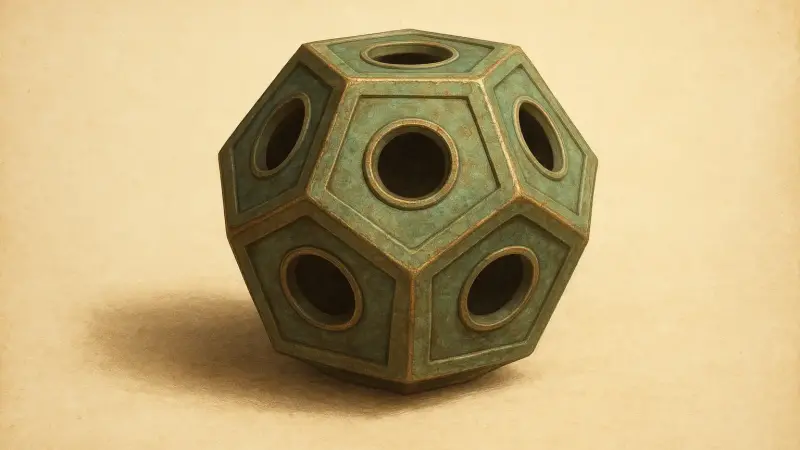
People assume Roman military gear was built for one job. Then you see a bronze dodecahedron: a hollow twelve‑faced object with round holes of different sizes on each face, and little knobs on the corners. Finds turn up across the former northwestern empire rather than one single site, including Britain, Gaul, and the German frontier. The basic “mechanism” is simple. You can look through one hole and line it up with another. You can also rest it on a face, tilt it, or suspend it. Past that, things get murky fast. No surviving Roman text clearly says what it was for.
What the object is, in plain terms
A typical example fits in the hand. It is cast in bronze, usually with 12 pentagonal faces and 20 corner points. Each face has a circular opening, and the hole sizes vary from face to face. The knobs are not decoration in the way modern people expect. They change how it sits on a surface and how it can be gripped. Many are finely made, which is one reason “random scrap” never feels like a satisfying answer.
One detail people overlook is how uneven the holes can be. They are not always neatly matched in opposing pairs. On some, the edges are slightly beveled, and the wall thickness is noticeable. That matters for any theory involving measurement or optics, because the thickness changes the apparent diameter when you sight through it.
Where they turn up, and what that implies
They appear mostly in areas tied to Roman presence in the north and west. Britain has produced examples. So have parts of modern France and Germany. They are much rarer in the Mediterranean core where written sources and familiar “standard” Roman objects are more abundant. That distribution is part of the problem. It leaves open whether they were a local fashion, a regional tool, or something that mattered only in particular communities inside the empire.
Context varies, and it is not always well recorded. Some are stray finds with little archaeological detail. Others come from hoards or settlement layers. They are not consistently found with a kit that screams “this is a surveyor’s set” or “this is a soldier’s pack.” If a legionary owned one, it does not automatically mean the legion issued it.
Why the holes and knobs keep inviting “it’s a tool”
The first instinct is measurement. Different hole sizes suggest gauges. Looking through aligned holes suggests sighting. The object can be rotated to select a different pair of apertures, like choosing settings. People propose rangefinding, estimating the size of an object at a distance, or setting out angles. These ideas work best on paper, where perfect geometry behaves nicely.
The awkward part is standardization. If it were a formal military instrument, you would expect consistent dimensions or markings. Most examples are not identical. Even the hole sequences differ. That does not rule out a practical use, but it pushes toward “informal” practices: a craftsperson’s aid, a locally learned method, or a tool whose effectiveness did not depend on tight calibration.
Other uses people argue for, and why none settle it
Textile-related theories come up because the knobs could hold loops and the holes could guide thread or yarn. People imagine knitting devices, spools, or finger looms. The challenge is evidence. Organic materials rarely survive, and the bronzes themselves do not reliably show the wear patterns you would expect if cordage were being pulled hard through openings over long periods.
Ritual or symbolic use is another recurring idea, partly because the shape is striking and partly because the finds can feel “special.” But “ritual” is often what gets said when a function is unknown. Without inscriptions or clear find contexts, it is hard to separate an object used in ceremony from one that was simply valued. A well-made bronze piece can be treasured for reasons that leave no obvious trace in the ground.
What makes it feel so Roman, and yet so undocumented
Roman material culture usually comes with labels of a sort: standardized forms, depictions, or at least a trail of comparable objects. The dodecahedra resist that. They look deliberate, but they do not slot neatly into the catalogs of tools, weapons, or domestic wares. That mismatch is why they attract modern certainty. Someone always wants it to be a rangefinder, or a candle holder, or a knitting aid, because the alternative is admitting the record is thin.
It also does not help that the object invites handling. People pick it up, peer through it, balance it on a knobbed corner, and immediately feel like they are close to an answer. That physical plausibility is persuasive. It is not the same as proof, and with these bronzes, proof is exactly what never seems to survive alongside the object.
Related reads
- The antique camera that developed a decades old portrait on its own film
- How the brain invents reasons after we make a choice
- A library that stamps books with the weather they were read in
- How smiling can actually lower your stress levels
- Why some people prefer messy desks and others thrive on order
- How tiny annoyances hijack your focus all day