
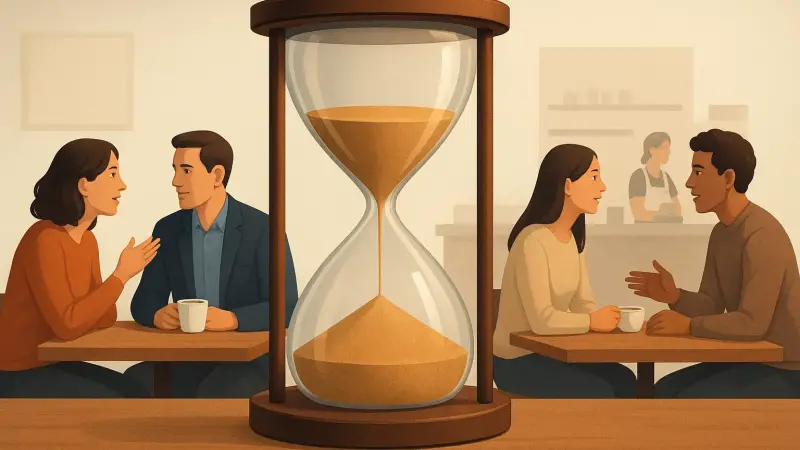
A price tag on talk
People expect a café to charge for coffee, maybe for extra syrup, maybe for a seat after a certain time. Charging for conversation feels like crossing a line most places don’t even draw. It’s also not one single famous café with one verified rulebook. Variations have popped up as stunts, experiments, and house policies in different cities. You’ll see versions reported in Japan (where “quiet cafés” are a known sub-genre) and in parts of Europe where table-time limits are normal, as well as occasional one-off “talk taxes” used for a week to make a point. The mechanism is simple: the longer or louder the chat, the more it costs—measured by a timer, staff judgment, or a menu of time blocks.
How a café even measures a conversation
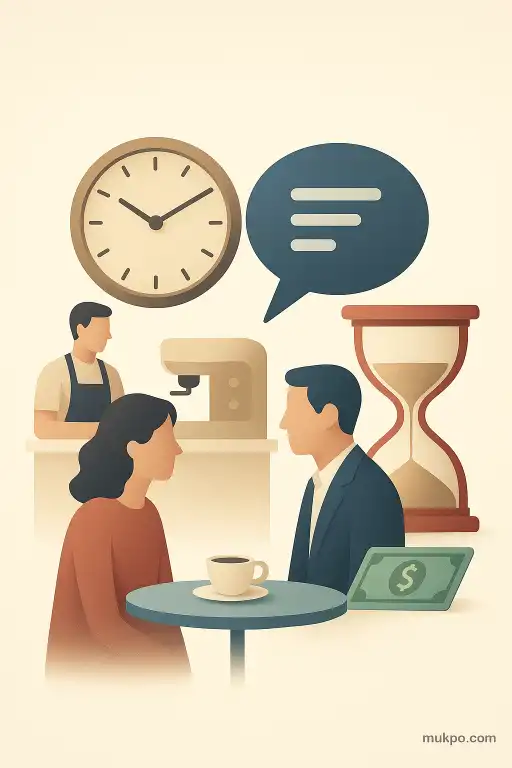
The practical problem is obvious: nobody wants a waiter standing over a table with a stopwatch. So the policies, when they exist, tend to measure proxies. The cleanest version charges by table time, not by words. You get a slot, like 30 or 60 minutes, and you’re paying for the right to occupy the space while you talk. Another version sets a “quiet discount” or a “conversation surcharge,” but it’s enforced softly, more like a nudge than a fine.
The overlooked detail is how much the rule depends on layout. In a small room with hard surfaces, two chatty people can dominate the sound for everyone. A café with carpeting, soft chairs, and distance between tables can tolerate the same conversation without anyone noticing. So some places can only “charge for conversation” because the space makes talk expensive in the first place—acoustically, not morally.
Why a business would want to discourage chatting
A café’s math is usually about seats, not espresso. If one table buys two coffees and stays for two hours, that table has to cover the rent for two hours. In busy neighborhoods, the pressure is constant: there are more people who want to sit than there are chairs. That’s why so many places use gentler tools first—no laptops on weekends, limited Wi‑Fi, or “please don’t camp” signage—before anything as explicit as putting a price on talking.
The other reason is customer mix. Some cafés want to feel like a library. Others want to feel like a bar at 11 a.m. Charging for conversation, or threatening to, is one way of picking a side without saying it out loud. It tells remote workers and quiet readers that the room won’t be taken over by meetings, birthday catch-ups, and speakerphone calls.
What it looks like at a real table
Picture a small weekend rush. A couple sits down with one drink each, then settles in for a long catch-up. Twenty minutes later, the line reaches the door and the staff starts bussing tables faster. Under a conversation-priced system, this is where the policy shows up: a second charge after a time block ends, a minimum order per half hour, or a higher “sit-and-stay” fee than “takeaway.” The talk itself may be irrelevant. The café is charging for the effect of the talk: the longer the conversation, the longer the seat is unavailable.
The awkward part is enforcement. If a server has to decide whether a table is “conversing” versus “working” or “reading,” it turns into guesswork. That’s why the more workable versions focus on time and capacity instead of behavior. They don’t need to judge tone, volume, language, or whether two people are discussing a breakup or a spreadsheet.
Why the idea keeps resurfacing anyway
It’s a perfect headline because it sounds petty and controlling, even when the underlying policy is basically a seating fee. It also hooks into a real social tension: cafés are treated as public living rooms, but they’re private businesses with tight margins. When someone hears “charged for conversation,” they imagine being billed for laughter. Owners often mean something narrower, like discouraging long stays during peak hours, or setting a quiet default without banning speech.
And sometimes it’s just a short-lived gimmick. A café tries it for a few days, the internet reacts, and then the rule disappears or gets rewritten into something boring like “90-minute table limit.” The idea doesn’t need to work for long to do its job. It just needs to be memorable enough that people talk about it—usually somewhere else, not at the table.

Related reads
- The calming tunnel effect of repetitive chores
- Why a 20 minute nap can reset a bad mood
- A legionary’s bronze dodecahedron: the Roman-era object’s baffling purpose
- The antique camera that developed a decades old portrait on its own film
- How the brain invents reasons after we make a choice
- A library that stamps books with the weather they were read in