
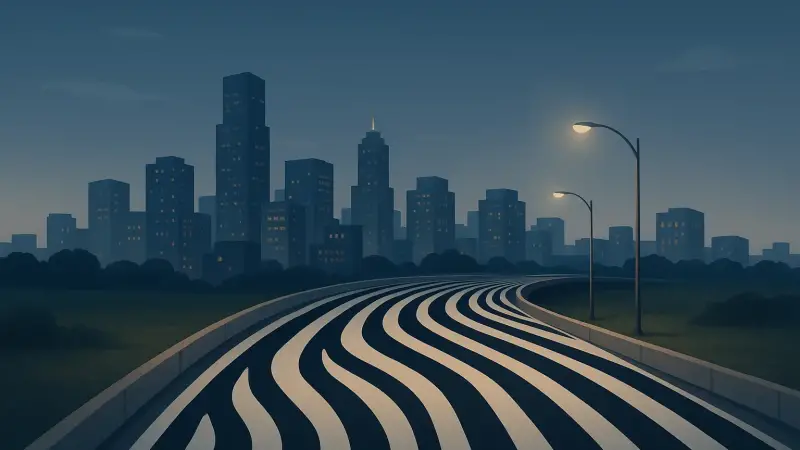
Most people assume road paint is slow work. You close lanes, set cones, wait for crews, then come back the next day and it still smells like fresh acrylic. But every so often you see photos that look like a prank: a long stretch of highway suddenly covered in bold black-and-white stripes, as if someone rolled out a giant zebra crossing overnight. There isn’t one single confirmed “the city” story that everyone agrees on. The examples that do circulate tend to be temporary art or safety demonstrations, like the 3D-looking crosswalks that appeared in places including Ísafjörður, Iceland, and other towns that tried similar visual tricks. The mechanism is simple: paint, planning, and timing.
How an overnight repaint can even happen
Road crews can repaint surprisingly fast when the job is mostly surface work. The “overnight” part usually means a tight closure window, often midnight to dawn, when traffic is light and the roadway is coolest. That matters because many road-marking materials cure faster and behave more predictably when the surface isn’t baking hot.
It also isn’t always the entire highway. Photos compress distance. A camera angle can make a few hundred meters of striped treatment look like it runs forever. When a city wants the effect to read instantly, it concentrates the pattern where drivers will notice it most: on approaches to crossings, near schools, or before a sharp curve.
Why stripes grab drivers’ attention
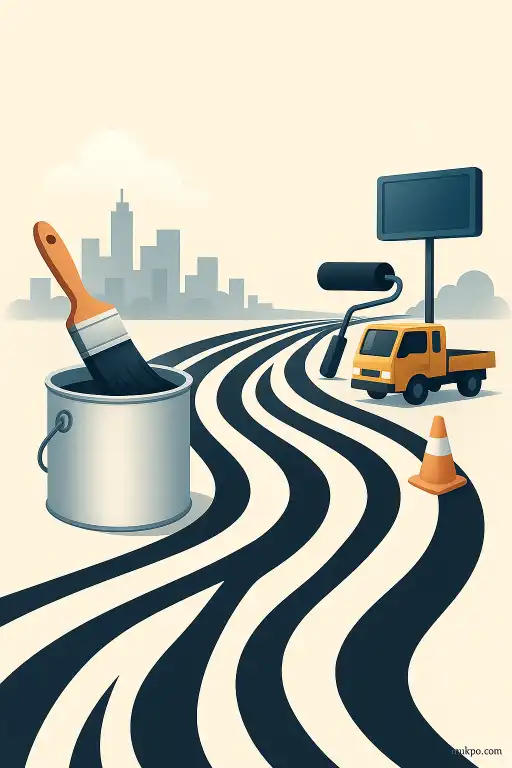
The point of zebra-like striping is usually speed and awareness. Drivers respond to contrast changes and repeated patterns. A sudden alternating light/dark sequence is hard to ignore, even when you’re tired or on autopilot. That’s why zebra crossings are so standardized in many countries. They create an instant “people might step out here” message without needing language.
Some places push the effect further with optical illusions. The best-known versions are the “3D crosswalk” style, where shading makes the bars look like they’re floating. The goal isn’t to fool someone for long. It’s to create a split-second hesitation—just enough to lift a foot off the accelerator.
The part people overlook: paint is a material system
People talk about the design, but the overlooked detail is the surface prep. Fresh stripes on a dirty or polished road don’t last. Crews often sweep, blow debris, and sometimes lightly grind or scarify the surface so the marking bonds. If it’s a high-speed road, they may add glass beads into the paint or drop them on top while it’s wet. That’s what makes lines reflect headlights at night.
Another overlooked constraint is friction. Big painted areas can get slick when wet if the material isn’t textured properly. That’s why road agencies specify skid resistance, bead size, and sometimes aggregate additives. A dramatic black-and-white pattern is only acceptable if it behaves like pavement, not like a painted gym floor.
Where the “giant zebra” stories usually come from
When a zebra-like highway repaint goes viral, it’s often tied to a temporary installation, a safety campaign, or a test section. That’s part of why details get fuzzy online. A clip might be reposted without the original caption, then people fill in the blanks with “a city did this overnight.” Sometimes it’s not even a highway. It’s a busy arterial road that looks like a highway in a wide-angle shot.
Documented examples people point to include Ísafjörður’s raised-looking crosswalk treatment, which was widely reported as a driver-slowing measure. Similar visual-crossing experiments have been reported in different countries at different times, but the exact paint scheme and permanence vary, and some were explicitly short-term pilots.
Why you don’t see whole highways painted this way
A full-lane zebra pattern across miles of highway would be expensive, hard to maintain, and visually exhausting. Road markings are communication, and too much pattern can become noise. Highways already have a dense sign language: lane lines, edge lines, gore markings, merge arrows, rumble strips, reflectors. Add a massive zebra treatment and drivers may lose the hierarchy of what matters.
There’s also a maintenance reality. Snowplows, studded tires, and heavy trucks chew through surface paint. Even in mild climates, ultraviolet light fades pigments quickly. So when the “giant zebra overnight” effect appears, it’s usually because the location is strategic, the window is short, and the stripes are meant to shout for attention right where attention tends to drift.
Related reads
- A laundromat that returned a wedding ring after two decades in a dryer
- The cafe that charged customers by the length of their conversations
- The calming tunnel effect of repetitive chores
- Why a 20 minute nap can reset a bad mood
- A legionary’s bronze dodecahedron: the Roman-era object’s baffling purpose
- The antique camera that developed a decades old portrait on its own film