
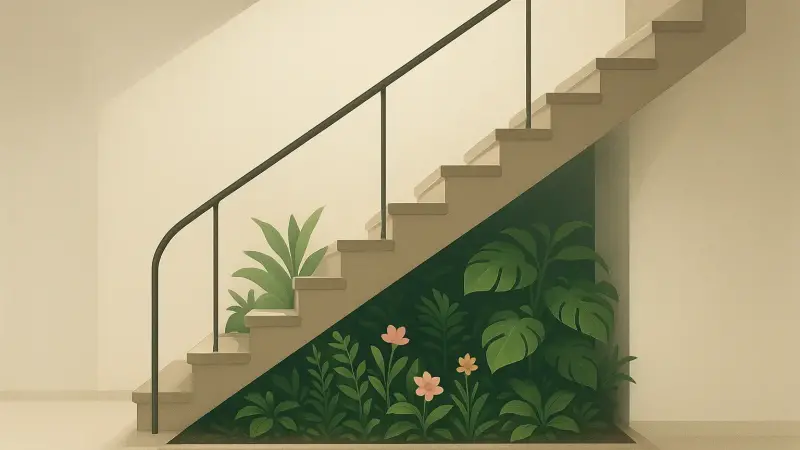
Most apartment stairwells feel like dead space. Hard surfaces. Dusty corners. Then you see one that keeps a patch of green alive where nothing should grow. It’s not one single famous building, and details vary by climate and construction, but the setup shows up in older walk-ups in New York City, in basement flats in London, and in narrow courtyard buildings in Paris. The “hidden garden” usually isn’t planned. It forms because a stairwell can behave like a tiny courtyard: it catches stray light, collects moisture, and traps wind. The overlooked detail is often the same: a small gap at the stair landing or along the wall that lets water and soil sneak in over time.
How a stairwell turns into a pocket of outdoors
A stairwell that drops below street level can act like a sheltered bowl. Air movement slows down. Temperatures swing less, especially if the surrounding building mass stays cool in summer and less freezing in winter. If there’s any opening to the sky—a lightwell, a transom, a vent, a loose window frame—sun arrives in short, predictable slices. That’s enough for shade-tolerant plants, mosses, and volunteer seedlings.
What makes it feel like a “garden” is that it’s not just one plant. Once a few leaves establish, they hold onto moisture and trap more dust. That changes the surface. It becomes a place where tiny bits of organic matter can stick instead of blowing away. The space stops behaving like bare concrete and starts behaving like soil.
Where the soil comes from (and why it keeps coming)
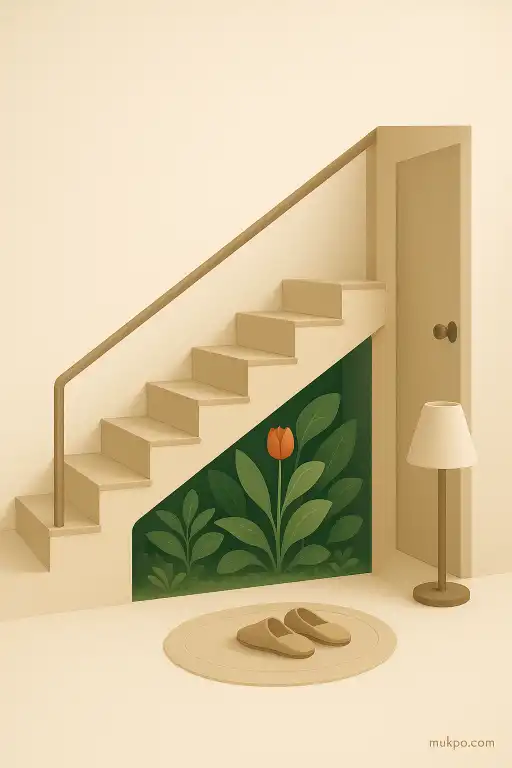
Soil rarely arrives as a single dump. It arrives as a slow accumulation. Wind-blown grit drops in from the street. People track in fine dirt on shoes, then it gets pushed into edges by foot traffic and cleaning. In buildings with brick or stone, mortar dust and crumbling material add to the mix. Even paint flakes and tiny fibers from doormats become part of the layer that holds water.
The thing people usually overlook is the path water takes. A stairwell doesn’t need a leak in the dramatic sense. A small drip line from a handrail, condensation from a cold pipe, or rain that sneaks under a door during storms can be enough. Water tends to run to the same low point every time. Once there’s a bit of dirt to slow it down, the water lingers longer, and the dirt doesn’t wash away as easily. That’s when seeds can stay put.
What actually grows there, and why it’s often the same cast
The first residents are usually the tough, quiet ones: moss, algae, and small ferns if the light is low and the surface stays damp. If sunlight hits for an hour or two, you start to see “volunteers” like dandelion, plantain, or chickweed, depending on the region. In some cities, tiny tree seedlings appear too—maple in parts of North America, plane tree in parts of Europe—because those seeds travel well and don’t need much to sprout.
A specific situational example shows how little it takes: a basement stair in a rowhouse-style building where the bottom step sits beside an old drain. If that drain clogs even slightly, a shallow puddle forms after rain. The puddle leaves a dark stain line. Over months, dust sticks to the damp area. Then a green film appears. Later, a fern shows up in the seam between the step and the wall, exactly where water pauses before it finally evaporates.
Light, airflow, and the odd “microclimate” inside a building
Stairwells create strange lighting. A small window can act like a spotlight that moves across one patch of wall at the same time every day. Plants respond to that regularity more than to brightness. Airflow matters too. If the stairwell is drafty, surfaces dry quickly and only hardy species persist. If it’s sealed and humid, growth shifts toward mosses and mildew-like films that hold moisture, which then helps larger plants later.
Materials shape the result. Porous brick and limestone wick water and offer tiny ledges for roots. Smooth poured concrete sheds water and leaves fewer places to grab on, unless cracks develop. Metal stair structures can drip condensation in cold weather, which is easy to miss because it looks like the building is “sweating,” not leaking. That seasonal drip can be the whole irrigation system.
Why these hidden patches can persist for years
Once a patch establishes, it can become self-reinforcing. Leaves and dead stems break down into darker, finer material. That holds more water. Roots widen cracks a little, which makes more space for more debris. Even a thin layer of organic matter can buffer temperature swings at the surface, making the difference between a seedling surviving a dry week or not.
It also persists because it sits in an in-between zone of attention. It’s not quite “inside,” so it doesn’t always get the same cleaning as a hallway. It’s not quite “outside,” so it doesn’t get the same maintenance as a courtyard. The result is a small place where slow processes—dust settling, moisture collecting, seeds landing—get to keep running without being reset every day.
Related reads
- A tiny island where locals deliver mail by canoe and exchange homemade maps
- Why crying can feel identical for joy and grief
- When memories fill in details that never happened
- The supermarket scanner that rang up free produce for random shoppers
- A vivisection in Edwardian London that ignited the Brown Dog riots
- A parking meter that started dispensing coins instead of taking them