
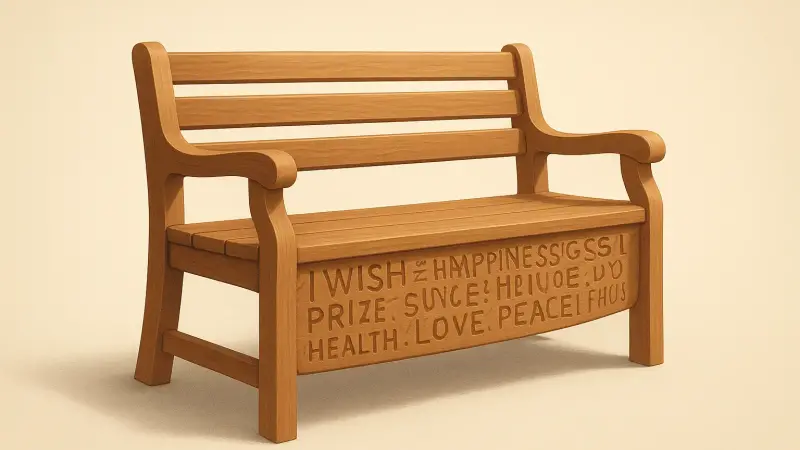
You sit down, shift your weight, and the bench squeaks the way public benches do. Nothing on the backrest. No plaque. No marker. Then someone tells you to look underneath. Not at the bolts. Not at the gum stuck to the slats. At the carvings. People have been turning the hidden side into a small archive of wishes, one scratched line at a time. There isn’t one famous bench that owns this idea. It shows up wherever wood meets pocketknife. You can see the same habit on park benches in London, on boardwalk seating along the Jersey Shore, and on older timber benches in parts of Scandinavia where carving traditions never fully went away.
How the underside becomes the chosen surface
The underside is protected in a way the top isn’t. Rain hits it less. Sun fades it less. Municipal cleaning crews rarely flip benches over. That makes it a natural spot for writing that’s meant to last longer than a message on the seat.
It also solves a social problem. Writing on the visible face feels like vandalism with an audience. Writing underneath is more like whispering into a public place. The person carving gets privacy without needing solitude, which is a rare combination in parks and transit areas.
What “wish” looks like when it’s scratched into wood

People don’t usually carve full sentences. Space is tight, and carving is slow. A “wish” often shows up as a name plus a verb, an initialed pair, a date with no context, or a single word like “please.” Sometimes it’s a goal made small enough to fit: “pass,” “safe,” “home.” The shorter the text, the more it can pretend to be casual.
An overlooked detail is direction. Undersides force awkward angles. Messages end up rotated or upside down because the carver is working by feel, not by a clean line of sight. That’s why you’ll sometimes see a cluster of text oriented three different ways on the same slat. It isn’t style. It’s ergonomics.
Why people choose a bench instead of a wall or a tree
A bench is already a pause point. People arrive there with time they didn’t plan to use: waiting for a friend, killing ten minutes before a bus, taking a break mid-walk. That idle window is long enough for a pocketknife, a key, or a broken bit of metal to do real work.
Benches also feel oddly personal. Someone sat where you’re sitting. Someone will sit there after you. The underside carries that sense of handoff. It’s not a billboard. It’s a shared object with a routine of bodies coming and going, which makes a private hope feel like it has somewhere to “go” without being publicly announced.
The bench as an unplanned archive
Over time, the carvings stack up like layers. Older marks get rounded at the edges. Newer ones look raw and pale. If the bench is painted, the paint fills shallow cuts and leaves deeper grooves dark, so the most forceful wishes become the most legible ones months later.
This is where the “collection” feeling comes from. The bench isn’t collecting in the way a museum collects. Nobody curates it. But repetition creates a pattern: similar phrases, similar dates around school exam periods, the same names reappearing after a breakup, the occasional line that reads like a promise. If a bench is replaced, the archive vanishes instantly. If it’s repaired slat by slat, it becomes a patchwork of eras.
How cities respond when they notice
Responses vary because benches sit at the intersection of maintenance and public behavior. Some parks departments sand and repaint, which erases shallow carving but not deep grooves. Some replace damaged boards, which deletes the underside text while leaving the visible bench “clean.” In high-traffic areas, benches get swapped for metal or composite designs that don’t take marks the same way.
When the underside is the main writing surface, enforcement is inconsistent. It’s hard to catch. It’s hard to prove intent after the fact. And people who would never carve into the top will still add a small line underneath because it feels like it doesn’t count. That quiet moral loophole is part of why the underside ends up so busy, even on benches that look perfectly untouched from above.

Related reads
- How a single scent can unlock an entire afternoon from decades ago
- The muddled alertness after waking that slows decisions
- Why a stranger can feel like an old friend at first sight
- The night Pope Alexander VI’s Banquet of Chestnuts exposed the excesses of Renaissance Rome
- The apartment with a hidden garden growing beneath a stairwell
- A tiny island where locals deliver mail by canoe and exchange homemade maps