
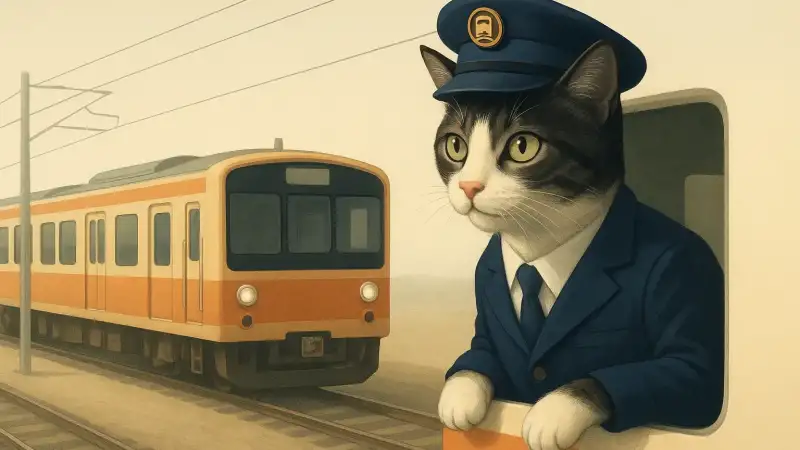
A cat on the platform isn’t unusual
You sometimes see a station cat before you even see the departure board. It happens in places where platforms are open to the street and food smells travel. Not every story points to one single commuter line, because different rail systems have had their own “rail cats” at different times. Japan is the best-known example, like Tama the “stationmaster” cat at Kishi Station on the Wakayama Electric Railway. Istanbul has also built a reputation for transit-adjacent street cats, including at ferry piers and metro entrances. The conductor part is usually a nickname, but the mechanism is real: a stray settles in, staff stop shooing it away, and the public starts treating it like it belongs there.
How a stray becomes “official”
The shift usually starts with routine. A cat finds the warmest spot, the quietest corner, or the place where people drop crumbs. Staff notice the same animal day after day. Someone leaves water. Someone else gives it a name. The moment it becomes “official” tends to be when an employee puts it in writing, even casually—on a little sign, a social post, a notice near a ticket window. After that, the story propagates faster than the cat ever could.
It also helps that commuter rail has a repeating cast. The same faces show up at the same time each morning. Regulars point the cat out to newcomers. Photos spread. A role gets assigned because it’s funny and easy to understand: mascot, stationmaster, conductor. In reality, the animal is usually tied to one station or one platform, not roaming the whole line. That detail gets overlooked because “it rides the train” is a better sentence than “it sleeps under the bench by Track 2.”
Why trains and stations attract cats
Stations have three things stray cats look for: shelter, predictable human traffic, and heat. Even without access to indoor staff rooms, there are vents, sun-warmed concrete, and windbreaks created by walls and stairwells. Platforms can be comparatively calm between arrivals. That quiet matters, because a cat can hold a territory there without constant competition. Commuter stations also generate steady “micro-food”: dropped pastry, open trash bags, and the occasional person who feeds a cat because they see it every day.
The overlooked part is sound and vibration. Big, sudden noises can scare animals away, so the cats that remain are often the ones that habituate. They learn the timing. They stop bolting at every announcement. They pick spots where trains pass without direct gusts of wind. If there’s a staff office door that opens at the same times each day, a cat can anchor its schedule to that, not to the trains themselves.
What “conductor” means in practice
No rail operator is letting a stray cat handle safety duties. When people say a cat was adopted as a conductor, it usually means the staff accepted it as part of the station environment and gave it a ceremonial title. In Japan, the well-documented case of Tama at Kishi Station shows how far a symbolic role can go: a uniform, a little office space, merchandise, and a tourism bump. That’s closer to “stationmaster” than “conductor,” but the social mechanism is the same.
On an actual commuter train, the “conductor” version tends to be smaller and more local. The cat sits near the same car door when it’s open at the platform. It strolls along the platform edge after the train leaves, like it’s checking departures. Regulars read personality into those habits. A cat that tolerates crowds becomes “professional.” A cat that wanders into the vestibule once becomes “it rides every morning.” The title sticks even when the behavior is rare.
The messy parts people leave out
Once a cat becomes a local celebrity, the station has to manage two things at once: the animal’s welfare and the station’s rules. Strays bring real concerns—fleas, injuries, territorial fights, and the risk of getting onto tracks. Some places respond by formalizing care with a staff member or local volunteer, while keeping the cat out of operational areas. Others quietly rehome the cat, which can disappoint commuters who felt the animal “belonged” to the line.
There’s also the issue of crowds. A cat that was fine with a few regulars can get stressed when a story goes viral and people start arriving just to see it. That changes the environment the cat originally chose. The public-facing story stays cute because it has a clean arc. On the ground it’s usually a series of small decisions: who feeds it, where it sleeps, whether it gets neutered, and what happens when winter comes and the platform gets colder.
Related reads
- The winter night of 1916 when conspirators tried to poison, shoot and drown Rasputin in a St. Petersburg house
- A public bench that collected wishes carved into its underside
- How a single scent can unlock an entire afternoon from decades ago
- The muddled alertness after waking that slows decisions
- Why a stranger can feel like an old friend at first sight
- The night Pope Alexander VI’s Banquet of Chestnuts exposed the excesses of Renaissance Rome