

Most monarchies say the throne passes smoothly from father to son. The Ottoman Empire often didn’t. When a sultan died, several adult princes could be out in the provinces with their own households, allies, and access to troops. That made succession feel less like paperwork and more like a race. After Mehmed II issued a legal code in the 1400s that tolerated fratricide “for the order of the world,” new rulers sometimes had brothers quietly killed to prevent a civil war. Mehmed III’s accession in 1595 is a stark, named example, because chroniclers record a large number of his brothers being executed almost immediately.
Why so many princes had a claim at the same time
The early Ottoman system didn’t lock the throne to the eldest son. All male dynasts were potential sultans, and the winner was often the one who could reach the capital and secure the bureaucracy, the army, and the palace. Before the 1600s, princes commonly served as provincial governors. That gave them experience, money, and a local network. It also meant that at the moment of death, the empire could have multiple claimants who were already positioned to move fast.
That overlap produced a predictable fear: if a new sultan left adult brothers alive, those brothers could become rallying points for unhappy factions. The Ottoman court had seen succession struggles turn into prolonged conflict before. The interregnum after Bayezid I’s defeat in 1402, when his sons fought for years, hung over later generations as a warning of what an “open” succession could cost.
The rule that made it thinkable
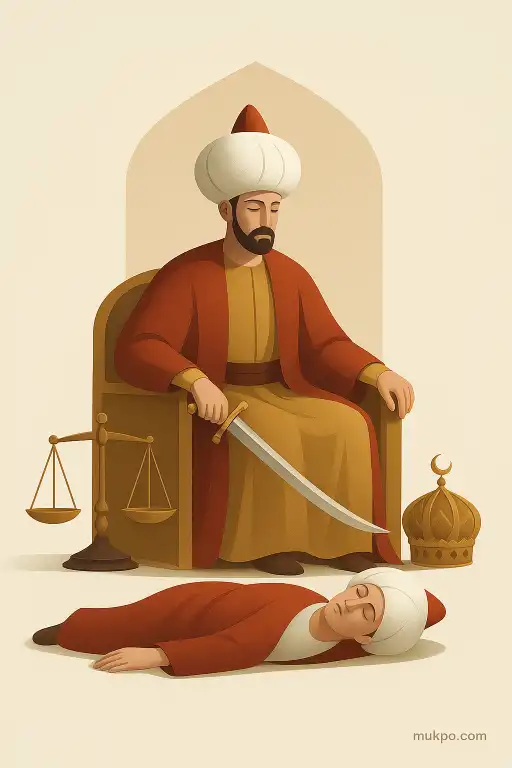
Mehmed II’s kanunname is often cited because it put into words what had already happened in practice. The phrasing varies in translation, but the core idea is consistent: for the sake of order, a sultan could lawfully kill his brothers once he secured the throne. It wasn’t framed as cruelty. It was framed as prevention, a grim trade meant to avoid the wider bloodshed of civil war.
People sometimes imagine an open, public spectacle. The overlooked detail is how procedural it could be. Fratricide was often carried out inside the palace by officials whose job was to keep blood from being spilled in a way that violated courtly norms. Execution by strangulation with a bowstring is frequently mentioned in sources for that reason. The method mattered because it signaled that this was being treated as state business, not personal revenge.
What “quietly eliminate” looked like in real life
When Mehmed III took power in 1595, reports describe the immediate execution of many brothers. The numbers differ between accounts, and the exact details can be hard to pin down, but the episode is remembered because it made the logic of the system visible all at once. A single night in the palace could change the future of the dynasty. It also changed the atmosphere of the court. Everyone understood that the first days of a reign weren’t only about ceremonies.
There were other moments when a brother’s existence created a permanent political problem. The rebellion of Şehzade Mustafa against Suleiman the Magnificent earlier in the 1500s, and the later execution of another Prince Mustafa in 1553 amid factional accusations, show the larger pattern. A prince did not need to openly claim the throne to be treated as a threat. Court politics could turn the mere possibility of an alternative heir into a crisis.
The shift from fratricide to confinement
By the early 1600s the empire began moving away from routine fratricide. A key change was the growing preference for seniority and for keeping princes inside the palace rather than sending them out as governors. This is where the “kafes” becomes important: a secluded set of apartments where princes could be confined under watch. It reduced the risk of rival power bases forming in the provinces, but it created a different problem.
Princes raised in isolation could reach the throne without administrative practice and with a narrower circle of trust. Some reigns show the consequences in uneven ways, and historians argue about how direct the link is. What’s clear is that the system traded one kind of danger for another. It lowered the odds of immediate fraternal war, while increasing the odds of court factions dominating an inexperienced ruler.
Legitimacy, religion, and the uneasy paperwork of killing kin
Ottoman rulers and jurists still had to live with the contradiction. Islamic law does not casually permit killing relatives, and Ottoman political language tried to place the act in a category of necessity. That’s part of why the legal code and court procedure mattered. The executions were not supposed to look like private murder. They were presented as a harsh instrument of governance meant to protect the wider population from prolonged conflict.
Even then, the practice sat uneasily with people who served the dynasty. Chroniclers could describe it as “for order,” but they also recorded the human cost, sometimes in stark terms. The palace was both home and state. That meant the moment of accession could involve the same corridors that led to celebrations, audiences, and prayers, and also to the locked rooms where a new reign tried to erase its rivals before anyone outside could organize around them.
Related reads
- Why you keep rehearsing conversations you never have
- The commuter train that adopted a stray cat as its official conductor
- The winter night of 1916 when conspirators tried to poison, shoot and drown Rasputin in a St. Petersburg house
- A public bench that collected wishes carved into its underside
- How a single scent can unlock an entire afternoon from decades ago
- The muddled alertness after waking that slows decisions