
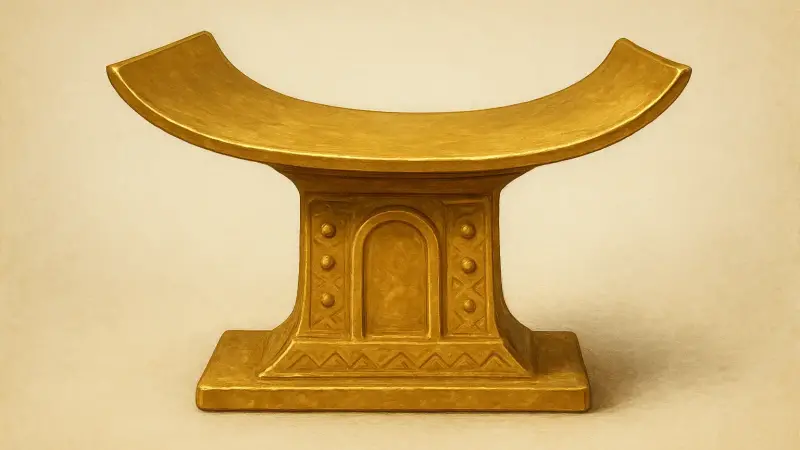
A chair that wasn’t treated like furniture
It’s hard to explain why a “stool” could stop an empire until you hear what happened in Kumasi in 1900. The British colonial governor, Sir Frederick Hodgson, wanted the Ashanti Golden Stool brought to him so he could sit on it. That request landed like an insult with teeth. The point wasn’t comfort or ceremony. The Golden Stool was understood as the seat of Ashanti nationhood itself, tied to the authority of the Asantehene and the unity of the people. So the standoff became immediate and concrete: a colonial government asking for an object, and a society refusing to treat it as a transferable thing.
Why the demand hit a nerve
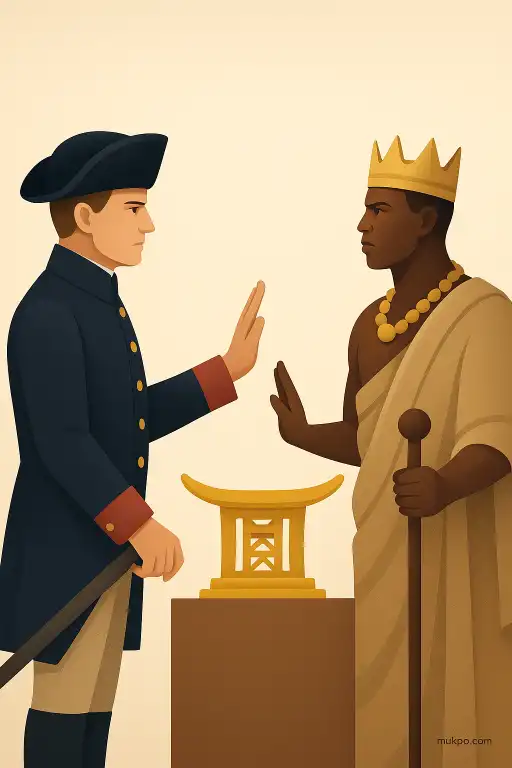
British officials tended to think in the grammar of crowns, thrones, flags, and regalia. Those are powerful symbols, but they are also objects a conqueror can seize, display, and reassign. The Golden Stool didn’t fit that logic. In Ashanti tradition, it wasn’t simply owned by a ruler the way a chair belongs to a palace. It was regarded as belonging to the Ashanti people as a whole, and its status was protected by strict rules about who could touch it and how it could be approached.
One detail people often miss is that “hand it over” wasn’t even a neutral request. Sitting on the stool was part of the problem. Under Ashanti norms, it was not a seat for casual use, and it was not something an outsider could claim by performing authority on top of it. So the demand wasn’t just for custody. It was for a kind of recognition: a public act that would imply British supremacy over Ashanti legitimacy.
How refusal worked in practice
Refusing to surrender the stool wasn’t as simple as hiding a box. The British had military power and administrative pressure, and Kumasi had already seen conflict and occupation. What made the refusal durable was that the stool’s location and handling were not widely shareable knowledge. The fewer people who knew where it was, the harder it was to force a “handover” through arrests or threats. Even within Ashanti society, access was controlled, so coercion could hit leaders and still fail to reach the object.
This is where the mechanism of these symbolic standoffs becomes visible. An empire can confiscate what it can identify, inventory, and transport. A community can protect what it keeps outside normal chains of custody. The Golden Stool wasn’t just hidden physically. It was insulated socially. That insulation mattered as much as any secret location.
The conflict around it wasn’t just symbolic
The 1900 crisis didn’t stay at the level of speeches. It fed directly into armed confrontation, often referred to as the War of the Golden Stool, with fighting around Kumasi. Colonial authority depended on visible submission and predictable administration. Ashanti authority depended on maintaining the integrity of a symbol that validated leadership and cohesion. When those two needs collided, compromise was hard, because each side saw the other’s “small” action as a direct attack on legitimacy.
It also shows why colonial governments sometimes fixated on objects. A single seized emblem can feel like a shortcut to rule. But that shortcut only works if the emblem is treated as an object whose meaning follows possession. Here, meaning did not follow possession in a simple way, and the attempt to force possession created its own resistance.
Why it stayed a non-negotiable object
The Golden Stool remained powerful because it marked a boundary the colonial state struggled to cross: the difference between governing bodies and governing belief. A governor could occupy a capital and install rules, but could not easily rewrite what an object “was” to the people who gave it its force. That’s why the British demand mattered even after it failed. It clarified that the stool was not just heritage. It was a line of legitimacy that could be defended without needing to win every argument or control every building.
Even today, when people retell the episode, the enduring tension isn’t about whether an official asked rudely. It’s that the request assumed the wrong category of thing. It treated the symbol as portable property, and it met a system designed to prevent exactly that kind of transfer.

Related reads
- When Ottoman succession customs let new sultans quietly eliminate brothers to secure the throne
- Why you keep rehearsing conversations you never have
- The commuter train that adopted a stray cat as its official conductor
- The winter night of 1916 when conspirators tried to poison, shoot and drown Rasputin in a St. Petersburg house
- A public bench that collected wishes carved into its underside
- How a single scent can unlock an entire afternoon from decades ago