
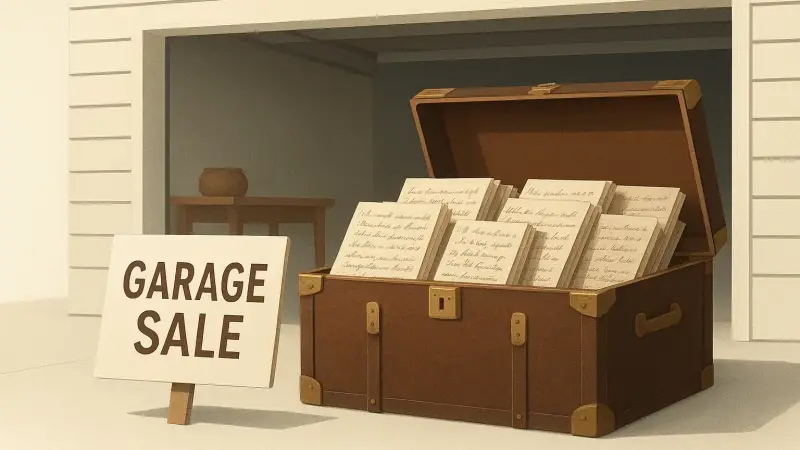
At a garage sale, you expect old dishes, a box of cords, maybe a lamp that buzzes. Every so often, someone opens a trunk and finds pages. Not a few letters. Not a diary. A full stack of handwritten novels, bundled in chapters, sometimes numbered, sometimes not. There isn’t one famous “trunk of novels” incident everyone agrees on. Stories like this pop up in different places and get retold without the same details. You hear versions from estate cleanouts in the U.S., house clearances in the U.K., and flea markets in Australia. The core mechanism is always the same: writing survives its writer, but the context doesn’t.
How a trunk like that ends up for sale
Most garage sales are really small-scale disposals. A family is moving, downsizing, or clearing a house after someone dies. A trunk is heavy, awkward, and easy to treat as “just storage.” If it’s been in an attic or basement for years, nobody remembers what’s inside. Or they do remember, but they don’t want to deal with it. Handwritten manuscripts are time-consuming to sort, and they look like clutter unless someone in the room recognizes what they are.
The other path is delegation. One relative tells another, “Just get rid of what you can.” Or a friend volunteers to help empty a place and doesn’t know which items are sensitive. When that happens, the trunk doesn’t arrive at the driveway as “a life’s work.” It arrives as “an old trunk.” That shift in labeling is what makes the rest possible.
Why nobody claims them afterward
Once the trunk is gone, claiming it isn’t as simple as making a phone call. People often don’t know which sale it was, which weekend, or which neighbor ran it. Yard sales rarely keep receipts. Addresses get forgotten. If the original seller was acting on behalf of someone else, they may not even know who the writer was. Even when a family member realizes what was lost, there’s a social cost to showing up later and saying, “We accidentally sold that trunk, can we have it back?”
There’s also a subtler reason: the writer may not have been “a writer” to the family. They may have been the quiet person who filled notebooks and never talked about it. If the manuscripts were never submitted, never copyrighted, never mentioned in a will, they don’t feel like an asset. They feel like private papers. Private papers are the first things people avoid dealing with because they raise questions no one wants to answer about what should have been kept.
What the pages usually look like up close
Handwritten novels found this way tend to be physically consistent because they were made with the same habits over years. The paper might be cheap lined pad paper, or a mix of stationery and loose-leaf. Ink color can change mid-chapter as pens ran out. Corrections show up as crossed-out paragraphs and rewritten lines crammed into margins. People often overlook the backs of pages. A lot of writers reused paper, so the reverse side might contain grocery lists, phone numbers, or old work notes that unintentionally date the manuscript.
The trunk itself can tell a story. Musty smell suggests long storage. A brittle rubber band suggests decades. So do certain bindings: metal fasteners, carbons from typewriter drafts, or onion-skin copies. Sometimes the “novels” aren’t a single set at all. They’re multiple false starts, rewritten versions, or the same story copied out neatly after a messy draft, because rewriting by hand was the editing process.
What gets lost when the context disappears
Without context, a manuscript becomes hard to place in time, and even harder to attribute. A name on a title page might be a nickname. A dedication might only make sense to one person. If there’s no address, no correspondence, and no mention of publication attempts, it’s unclear whether the writing was meant for anyone else at all. That uncertainty matters because it affects how people treat the find. Some read it as abandoned art. Others read it as something too personal to circulate.
It also changes how “valuable” it is. Monetary value usually depends on a recognized author, provenance, and market demand. A trunk full of unknown novels can be priceless to the right reader and worthless to an appraiser. The mismatch is part of why these stories spread. They sit at the intersection of thrift-store randomness and the uncomfortable fact that serious creative work can vanish without anyone noticing.
How these finds turn into stories people repeat
When someone discovers a trunk of manuscripts, the first version of the story is usually practical. “Look what I found.” The second version adds a hook: “No one claimed it.” By the third retelling, details shift because the audience wants a clean narrative with a clear author and a clear ending. But real cases tend to stay messy. It’s unclear whether the seller knew. It’s unclear whether the family was reachable. It’s unclear whether the author wanted the work shared.
The situational example that comes up again and again is ordinary: a weekend sale after a move, a trunk priced low because it’s heavy, and a buyer who only opens it at home. The overlooked detail is how often the manuscripts are labeled in a way that looks meaningless at a glance—“Book 3,” “Revisions,” “Copy”—because the person who wrote them never expected a stranger to be the one reading the label.
Related reads
- The colonial standoff over the Ashanti Golden Stool and the symbol no one would hand over
- When Ottoman succession customs let new sultans quietly eliminate brothers to secure the throne
- Why you keep rehearsing conversations you never have
- The commuter train that adopted a stray cat as its official conductor
- The winter night of 1916 when conspirators tried to poison, shoot and drown Rasputin in a St. Petersburg house
- A public bench that collected wishes carved into its underside