
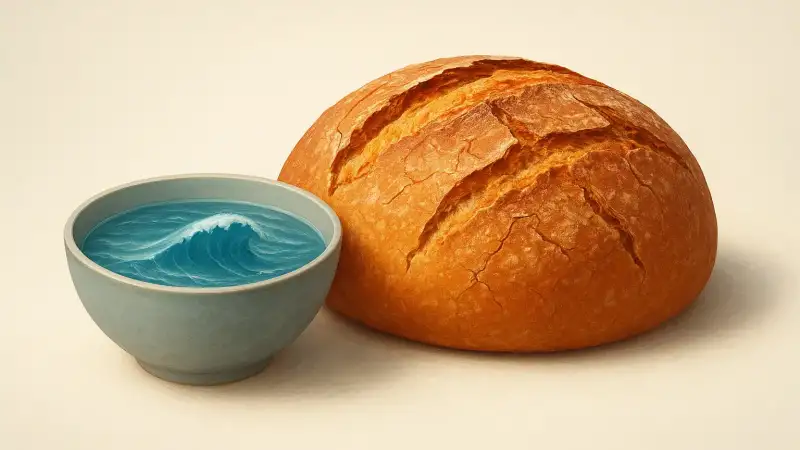
Why would anyone put seawater in bread?
Walk into a bakery by the coast and you’ll sometimes hear the same claim: the crust gets louder if the dough is mixed with seawater. This isn’t one single famous shop with a documented origin story. It pops up as a local practice in different places, including parts of Japan, Italy, and the U.S. West Coast. The basic mechanism is simple and not mystical. Seawater brings salt and minerals into the dough. Salt changes how gluten tightens, how yeast behaves, and how moisture moves during baking. Those changes can nudge a loaf toward a thinner, glassier crust that crackles as it cools, though results vary a lot.
Salt is doing most of the work

If a crust crackles, it’s usually because it dried into a brittle layer while the inside stayed moist. Salt helps create that split personality. In dough, salt strengthens gluten so it holds gas better and sets up a tighter skin. It also slows yeast down, which often leads to a steadier fermentation and a different balance of acids and sugars by the time the loaf hits the oven. More sugar available at the surface means more browning reactions, and a darker crust often ends up drier and crisper.
The part people usually overlook is that “more salt” isn’t automatically “more crisp.” Too much salt can tighten the dough so much that expansion is limited. That can reduce the thin, stretched crust effect that makes the snap. It can also pull water differently, changing how quickly the crust dries. The sweet spot is narrow, which is why two bakers can try the same idea and get opposite results.
Seawater isn’t a standard ingredient
Seawater salinity isn’t fixed. Open ocean water is often around 3.5% salt by weight, but local conditions change it. Near river mouths it can be much lower. In enclosed seas it can be higher. That matters because a dough formula depends on knowing how much salt is present, usually to a tenth of a percent. If a baker replaces tap water with seawater “by feel,” the salt level can swing enough to change fermentation speed and dough strength from one day to the next.
Minerals are the other variable. Seawater contains magnesium and calcium, among others, and those ions can affect dough behavior. Calcium can slightly reinforce gluten networks, while magnesium can change how enzymes and proteins interact. These effects are real but subtle compared with plain salt concentration. In practice, many of the dramatic stories about seawater crust are still mostly stories about consistency and technique—steam, oven heat, and timing—plus a salt level that happens to land in a useful range that day.
Crackle is mostly about moisture leaving at the right moment
The loud crust moment happens after the loaf comes out. In the oven, the surface gelatinizes as starches absorb water and heat. Later, as the loaf cools, moisture from the interior migrates outward, and water on the surface evaporates. If the outer layer dries into a thin, rigid shell while the inside is still releasing steam, tiny fractures form. That’s the crackle sound. This is why two loaves with identical dough can behave differently if one cools in a drafty spot or near a humid dishwasher vent.
Seawater can influence this indirectly. Salt affects how tightly water is held in the dough, and that shifts how quickly moisture moves. But the major levers are still bake profile and steam management. A loaf baked with strong initial steam often gets a thinner, shinier crust that can later dry into a brittle shell. Without that early steam, the crust can set too early and become thick and leathery instead of shattering.
There are practical reasons the claim sticks
Even when the science is modest, the idea has staying power because it’s a concrete, local detail people can point to. Coastal bakeries already have a narrative of place built into their flour supply, their air, and their regular customers. “We use seawater” is memorable. It also sounds like an old trick, even if it’s just a modern variation on using mineral-rich water or adjusting salt levels. And because crust quality is affected by so many small factors, it’s hard for an outsider to falsify the claim by taste alone on a single visit.
There’s also a quiet constraint: food safety and regulation. It isn’t always clear whether a bakery is literally hauling raw seawater, using filtered or sterilized seawater, or using a prepared saline solution that mimics it. Those are different things, with different risks and consistency. When people hear “seawater,” they imagine a bucket from the beach, but the reality—when it’s done at all—often involves processing, testing, or a controlled substitute that behaves more predictably in dough.

Related reads
- How micro-expressions reveal thoughts before words
- The urge to double check locks even when you know you did
- How indoor plants change room microbes and alter airborne chemistry
- The sea slug that steals chloroplasts and runs on borrowed sunlight
- The village that still pays some workers with fresh fish hauled each morning
- The petrifying well that turns lost toys to stone