

Seeing color in “white” water
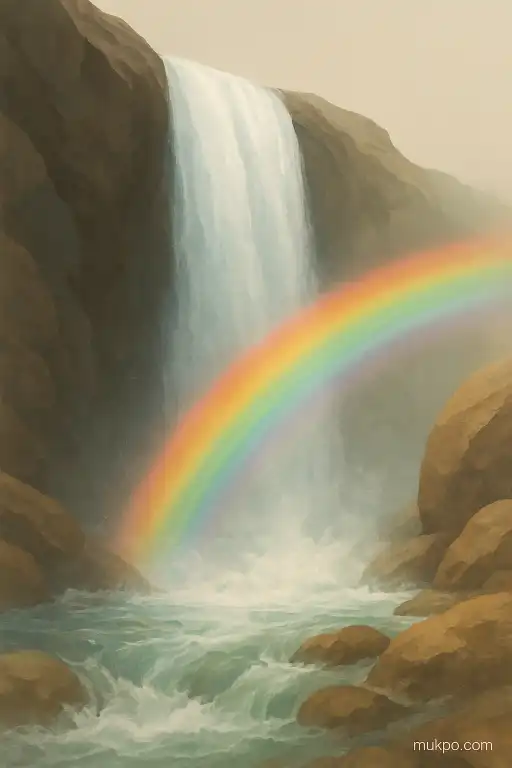
Stand near a big drop of water and the air can look plain one second, then suddenly show a clean arc of color. It isn’t one single famous spot where this happens. You can catch it at Niagara Falls in the U.S. and Canada, at Iguazú Falls on the Argentina–Brazil border, or at Skógafoss in Iceland. The mechanism is simple in principle: sunlight meets a cloud of tiny water droplets, and each droplet bends and reflects light in a very particular way. The part that surprises people is how much the local air motion matters. The spray is not a uniform mist. It is shaped, moment by moment, by tiny spinning eddies right at the edge of the falling water.
Where the droplets come from

A waterfall doesn’t just “throw” water into the air. It tears it. As water accelerates over the lip and crashes into rocks or a plunge pool, sheets and jets break into filaments, then into droplets. The breakup happens because the water surface can’t stay smooth under that stress. Surface tension tries to hold it together. Impact and shear forces pull it apart. The result is a mix of droplet sizes, from visible beads to droplets so small they behave almost like smoke.
One detail people usually overlook is that the best rainbow spray is often not the biggest splash. It’s the persistent, fine mist that hangs in the air downwind of the main impact. That mist has lots of droplets in the right size range to scatter light strongly, and it sticks around long enough to be organized by the air flow instead of just falling out immediately.
Tiny vortices you can’t see are doing the arranging
Air next to fast-moving water is full of turbulence. When the falling sheet drags air downward, and surrounding air rushes in to replace it, the flow rolls up into vortices. These are small spinning structures, from centimeter scale to much smaller, constantly forming and breaking. They matter because they concentrate droplets in some regions and clear them out of others. A rainbow needs a lot of droplets along the right line of sight. If vortices sweep a “curtain” of droplets into place, the colors pop. When that curtain shreds, the colors vanish.
Those vortices also keep droplets suspended. A droplet is always settling under gravity, but swirling air can slow that settling or even loft the droplet briefly. That changes how thick the spray looks at eye level. It also changes how stable the rainbow appears. A steadier spray field produces a steadier arc. A rapidly shifting field produces flicker and broken segments.
How the light makes the arc
Once droplets are in the air, the optics are mostly about geometry. Sunlight enters a droplet, bends (refracts), reflects off the inside surface, then bends again as it exits. Different wavelengths bend by slightly different amounts, so the exit angles spread into colors. The brightest part of the primary rainbow comes from rays that leave droplets at about 42 degrees from the direction opposite the Sun, with red on the outside and violet on the inside. That angle is why the arc seems fixed in space even though the droplets are moving. You’re always seeing a new set of droplets that happen to sit on that cone of angles.
Waterfall rainbows often look unusually vivid because the background behind them can be dark rock or shaded forest. Contrast matters. Also, the spray droplets can be fairly uniform for brief moments when the breakup process steadies, and uniform droplets tighten the angular spread of colors. If the droplet sizes are all over the place, the rainbow can look washed out even when there’s plenty of mist.
Why it changes with wind, Sun, and viewpoint
The same waterfall can show different patterns within minutes because the spray field is being rebuilt constantly. A small shift in wind can move the main mist plume sideways, or shear it into ribbons. Turbulent vortices then turn those ribbons into patches of higher droplet density. That is why you can see a bright fragment of color hovering in one spot, then sliding or breaking apart without the Sun changing much. The sunlight angle still sets the rainbow geometry, but the vortices decide where there are enough droplets to reveal it.
Viewpoint matters for a simple reason: the rainbow is centered on the antisolar point, which is directly opposite the Sun from the observer. Two people standing a few meters apart are literally seeing different sets of droplets satisfying the same angle. At places like Niagara, that can make one person see a clean arc while another sees only a pale smudge, even though both are looking at the same spray cloud and hearing the same roar.
Related reads
- The pond that freezes into perfectly clear glass overnight every winter
- The lamppost used as an informal speed detector after repeat dents proved a pattern
- The bakery that insists seawater is the secret to its crackling crust
- How micro-expressions reveal thoughts before words
- The urge to double check locks even when you know you did
- How indoor plants change room microbes and alter airborne chemistry