
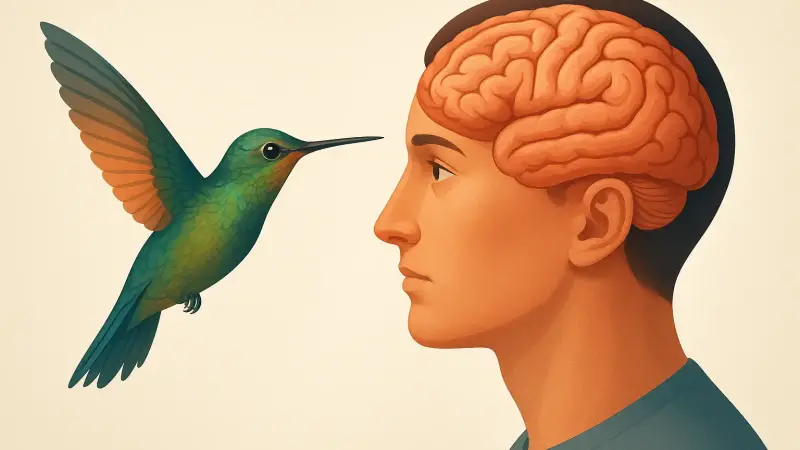
That tiny moment when your eyes meet
On a crowded New York City subway, it happens all the time. Your gaze lifts. Someone else’s gaze lifts. For a split second, you’re both looking straight at each other, and then one of you looks away. That moment feels small, but the brain treats it like fresh data. Eye contact is a fast cue about another person’s attention and possible intentions. It moves through visual systems that are tuned for faces, then into networks that tag the moment as socially relevant. The odd part is how little time it takes. Even before you can name what you saw, your brain has already started sorting it.
How your brain detects “someone is looking at me”
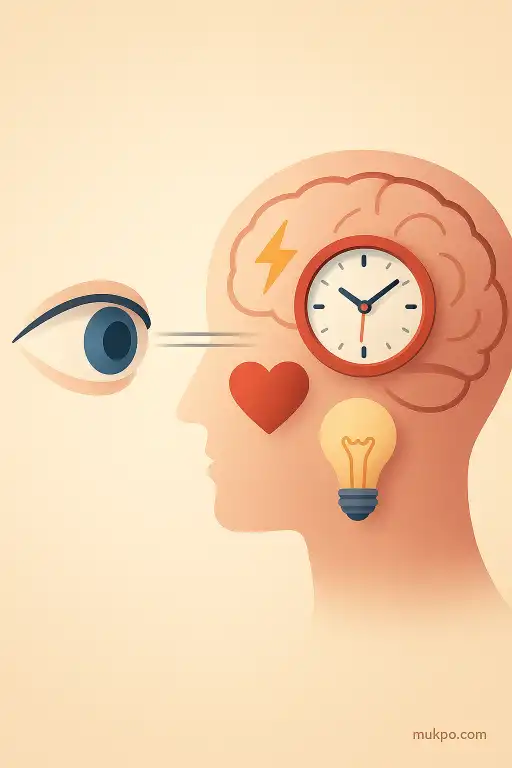
Eye contact starts as geometry. The brain estimates gaze direction by combining where the iris sits, the shape of the eyelids, and the angle of the head. It is not a single “eye contact detector.” Several areas cooperate, including face-sensitive regions in visual cortex and systems involved in attention. A key point people miss is that gaze direction is judged relative to the whole face. The same eyes can feel direct or not depending on a slight head turn or tilt. Lighting matters too. A shadow across the whites of the eyes can flip the judgment, especially at a distance.
Timing matters because the brain does not wait for certainty. Early visual processing is quick and imperfect, and it often leans toward “maybe direct” when the signal is ambiguous. That bias varies by person and situation, and it is not always clear how much comes from learning versus baseline sensitivity. But the general pattern is consistent: direct gaze tends to win the competition for attention. It gets processed as if it might be important right now.
What changes in attention and body state in a split second
When another person looks directly at you, attention narrows. The brain allocates more processing to that face, and other details can drop out for a moment. This is one reason people later remember the look but not what was on the wall behind the person. Alongside attention, the body can shift into a light readiness state. Heart rate, skin conductance, and other autonomic signals often change with social cues, and direct gaze is a reliable trigger in lab settings. The intensity varies widely, and context can flip the meaning from neutral to threatening to friendly.
There is also a micro-timing effect that’s easy to overlook. The brain reacts differently to a gaze that is already direct versus a gaze that turns toward you. A shift into direct gaze is a change event, and change events get prioritized. That tiny motion in the eyes and head can matter more than the final “straight at me” snapshot. It is one reason a glance that lands on you can feel sharper than a steady stare you only notice late.
How it shapes meaning: threat, interest, or just navigation
Once attention locks, the brain starts assigning meaning. The same eye contact can signal attraction, challenge, monitoring, or simple coordination. A concrete example is sidewalk choreography. Two people approaching each other often use brief eye contact to negotiate who shifts left or right. Without it, both may mirror each other and drift into the same path. In that moment the “message” is not emotional at all. It’s a fast way to synchronize movement.
Context fills in the rest. In a job interview, sustained eye contact is often interpreted as engagement in some cultures and as disrespectful in others. Japan and the United States are commonly cited as having different comfort zones, but even within one country it varies by region, family norms, and setting. The brain still does the same early detection, but the learned social rules change what happens next: whether you interpret it as warmth, evaluation, or pressure.
Why the feeling can be strong even when the moment is brief
Eye contact is tied to self-relevance. A face looking at you is not just another object in the scene. It implies you are part of what is happening. That can amplify memory. People often recall the presence of direct gaze better than they recall clothing color or exact words, even when the look was short. The brain is not recording a perfect video. It’s tagging what seems socially important and leaving the rest thinner.
It also explains a common experience: thinking someone looked at you when they didn’t. Peripheral vision is poor at fine detail, and gaze direction is one of the easiest things to misread from the side. Add a quick head movement or a bright reflection on glasses and the signal becomes guessy. The brain would rather flag a possible “they’re looking at me” than miss it. By the time you check, the moment is already gone, but the tag can linger.
Related reads
- How changing your posture shifts decision making
- Why rearranging small objects calms an anxious mind
- How tiny vortices make rainbows around waterfalls
- The pond that freezes into perfectly clear glass overnight every winter
- The lamppost used as an informal speed detector after repeat dents proved a pattern
- The bakery that insists seawater is the secret to its crackling crust