

How it can happen so fast
A song can come on in a grocery store and, for a second, the room changes. It’s not just “remembering the song.” A familiar melody can pull up a scene that feels older than the moment: a car ride, a specific kitchen, a person’s voice. This isn’t tied to one famous event. It shows up everywhere, from people hearing ABBA at a wedding reception in Sweden to a Motown chorus on oldies radio in the U.S., to karaoke staples in Japan. The basic mechanism is that music is a strong cue. The brain treats it like a pattern it has stored with other details, then it reopens the whole package.
The speed is part of what surprises people. Melodies are predictable in a way everyday sounds aren’t. Rhythm, key changes, and repetition create a structure the brain can recognize with very little input. A couple of notes can be enough. Once recognition clicks, the rest of the network that was linked to that music can light up too.
Music is built to stick in memory
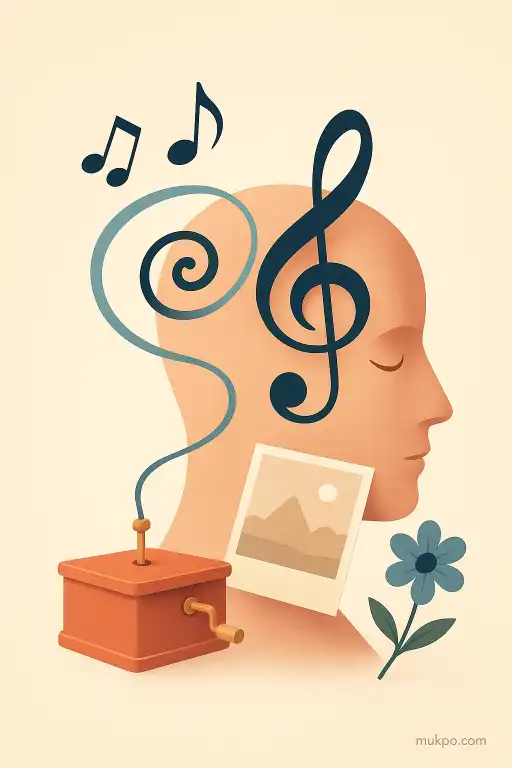
Speech is designed to convey meaning and then move on. Music is designed for repetition. Choruses return. Hooks repeat. Even when people aren’t trying to memorize, their brains get multiple passes at the same pattern. That’s one reason tunes can become “overlearned.” They end up stored in a way that survives long gaps without hearing them.
A specific, often overlooked detail is that memory for a melody can be robust even when other details fade. Someone might not recall the artist’s name, the year, or the lyrics. They can still hum the contour correctly—up, down, a held note, then a jump. That contour is a compact code. It’s easy for the brain to match later, like recognizing a face from a silhouette.
Why it brings back scenes, not just songs
Music tends to be present during moments that are already loaded with context. Long drives. First apartments. School dances. The song becomes bound to the setting, the people, and the emotional tone. When the melody returns, it doesn’t just retrieve “audio.” It can retrieve the whole situation that was linked to it, including details that were not the focus at the time.
Think of a concrete scene: someone hears the same pop track they used to play on a CD in a 2003 Honda Civic. The first thing that comes back might be the click of the seatbelt or the feel of warm air from the vents, not the lyrics. That kind of sensory hitchhiking is common because the brain stores experiences as bundles—sound, place, body state, and emotion all tied together. Music is simply a very good handle for grabbing the bundle.
The emotional shortcut matters
Emotions change what gets stored and how easily it’s retrieved. Music is unusually good at shaping emotion quickly, even without words. Tempo, harmony, and dynamics can shift arousal and mood in seconds. When a melody is first learned in a highly emotional moment—good or bad—the association can become stronger and easier to trigger later.
This is also why the memory can feel oddly “present.” The feeling comes with it, and feelings can create a sense of certainty. The scene might not be perfectly accurate in detail, but it can still land with force. That can be confusing because it feels like a replay, yet memory is reconstructed each time. Music supplies a stable skeleton, and the brain fills in the rest using whatever fragments remain.
Why some melodies hit harder than others
Familiarity isn’t the only factor. Frequency matters, but so does timing. Songs learned during certain life windows—often adolescence and early adulthood—tend to stay vivid for many people. There’s no single “magic age” that fits everyone, but it’s a period when identity, social life, and novelty are high, and music is used a lot to mark belonging and mood.
Context can decide whether the memory shows up at all. Hearing the melody with the same production style—same synth sound, same drum pattern, the exact intro—can be a stronger trigger than hearing a live cover. Small details that people barely notice, like the reverb on a snare or the pause before the chorus, can be the part that matches the stored pattern. That’s sometimes why the “right” version suddenly unlocks a memory that the song title never could.
Related reads
- What a split second of eye contact tells your brain
- How changing your posture shifts decision making
- Why rearranging small objects calms an anxious mind
- How tiny vortices make rainbows around waterfalls
- The pond that freezes into perfectly clear glass overnight every winter
- The lamppost used as an informal speed detector after repeat dents proved a pattern