
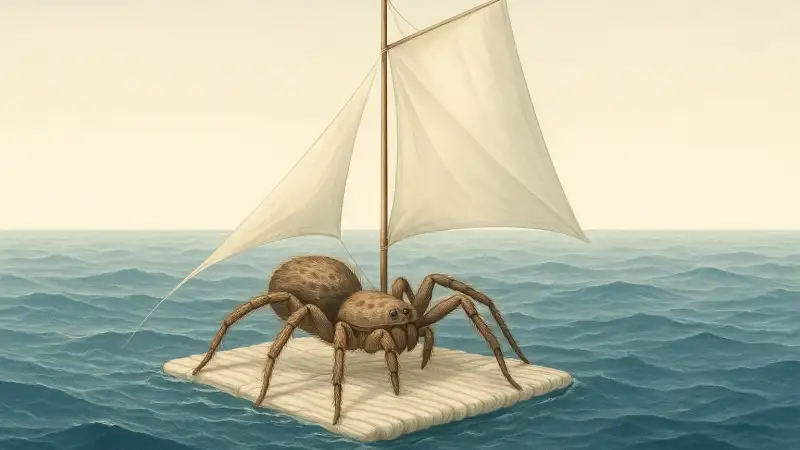
Seeing spiders where there shouldn’t be spiders
People sometimes report spiders landing on boats far from shore, or showing up on small islands that don’t seem to offer an obvious route. This isn’t one single event tied to one place. It’s been described around the North Sea, the Mediterranean, and the Southern Ocean, including sightings made during the 2019 expeditions that documented tiny coastal spiders rafting at sea. The basic trick is simple. A spider gets on a floating bit of plant or debris, then throws out silk that wind can catch. The silk acts like a sail. The raft drifts. The spider just hangs on.
How a silk “sail” actually works
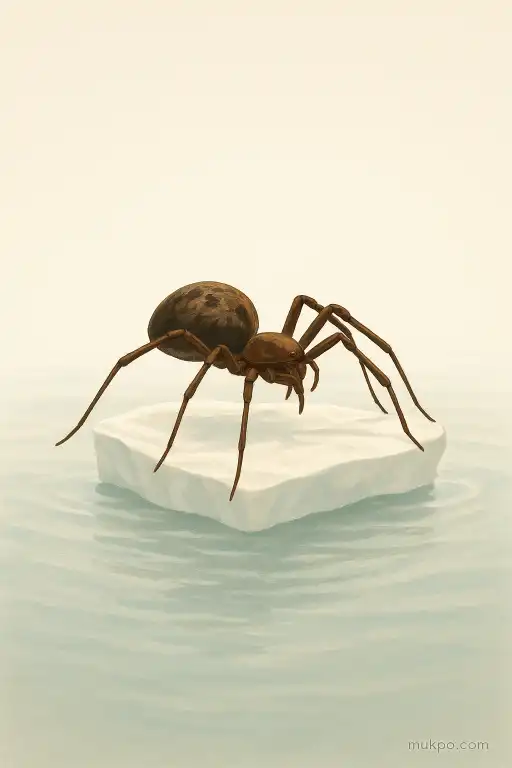
Spider silk is light, strong, and sticky in ways that matter here. When a spider releases long threads into moving air, those threads can create drag like a tiny streamer. On land this is tied to ballooning, where spiders lift off and travel on air currents. On water it can be similar, but the spider’s body weight is carried by the floating raft instead of the air. The wind still does useful work, because the silk increases the surface area “catching” that wind.
A detail people often overlook is that the silk isn’t always one neat line. Spiders can put out multiple strands, and the bundle can tangle around the raft or stick to salt spray. That changes how it pulls. Even small shifts in strand length or angle can turn a simple drift into something more like a controlled downwind slide.
What counts as a raft, and where spiders get one
The raft can be almost anything that floats long enough. A curled leaf. A piece of bark. Seaweed. Even a cluster of dead insects stuck together. After storms or floods, shorelines release a lot of loose material at once, and currents gather it into streaks or mats. That’s when rafting becomes much more likely, because spiders already living near the edge don’t need to “choose the ocean.” They just need to end up on a floating fragment at the wrong moment.
Some spiders also survive better on the trip than people assume. Many can go a long time without food. Some tolerate getting wet. A few can trap air against their body hairs for short periods, which helps if waves wash over the raft. None of that makes the trip easy, but it makes it possible often enough to matter.
Crossing water is mostly about weather, not distance
“Crossing an ocean” sounds like a single, heroic voyage, but the conditions decide what the journey even looks like. A spider raft might only need to cross a channel, then later hop between islands, then ride another current. Wind direction matters more than straight-line distance, and winds can shift fast. A steady onshore breeze can strand a raft quickly. A long offshore wind can keep it moving for days.
Currents add another layer. A raft can be pushed one way by wind while the surface water slides another way beneath it. That mismatch can create looping paths that are hard to predict. It also means two rafts launched from the same beach can end up in very different places, even if they start minutes apart.
Why this happens often enough to shape where spiders live
For island ecosystems, rare arrivals are still arrivals. One pregnant female, or a handful of juveniles, can be enough to establish a population if the habitat fits. That’s why spiders are among the animals most frequently found on remote islands compared with many insects that seem like they should travel just as well. Silk gives spiders two options: riding air when they can, and riding water when they have to.
It also explains why people sometimes find tiny spiders on drift lines after a storm. They aren’t always “washed in.” Some are arriving on purpose in the only way a small animal can, by taking advantage of wind, floating debris, and a material they can make on demand.
Related reads
- The mural that slowly revealed a hidden city map as layers of smoke were cleaned away
- Why people scan exits when they enter unfamiliar rooms
- The clock tower that loses precisely twelve minutes every year without fail
- Why a single glance can make a stranger unforgettable
- How tiny habits conserve mental energy all day
- Why a familiar melody can surface a distant memory