
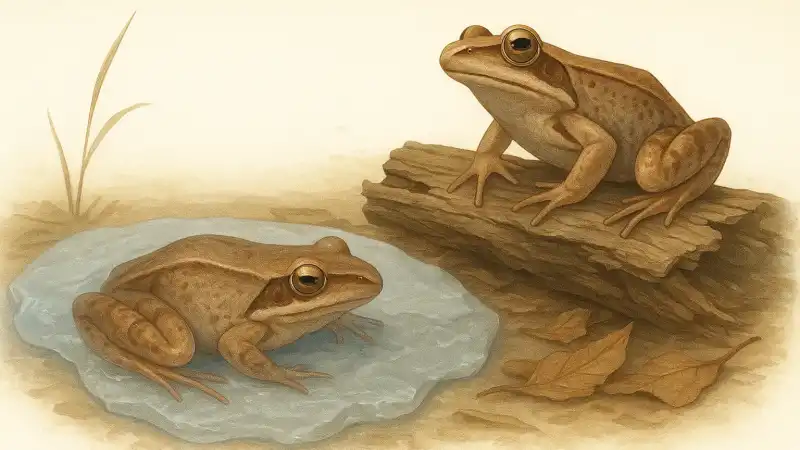
A frog that spends winter as a block of ice
On a cold spring day in Alaska or northern Minnesota, you can find a wood frog that looks dead in the leaf litter. It may have been frozen for months. That sounds impossible, because ice should shred cells and stop the heart for good. Wood frogs get around it with timing and chemistry. They don’t “resist” freezing so much as manage it. As temperatures drop, their bodies flood their tissues with protective sugars and push ice to form in safer places first. The result is a controlled shutdown, not a chaotic one, and that distinction is the whole trick.
Freezing starts outside the cells
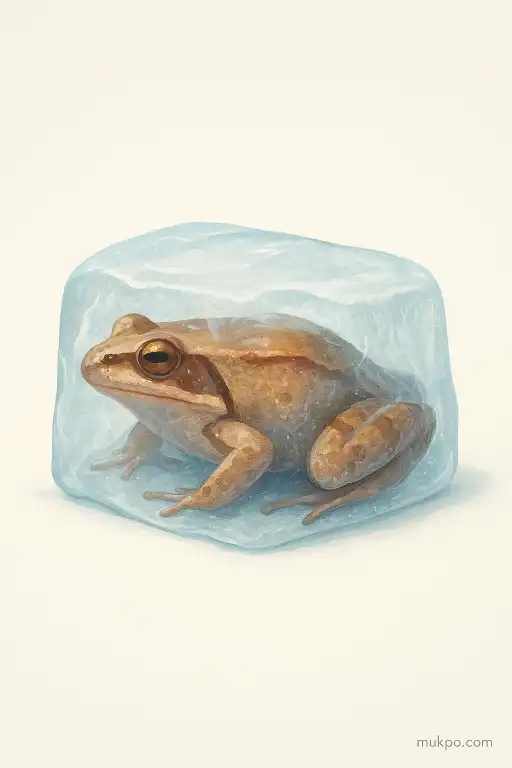
When a wood frog begins to freeze, the first ice forms in the spaces between cells, not inside them. That matters because an ice crystal inside a cell is usually fatal. Extracellular ice pulls liquid water out of cells by osmosis. The cells shrink and concentrate, like brining. That sounds dangerous too, but it’s survivable if it happens in a controlled way and if cell membranes stay flexible instead of cracking.
One detail people often overlook is that the frog still needs some water left in the right places. It can’t just “dry out” completely. Too much dehydration collapses tissues and disrupts proteins. The frog’s freezing response is a tight balancing act: allow enough water to leave cells to prevent internal ice, but not so much that cells become irreversibly damaged.
Glucose acts like an emergency antifreeze
As soon as freezing begins, the frog’s liver breaks down glycogen and dumps large amounts of glucose into the bloodstream. That glucose spreads through many tissues fast. It lowers the freezing point a bit, but its bigger job is protection. High sugar concentrations help stabilize proteins and membranes when water shifts around. It also helps reduce the damage caused by dehydration and high salt levels inside shrinking cells.
This isn’t the same as the antifreeze chemicals used by some insects or fish, and it’s not a slow seasonal adjustment. The spike can happen quickly once ice starts forming. A situational example: a wood frog tucked under a thin layer of leaves can freeze during a sudden overnight drop below 0°C and then thaw during a sunny afternoon. That rapid swing is exactly the sort of weather it’s built to handle.
The body shuts down, but not randomly
During deep freezing, the heart stops. Breathing stops. Blood flow stops. The frog doesn’t maintain normal metabolism while frozen solid. Instead, it enters a state where cells rely on protective chemistry and extremely low energy demands. Not every organ experiences the same conditions. Some tissues freeze more than others, and the pattern can vary with temperature and how quickly the cold arrives.
The dangerous moment is often the transition, especially thawing. As ice melts, water rushes back toward cells and circulation restarts. That can create oxidative stress, similar in broad outline to what happens in other animals when tissues lose oxygen and then get it back. Wood frogs have ways to limit that damage, including changes in antioxidant defenses, but the exact balance can vary across populations and conditions.
Limits, tradeoffs, and why this works on the forest floor
Wood frogs can’t survive any amount of freezing in any situation. Colder isn’t always better. The depth and duration of freezing they tolerate depend on local climate, the frog’s condition, and how insulated its hiding spot is. Snow cover, damp leaves, and soil can buffer temperature swings. A frog under steady snowpack may experience a different winter than one exposed to repeated freeze–thaw cycles during a mild season.
That lifestyle fits where they live. Wood frogs breed in temporary pools early, sometimes while ice is still around, and then they spend much of the year in woods where shallow shelters are all that’s available. Being able to survive freezing isn’t a party trick. It lets them wait out winter right where they are, motionless under leaves, until a thaw is warm enough for everything to start moving again.
Related reads
- How hermit crabs choose shells using chemical cues
- How photosynthetic bacteria thrive in boiling hot springs
- A rainforest bat that farms figs by planting seeds
- The night in 1944 when a Midwestern town awoke to an invisible assailant
- The medieval forger who persuaded Europe that three centuries were fabricated
- The spider that sails on silk rafts to cross oceans