
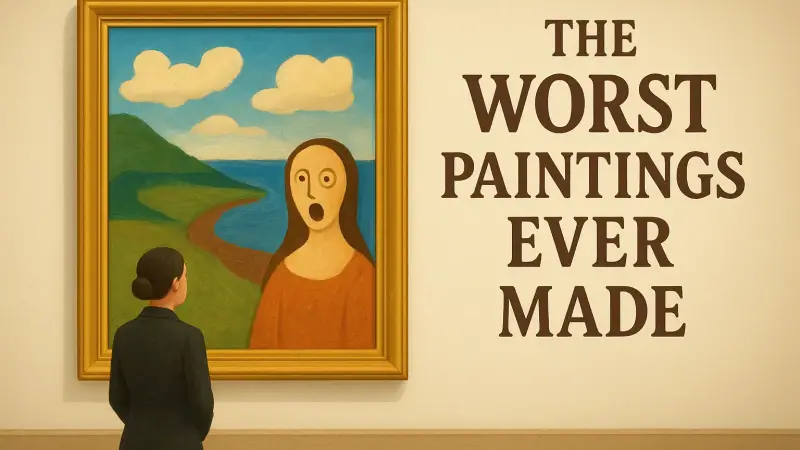
Most museums ask you to look up at genius. This one asks you to look a little sideways. The Museum of Bad Art in Massachusetts—MOBA, best known for its gallery in Somerville—collects paintings that fail in ways you can’t ignore. Not “outsider art” that’s raw but intentional. Not student practice that’s simply unfinished. The rule is that the work has to be sincerely trying, and still go off the rails. Visitors come in expecting a joke and end up lingering, because the failures are specific. You can often see the exact moment where confidence outran skill, and the painting never recovered.
Where this museum came from
MOBA started with a rescue story, not an art-world plan. One of the founders, Scott Wilson, found a painting in the trash and thought it was too strangely compelling to throw away. That impulse—this is bad, but it shouldn’t disappear—turned into a collecting mission. The museum later formalized its standards and began mounting shows, treating the work with the same basic respect any museum gives an object: labels, lighting, and a clear sense of “this belongs here.”
That respect matters because the collection depends on sincerity. The museum generally avoids pieces that feel like they were made to be “bad on purpose.” The line can be blurry, and MOBA has acknowledged that judgment is part of the fun. But the organizing idea stays consistent: the most interesting failures are the ones where someone meant it.
How a painting qualifies as “bad”
Bad, here, doesn’t mean “ugly” or “unskilled.” It means the work collapses under its own choices. The anatomy might be sort of right and still deeply wrong. The perspective may be ambitious but impossible. Often the color decisions fight each other until the subject looks slightly unwell. The museum’s own descriptions tend to circle a particular kind of failure: a painting that is technically earnest, yet creates an unintended mood that’s hard to name.
There’s also a practical filter people overlook. The museum can’t collect everything, so it needs survivable objects. Works that are too damaged, too fragile, or too huge to store usually don’t make the cut. A lot of “worst painting ever” candidates are on crumbling canvas or warped board from damp basements. Being bad isn’t enough. It has to be bad in a way that can be hung on a wall without falling apart.
What it feels like inside the galleries
Seeing these works grouped together changes how people look at them. In a thrift store, a failed portrait is easy to dismiss. In a gallery, it becomes a case study. A concrete example comes up again and again in photos and write-ups: MOBA’s “Lucy in the Field with Flowers.” The title sounds gentle. The image isn’t. A childlike figure stands in a field, but the expression and proportions land in an unsettling place, like the painter was chasing sweetness and accidentally found menace.
The room dynamic is different from a typical museum hush. People laugh, then get quiet. They lean in close to inspect a hand that doesn’t connect to an arm correctly, or a shadow that goes the wrong direction. The laughter is usually less “look at this idiot” and more the relief of seeing a mistake you recognize. It’s the same feeling as reading an email you sent too fast, except it’s framed and spotlit.
Why anyone would preserve a failure
Bad paintings hold a kind of information that polished work hides. They show decision-making in the open. You can spot the moment where the artist committed to a background that was too complex, or tried to fix a face and made it worse, or added one more highlight that turned into a glare. In good work, those moments are either solved or concealed. Here, they stay visible, and viewers can trace the path.
There’s also a social reason collections like this endure. Most people make things privately and never show them. A museum that exhibits failure—without pretending it’s secretly genius—creates a rare public space where “trying” is visible. The paintings aren’t treated as heroic. They’re treated as real artifacts of effort, misjudgment, and taste that didn’t land where the maker hoped.
The awkward ethics of laughing at someone’s work
The uncomfortable part is obvious: these were made by someone. Sometimes the original artist is unknown, especially when pieces are found at yard sales or pulled from donations. Sometimes an artist finds out later, and reactions can vary. The museum leans on a curatorial stance that tries to keep the joke aimed at the outcome, not the person. Labels tend to be playful but not cruel, and the point is usually to describe what went wrong in the image, not to speculate about the painter’s life.
Still, it’s a tightrope. The same painting can read as harmless comedy to one visitor and as humiliation to another. That tension sits in the room with the work. It’s part of why people keep looking longer than they expect, especially when they notice how often the “worst” paintings include one oddly competent detail—a beautifully painted tree, a careful fold in fabric, a convincing cloud—that makes the failure feel more human than absurd.
Related reads
- The postman who delivers mail by zipline in a mountain village
- The pocket watch found fused inside an old oak’s heartwood
- The tiny hesitations that make someone come across as more trustworthy
- Why the face in the mirror can look like a different person after a haircut
- The river that briefly runs neon green after a festival dye washout
- Why we cling to useless belongings: the surprising psychology of sentimental clutter