
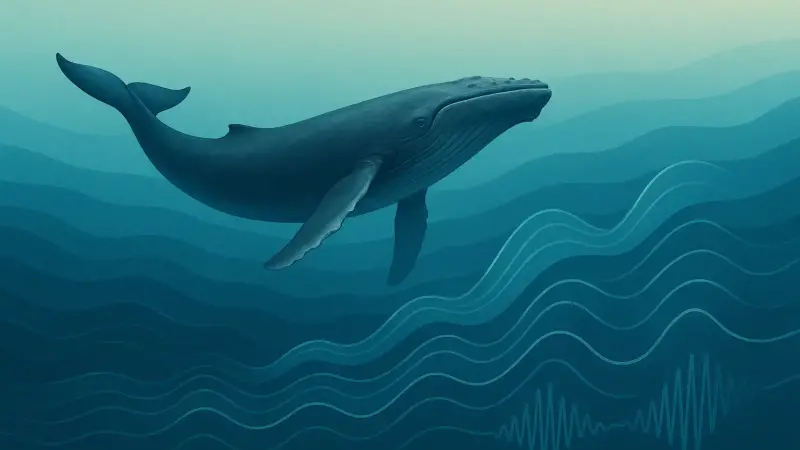
Sound that doesn’t travel straight
It’s easy to picture a whale call moving through water like a straight beam. In the open ocean it usually doesn’t. There isn’t one single “deep ocean layer” that does this everywhere. It depends on local temperature and salinity patterns in places like the North Pacific, the North Atlantic, and the Southern Ocean. What matters is that sound speed changes with depth, and the path of a call bends toward slower layers. That bending is refraction. It can aim a song down into the depths, curve it back up, or trap it in a band of water that carries it far.
The core mechanism is simple: sound travels faster in warmer water and generally faster under higher pressure, and it also changes with salinity. When those factors make a “sound speed minimum” at some depth, the ocean acts like a lens. The song curves, not because the whale is “aiming,” but because the water column is doing it.
Layers that change the speed of sound
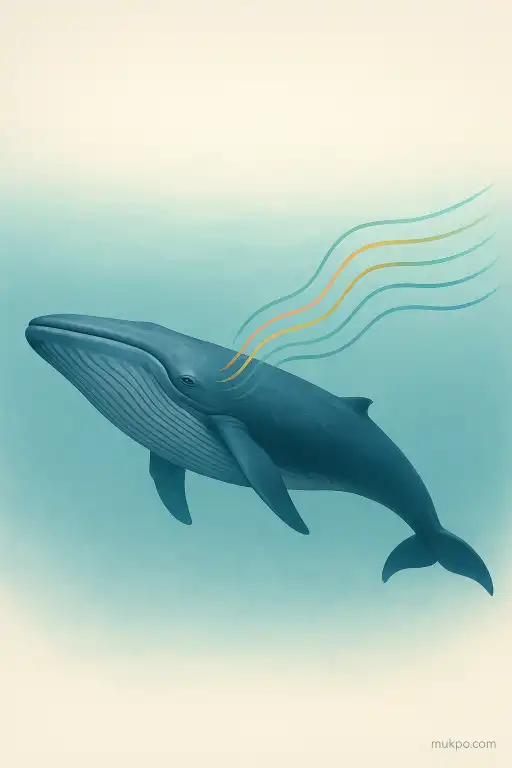
Near the surface, temperature often drops quickly with depth in a thermocline. That drop can slow sound down fast. Deeper down, pressure keeps rising and eventually makes sound speed increase again. Put those together and you often get a minimum sound speed somewhere in the midwater, commonly on the order of a few hundred to around a thousand meters, though the exact depth varies a lot by region and season.
A detail people overlook is how sharpness matters. A gradual change in sound speed bends a path gently. A strong gradient—like a pronounced thermocline—can bend it more strongly over a shorter vertical distance. The whale’s call frequency matters too, but not because higher pitch “bends more.” Bending mainly follows the speed structure; frequency shows up more in how much energy gets absorbed and scattered along the way.
Why the path curves instead of staying level
As a call moves through layers, parts of the wavefront enter slightly different sound speeds. The side in faster water advances a bit more per second than the side in slower water, and the whole path curves. The direction of the curve is predictable: it bends toward the slower region. If there’s a speed minimum, rays above it tend to bend downward toward it, and rays below it tend to bend upward toward it.
This is why a call can “bounce” in a smooth, continuous way without reflecting off a hard boundary. It’s not like echoing off the seafloor or surface. It’s the geometry of refraction through a speed gradient. In practice, real oceans add small wrinkles—internal waves and eddies slightly tilt and ripple the layers—so the bending is not perfectly stable over hours or days.
The SOFAR channel and long-distance singing
When the speed minimum forms a good duct, it creates what oceanographers call the SOFAR (Sound Fixing and Ranging) channel. Sounds launched near that depth can get trapped, curving up and down around the axis instead of leaking away. Low-frequency calls, like many baleen whale vocalizations, can travel especially far because low frequencies are absorbed less by seawater than high frequencies.
A concrete situational example: a blue whale calling in deep water off California can have its sound couple into the channel and be detectable hundreds of kilometers away under favorable conditions. The same call in a shallower continental shelf area may not couple into a stable duct at all. It can lose energy into the bottom, interact with complex bathymetry, and end up being heard in patchier, less predictable ways.
What bends the song in real life
Depth of the whale is a quiet but crucial variable. A singer near the surface often sends more energy into paths that interact with the surface, where bubbles and wave roughness can scatter sound. A singer deeper down may launch more energy toward the channel axis, which changes who can hear it and from where. This is one reason recordings from hydrophones can show strong day-to-day variability even when whales are still present.
Seasonal and regional changes can shift the duct. Winter mixing can weaken the near-surface thermocline, changing the curvature of paths. Freshwater input and fronts can also tilt layers, steering sound sideways as well as up and down. That steering is easy to miss because it doesn’t show up as an obvious “bend” in a simple diagram, but it can move the loudest part of a song’s footprint away from where a straight-line guess would put it.
Related reads
- Why lightning sometimes strikes the same tree dozens of times
- The vending machine that dispenses live plants with tiny adoption cards
- How tardigrade proteins stop cells from drying out
- The bridge that plays a melody when cars drive over it
- The fungus that turns ants into trail-building automatons
- The parish that burned dozens in a single, frenzied 17th-century witch trial