
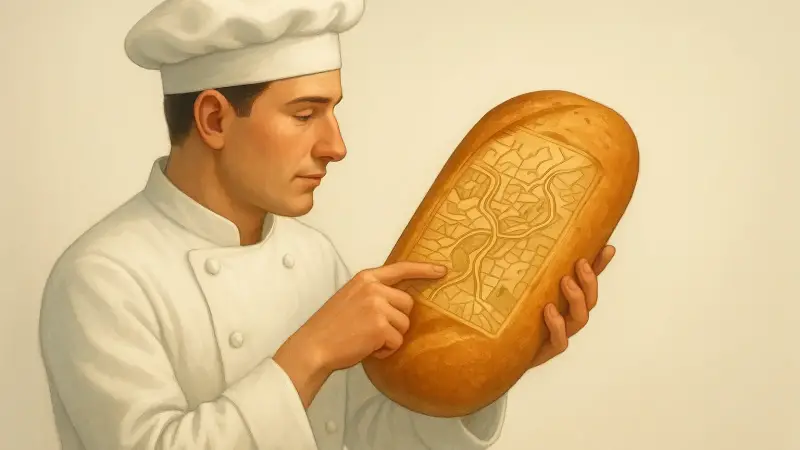
People notice the crust first. Then they turn the loaf over and see it: a tiny street grid, a river line, maybe a dotted route, all printed in edible ink. There isn’t one famous bakery that’s known everywhere for doing this. It shows up as a scattered idea, usually as a short-run gimmick or an art-bread collaboration. You might see map-printed loaves at a market in Paris, in a Tokyo bakery known for character bread, or as a pop-up in New York. The mechanism is simple. The loaf becomes a page. The map becomes a pointer. And the “secret recipe” sits somewhere off the bread, waiting for someone to follow the logic.
How a map ends up on bread
The printing usually happens after baking, when the crust is dry enough to take ink without smearing. Some shops use custom stamps. Others use a food-safe inkjet printer made for cakes and macarons, because it can handle fine lines without pressing into the surface. It tends to work best on flatter shapes: pan loaves, focaccia, or wide boules with a relatively even crust.
A detail people overlook is moisture. A loaf that looks perfect can still be “too alive” on the outside for clean printing if steam is trapped under the crust. That’s why the map sometimes looks crisp at the edges and fuzzy in the center. It’s also why you’ll see some bakers vent the loaf longer, or print on a thin, edible sheet that gets laid onto the crust like a label.
What the maps are actually pointing to
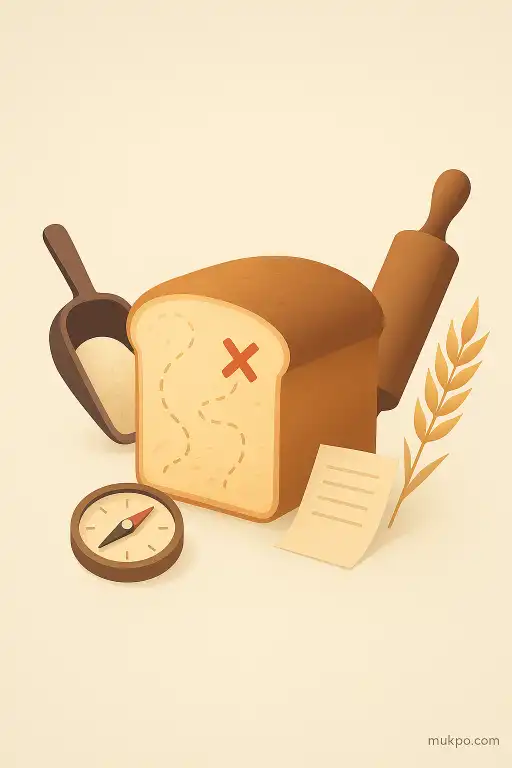
Most of the time, the “secret” is not a single, hidden document. It’s a small set of recipes or techniques that the bakery doesn’t put on the main menu. A map might lead to a back page on the bakery’s site, a QR code hidden in the legend, or a physical drop spot where a card gets swapped. The romance is in the chase, but the infrastructure is usually straightforward.
When the map points to a real place, it’s often somewhere the bakery already has a relationship with: a mill, a neighborhood market, a partner café. The bakery can keep control of the release that way. Someone “arrives,” gives a phrase from the loaf’s key, and gets a recipe card or a one-time code. It looks like a scavenger hunt. It behaves more like staged distribution.
Why bakeries bother with the secrecy
A recipe isn’t just ingredients. It’s timing, temperature, and repetition. Many bakeries are not protecting a list so much as a process that’s hard to copy at home. Printing a map on a loaf lets a shop share something “exclusive” without giving away the parts that actually make the product consistent. The card might include ratios, but not the dough temperature target, the mixer speed, or the fermentation schedule that makes it work.
There’s also a reason it shows up in limited runs. The moment it becomes routine, it becomes labor. Someone has to handle each loaf twice, align the print, track which batch corresponds to which route, and deal with the ones that smear. If a bakery is already slammed on a Saturday morning, a map-printing project is the first thing to get cut.
How people decode a loaf without eating the clue
Most customers don’t treat it like a puzzle at first. They just take photos. That changes the game, because the map becomes shareable before it’s even sliced. Bakeries that lean into the idea often design the maps to survive social media: high-contrast lines, a clear “you are here,” and a key that’s readable at arm’s length. If it’s too subtle, it gets mistaken for decorative scoring or a branding stamp.
There’s a practical constraint that shapes the whole concept: bread gets cut. If the important marker sits near the center, it disappears fast. So the “X” or the legend often lives near the heel, where the loaf is handled but not immediately sliced. That’s why you’ll see the densest information printed close to an edge, even when it makes the map look slightly off-balance.
What counts as a “secret recipe” in real life
Sometimes the secret is a seasonal formula the bakery only makes for staff meals, like a simple rye with a different preferment, or a sweet bun dough that gets repurposed for holidays. Sometimes it’s a collaboration recipe that belongs partly to a partner, which is why it can’t be posted openly. And sometimes it’s not a recipe at all. It’s a method: how they laminate without tearing, how they keep a starter stable, how they manage ovens that run hot on one side.
The secrecy can also be softer than it sounds. The “hidden” thing might be available to anyone who shows up at the right time, or who buys a specific loaf that day. The map, in that case, is less a lock and more a way to turn an ordinary purchase into an event that feels like it has a back room.
Related reads
- Why urban pigeons harbor unusual antibiotic resistant microbes
- How whale songs bend in deep ocean layers
- Why lightning sometimes strikes the same tree dozens of times
- The vending machine that dispenses live plants with tiny adoption cards
- How tardigrade proteins stop cells from drying out
- The bridge that plays a melody when cars drive over it