
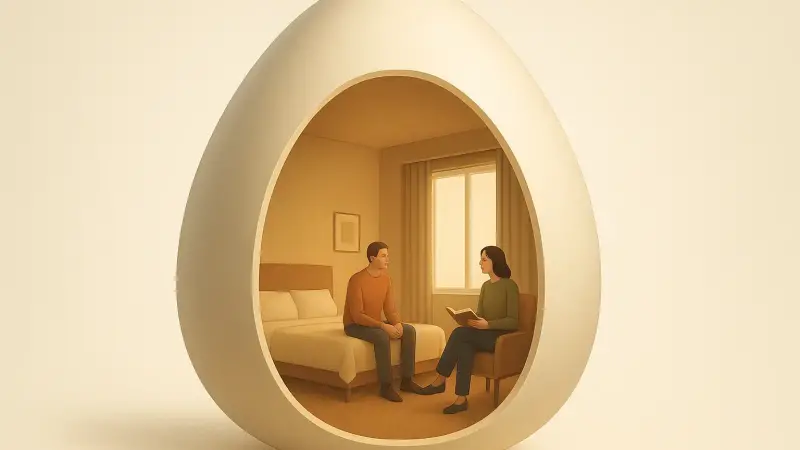
Why an egg-shaped room sounds different
You don’t usually think about the shape of a hotel room until you clap, speak, or unzip a suitcase at night. Then some rooms feel oddly “alive.” It’s not one single famous room, and details vary by building, but the effect shows up in egg-shaped pods, rounded suites, and other curved interiors. You can see similar acoustic quirks discussed in places like spherical listening rooms and whispering-gallery spaces such as the dome of St Paul’s Cathedral in London. In an egg-like room, the core mechanism is simple: smooth curves change how sound waves bounce, bunch up, and fade out. Sometimes that makes a voice feel louder than expected. Sometimes it makes certain notes jump out.
Curves, echoes, and the “hot spot” problem
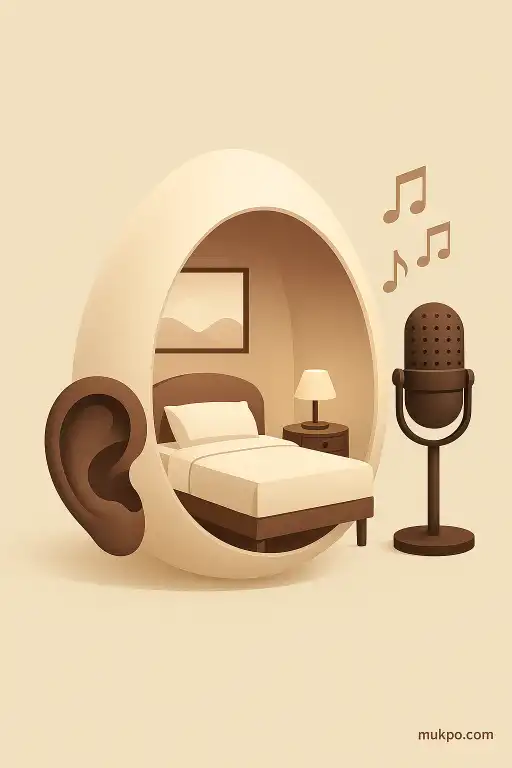
Flat walls tend to scatter reflections in predictable ways. Curved surfaces can do something trickier: they can concentrate reflections. With a concave curve, sound rays that leave your mouth don’t just spread out and die. Some get steered toward a smaller area. That can create a “hot spot,” where the same words suddenly sound closer, brighter, or more present, even if you didn’t move much. Step a foot to the side and it can drop off.
Egg shapes are not perfect spheres, so the focusing isn’t perfectly symmetrical. That’s part of why people describe it as strange rather than just echoey. The reflections can be uneven. A person near one end might hear a tight, quick slap-back. Another person across the room might hear a softer wash. It depends on where the bed, desk, and bathroom pod sit inside the shell.
Standing waves make some pitches feel louder
Even without obvious echo, a rounded room can make certain frequencies swell. That’s standing waves: sound bouncing back and forth in a way that reinforces itself at specific pitches. Rectangular rooms have their own version of this, but curves can shift where those peaks land and how they overlap. People notice it most with voices, hair dryers, and phone speaker audio. One note in a song can feel too loud. Another can vanish.
A detail people usually overlook is that the “weirdness” often comes from the lowest frequencies, not the high ones. Thick carpets and bedding can soak up treble and make the room seem acoustically tame. Meanwhile bass from footsteps, HVAC rumble, or a distant elevator can hang around because it’s harder to absorb. In an egg-like shell, that low-end energy can collect in certain zones, so a quiet hum feels oddly located, like it’s coming from the wrong corner.
Furniture and finishes can either tame it or amplify it
People imagine a smooth, clean “egg” interior, but hotel rooms are never just bare shell. The acoustic result is a negotiation between the curve and everything attached to it. A glossy fiberglass or plaster surface reflects strongly. Add soft curtains, a thick duvet, and an upholstered headboard and the room gets less ringy. Put a hard floor under a high ceiling and the reflections come back.
Small design choices matter more than expected in a curved room because there are fewer corners to break up reflections. A normal rectangular room has edges, shelves, and window wells that scatter sound. A pod that’s too smooth can behave like a bowl. Even a narrow seam, a vent grille, or a recessed light track can change the reflection paths and turn one part of the room into the spot where speech seems sharper. Guests tend to miss those tiny interruptions because they’re looking at the overall shape.
Why some guests book it on purpose
There’s a specific kind of novelty in a room that reacts to your voice. Some people try a whisper test. Some snap their fingers. Some notice it only when a late-night phone call suddenly feels too present, like the room is amplifying them. The attraction isn’t always about loudness. It’s about the way the room seems to “edit” sound by making certain syllables pop and others blur, depending on where you’re standing.
The experience also changes with occupancy. Two people, their luggage, coats, and an open closet door can damp reflections compared to an empty room. Even the bathroom door position can matter if the bathroom is a harder, more reflective cavity attached to the main shell. In some egg-shaped layouts, that side room acts like a little echo chamber that feeds sound back through the doorway, so the room feels different before and after you close it.
Related reads
- The bench that secretly grows a community garden inside its slats
- Why some river stones sing when water rushes over them
- The bakery that prints miniature maps on loaves pointing to secret recipes
- Why urban pigeons harbor unusual antibiotic resistant microbes
- How whale songs bend in deep ocean layers
- Why lightning sometimes strikes the same tree dozens of times