
Salt looks clean, but it isn’t sealed off
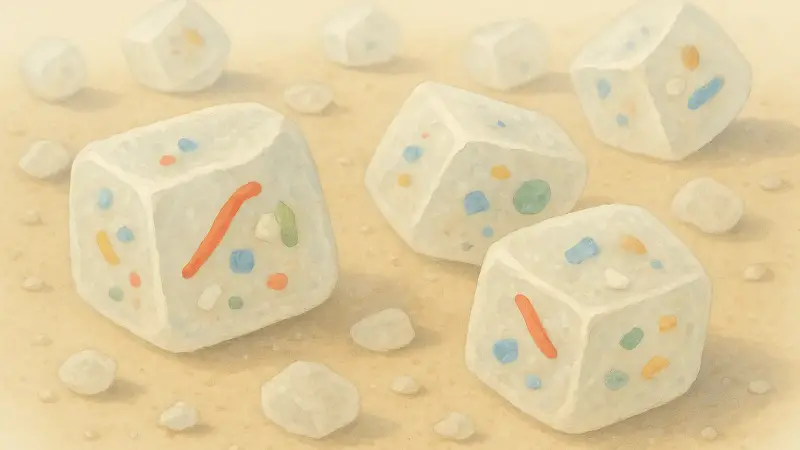
People sprinkle sea salt and assume it’s just dried ocean. But sea salt starts as seawater, and seawater now carries tiny plastic fragments almost everywhere people have looked. This isn’t tied to one single place. Researchers have reported microplastics in sea salt sampled from places as far apart as the Mediterranean, China, and the U.S. The basic mechanism is simple: as seawater concentrates and crystals grow, whatever is floating or suspended nearby can get pulled into the same space where salt is forming. The crystal doesn’t “absorb” plastic like a sponge. It grows around it, the way ice can freeze around a leaf.
Where the plastic is while salt is forming

Microplastics in seawater come in different shapes, and that matters. Fibers shed from synthetic clothing behave differently from jagged fragments or smooth beads. Some pieces float because they’re less dense than seawater. Others sink, especially after they pick up a coating of algae and bacteria. That coating is easy to overlook, but it changes everything. It makes plastic “stickier,” heavier, and more likely to hang around in the briny, particle-rich water used for salt making.
Salt doesn’t always come from open ocean water, either. A lot of sea salt is produced in shallow salt ponds and evaporation pans near coasts. Those ponds can trap whatever blows in from land and sea. Wind can deliver fibers. Runoff can deliver fragments. Once the water is shallow and still, particles that would disperse offshore can linger right where crystallization happens.
How a growing crystal can trap a hitchhiker
As seawater evaporates, dissolved ions become crowded. Sodium and chloride start assembling into solid crystals when the brine becomes supersaturated. Crystal growth isn’t perfectly smooth. It happens at edges, steps, and tiny defects on the surface. Any small solid nearby can become a “nucleation” site that disrupts how the crystal face grows. If a fiber or fragment is in contact with that growing surface, the new layers can build around it and bury it.
One specific detail people usually overlook is the role of the last, thickest brine. The final stages of evaporation create very dense, viscous liquid. Particles move more slowly there. They don’t drift away as easily when a crystal face advances. That increases the odds that a microplastic piece sitting in the boundary layer—the thin film of liquid right next to the crystal—gets walled in instead of swept aside.
Sea salt production creates good trapping conditions
In an evaporation pond, salt often forms as a crust, then breaks into grains during harvesting and drying. That physical handling can lock contaminants in two ways. First, if microplastics are already embedded, breaking the crust just produces smaller salty pieces that still contain them. Second, crystals and wet brine can act like glue. Fibers can cling to damp salt surfaces and get carried along even if they were never fully enclosed during growth.
Contamination can also happen after crystallization. Drying beds, storage sacks, and processing equipment introduce another pathway, especially for fibers. It varies by facility and is often unclear from the final product alone. A bagged salt labeled “sea salt” doesn’t tell you whether it was minimally handled, washed, refined, or blended. Those steps can reduce some particles, but they can also add others if the environment sheds lint-like plastic.
Why crystals don’t filter plastics the way people imagine
It’s tempting to think crystallization is a purification step, because the salt lattice is selective about ions. But microplastics aren’t dissolved ions. They’re physical objects. The crystal can’t “reject” them the way it excludes the wrong chemical. It can only grow past them, leaving them outside, or grow around them, leaving them inside. The outcome depends on size, shape, motion in the brine, and the micro-topography of the crystal surface.
That’s why measurements differ so much across brands and regions. A coarse flake salt made in open pans may trap and carry different particles than a refined salt that is dissolved and recrystallized industrially. Even within the same coastline, a windy season can change the mix of airborne fibers landing in ponds. The salt crystal is just the end point of that local, messy water-and-air environment.
Related reads
- How 17th-century Ottoman tulip mania turned gardens into a speculative market
- The hotel room shaped like an egg people book for its strange acoustics
- The bench that secretly grows a community garden inside its slats
- Why some river stones sing when water rushes over them
- The bakery that prints miniature maps on loaves pointing to secret recipes
- Why urban pigeons harbor unusual antibiotic resistant microbes