
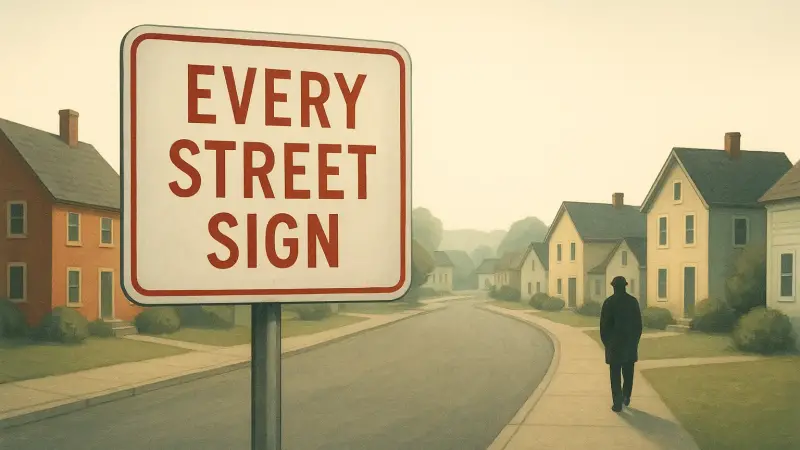
Street signs are supposed to be boring. Same font, same arrows, same rules, and nobody touches them unless they work for the city. So the idea of a place where every sign gets repainted overnight by a stranger feels like a story that should have a name and an address. But there isn’t one confirmed, single town that reliably works this way. What does exist are scattered real-world cousins: the street-art interventions on Melbourne’s laneways, the recurring “guerrilla” sign tweaks reported in cities like London, and the way Barcelona’s tourist-heavy neighborhoods constantly wake up to fresh tags. The mechanism is simple: paint, speed, darkness, and a lot of unattended metal.
Why a street sign is such an easy target
Most street signs sit in a strange gap. They’re official, but they’re also exposed. A person can reach them from the sidewalk without tools. They’re made to be seen at a distance, which means bold colors and clean shapes. That also means one sloppy layer of paint can change their meaning fast.
The overlooked detail is the reflective sheeting. Many signs aren’t “painted” in the normal sense. They’re wrapped in retroreflective film so headlights bounce light back toward the driver. When someone paints over that film, the sign can look fine in daylight and then go dead at night. People often assume the risk is just the message changing. The visibility changing is sometimes the bigger issue.
How overnight changes actually happen
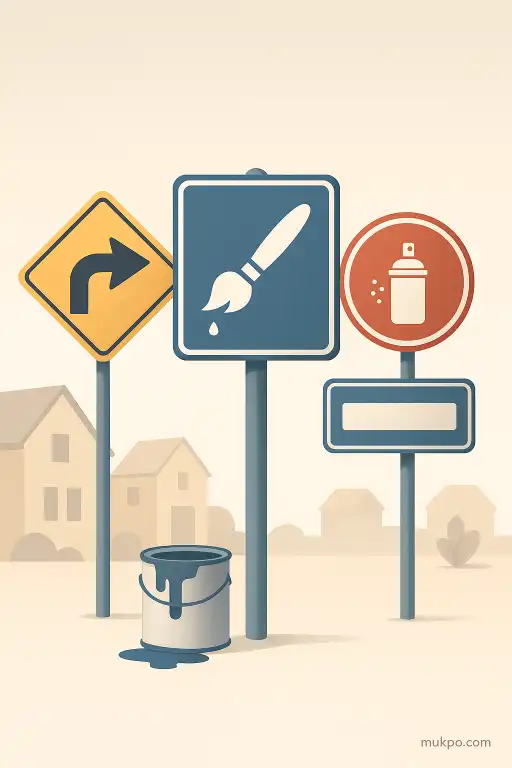
If you hear a story about signs being repainted overnight, it usually isn’t one person touring an entire town every night. It’s episodic. A few signs on a single route get hit, then nothing for weeks, then another cluster. That pattern matches how street-level interventions tend to work: someone lives nearby, walks the same streets, and returns to the same surfaces that feel “available.”
The materials matter. Spray paint is fast, but it drips and it doesn’t love glossy reflective film. Brush paint covers better but takes longer and is harder to carry. Stickers and pasted vinyl are even faster, and they’re quieter. A lot of “painted” sign stories turn out to be overlays that mimic paint from a distance.
What motivates a stranger to repaint a sign
The motives tend to fall into a few buckets, and you can often tell which one you’re looking at by the consistency. A prank aims for one clean joke and then stops. A tagger repeats a name or symbol. A political intervention targets specific streets or institutions. A pure aesthetic impulse shows up as color corrections, patterns, or a new typeface that looks oddly “designed” for something illegal.
There’s also the “fixer” impulse. Some people repaint signs because they think they’re improving legibility, restoring faded color, or making a place feel cared for. That’s the version that fuels the legend of a benevolent stranger. But the line between restoration and vandalism is thin when the sign is part of a regulated system.
Why the town keeps waking up to new signs
The persistence comes from maintenance reality. Cities don’t usually replace a sign the morning after it’s altered unless it creates an immediate hazard. There’s often a lag: a resident notices, reports it, a work order is created, and a crew eventually comes out. That delay gives an active painter time to make it feel continuous, even if they’re only out once in a while.
And when a sign becomes “known,” it attracts repeats. A funny alteration gets photographed and shared. The location becomes a small destination. Then a second person tries their own version. What started as one stranger can turn into a rotating cast, each person reacting to the last change, using the same pole as a kind of public notebook.
What people notice, and what they usually miss
People notice the clever message first. They notice the color second. They rarely notice the hardware. Street signs are attached with standardized bolts and brackets, and those leave clues. Fresh tool marks, mismatched fasteners, or a sign that’s been rotated a few degrees can matter as much as paint. Rotation is an especially quiet intervention, because it can misdirect without changing a single letter.
They also miss how quickly “overnight” can be. In a low-traffic window, a person can step off a bike, paint a rectangle, and leave in under a minute. If the streetlight is out, if there’s a tree canopy, if the sign is already scuffed, the change doesn’t even read as new until the next day’s angle of sunlight makes the fresh layer obvious.
Related reads
- How microplastics hitch rides inside sea salt crystals
- How 17th-century Ottoman tulip mania turned gardens into a speculative market
- The hotel room shaped like an egg people book for its strange acoustics
- The bench that secretly grows a community garden inside its slats
- Why some river stones sing when water rushes over them
- The bakery that prints miniature maps on loaves pointing to secret recipes