
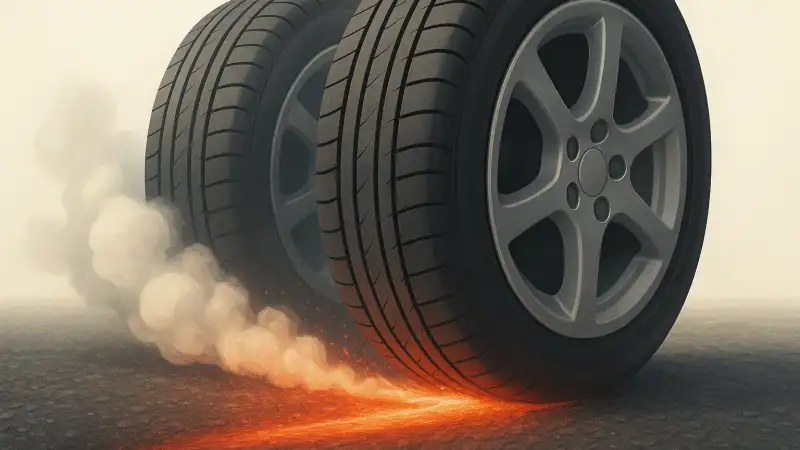
Pull out of a parking lot in Phoenix in July, turn the wheel a little too fast, and the car makes that sharp squeal. This isn’t one single local quirk. You hear the same thing in Los Angeles, Dubai, or on a summer day in Madrid. The core mechanism is simple: the tread rubber and the road surface briefly switch into a high-friction, stick-then-slip interaction. Heat makes that switch easier. It softens the rubber, changes how its polymers deform, and changes how quickly the contact patch can “grab” and then break free. The sound is the rubber vibrating as those microscopic grips fail in bursts.
Hot asphalt changes the contact patch
Asphalt isn’t just “a hard surface.” It’s rock aggregate held together by a bitumen binder, and it has texture at several scales. On a hot day, that binder can be softer and slightly more compliant. The tire’s tread blocks press into that texture more deeply, especially at the trailing edges of the blocks where forces concentrate during a hard turn or quick acceleration.
That matters because tire grip isn’t only about how “sticky” rubber is. A lot of it is mechanical keying: rubber deforming into the tiny peaks and valleys of the road, then resisting being sheared out. Heat changes the balance. The rubber conforms faster, but it can also lose the ability to stay elastically “springy” under rapid loading, so the grip can become jumpy instead of smooth.
Rubber chemistry sets a temperature window for grip
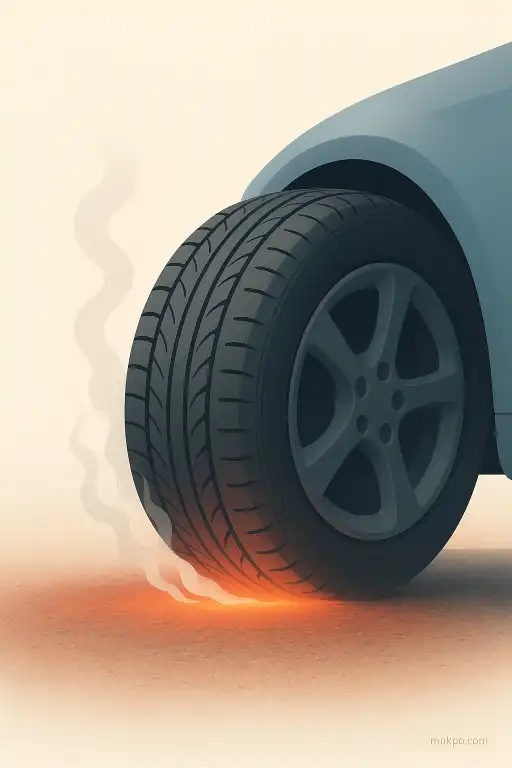
Tread rubber is a mix of polymers (often blends like styrene-butadiene rubber and butadiene rubber), fillers (carbon black and/or silica), oils, resins, and sulfur crosslinks from vulcanization. Those ingredients decide the viscoelastic behavior: part elastic spring, part energy-dissipating damper. The “damper” part is crucial for grip because it lets rubber absorb energy as it deforms over road roughness.
Temperature shifts where that viscoelastic sweet spot sits. If the tread is too cold relative to its formulation, it can be glassier and less able to flow into microtexture. If it’s too hot, it can become overly soft and the polymer network can’t transmit forces smoothly across each tread block. That’s when stick-slip becomes more likely under high slip angles, and squeal shows up as a symptom of the rubber’s friction behavior moving out of its calm zone.
Squeal is stick-slip turning into a vibration
The squeal isn’t “the tire slipping” in one continuous slide. It’s often a cycle: parts of the contact patch momentarily stick, shear stress builds, then they break free and slip, then they stick again. Each cycle can excite vibrations in the tread blocks, the sidewall, and even the wheel well. The frequency people hear depends on how fast those cycles repeat and how the tire structure resonates.
One overlooked detail is the role of the leading and trailing edges of individual tread blocks. The trailing edge tends to see the highest shear as the block exits the contact patch. On hot asphalt, those edges can smear microscopically, then snap back. That repeated micro-tearing and release can feed a clean, tonal squeal rather than a dull scrape.
Heat also changes what’s on the road and on the rubber
Road surfaces pick up films. Bitumen components can migrate slightly when it’s very hot, and dust plus fine rubber particles can create a thin “third body” layer between tire and road. That layer can make friction less stable, which favors oscillation. It’s not always visible. It can be a microscopic powdery mix that behaves differently from clean aggregate.
The tire compound itself can also show temperature-dependent friction because oils and resins influence surface tack. As the tread warms, the very top layer can become more compliant than the bulk rubber beneath it. That mismatch can create a surface that grabs hard for a moment, then releases abruptly when the underlying network can’t support the shear load, which is another way stick-slip gets encouraged.
Why it’s worse in some cars and not others
Even on the same hot street, different tires squeal differently because tread pattern, block stiffness, and compound tuning vary by model and category. A harder compound might squeal at lower slip because it transitions into slip more abruptly. A softer, more damped compound might generate plenty of grip but less audible vibration because it dissipates the oscillation as heat instead of sound.
Vehicle setup matters too. More load on the front axle during a tight, low-speed turn can increase deformation and shear in the front contact patches. Alignment, especially toe settings, can add a small constant slip angle that pushes the rubber closer to that unstable stick-slip boundary. On a hot day, it takes less extra demand for the tread to cross into the squeal regime.
Related reads
- How the Donner Party’s 1846 winter stranded a wagon train and forced unimaginable choices
- How some fungi collapse their caps to launch spores like tiny cannons
- A cafe that serves drinks in jars mailed from other countries
- How a small favor can quickly change someone’s impression of you
- The town where every street sign is painted by a stranger overnight
- How microplastics hitch rides inside sea salt crystals