
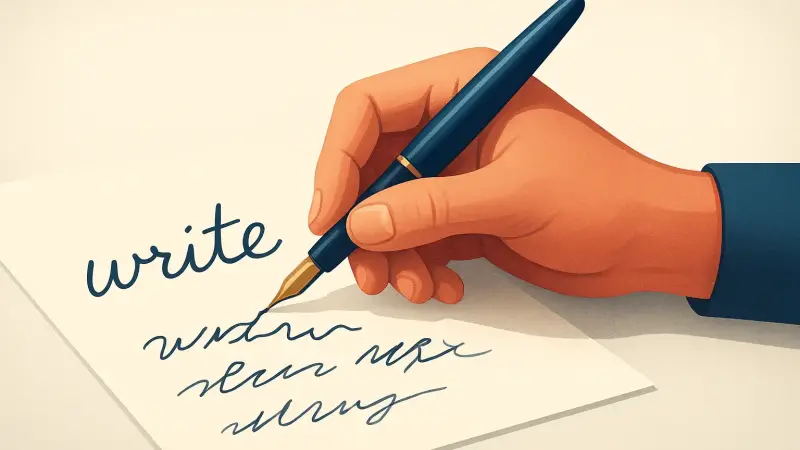
You can watch it happen on something as ordinary as a sticky note in a grocery store, a rushed signature at a UPS counter, or a quick message scrawled on a meeting agenda. The letters get narrower. The loops shrink. Lines tilt. It isn’t a “different you.” It’s your motor system switching modes under time pressure. Handwriting is a chain of tiny planned movements, and speed changes the plan. When the brain is trying to hit the point and get on, it simplifies strokes, leans on habits, and accepts more error. The page records that trade: less planning time, less correction, and more momentum.
Handwriting is a timed motor program, not a drawing
When people write slowly, they tend to build each letter from smaller segments. The hand pauses, the eyes check the shape, and the next stroke gets adjusted. When people write fast, writing acts more like a continuous motor routine. The brain relies on pre-learned patterns for common letter pairs and whole word shapes, because there isn’t time to plan every curve.
This is why “the same” word can look like two different styles depending on pace. The strokes are being generated from a different level of control. It’s closer to playing a memorized chord progression than carefully placing each finger while looking at the fretboard.
Speed pushes your hand toward shortcuts
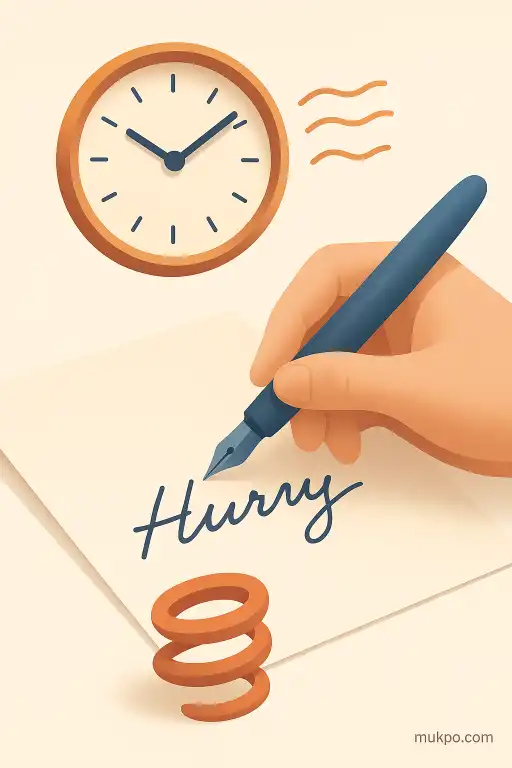
At higher speed, the hand naturally smooths motion. That smoothing often turns corners into curves and turns separate strokes into one connected sweep. You see it in things like m turning into a single hump, e losing its clear opening, or t bars getting dropped or drifting because the hand has already moved on.
A concrete example is filling in a form while someone waits. People often write their address with reduced detail: tighter loops in g and y, compressed spacing, and more joining between letters. It can still be readable to the writer, because the writer already knows the intended word. A stranger only has the marks.
Your brain also has less time to correct mid-stroke
Slow handwriting includes a lot of tiny “course corrections.” The eyes track the pen tip, and the brain tweaks pressure and direction. When you rush, that feedback loop can’t keep up. The correction happens later, if it happens at all. So errors don’t get repaired. They get carried forward into the next letter.
One overlooked detail is pen pressure. Under time pressure, pressure often becomes less consistent: heavier at the start of a word, lighter through the middle, then heavier again when the writer anticipates stopping or dotting an i. That inconsistency changes line thickness and makes the same handwriting look “sharper” or “messier” even if the letter shapes are similar.
Stress and attention change the shape you aim for
Hurrying is rarely just about speed. It usually includes divided attention. Someone is listening to a question, watching a clock, or thinking about the next task. That reduces the attention available for monitoring letterform. The hand defaults to the easiest, most automatic version of a letter, even if that isn’t the version the person uses when they’re calm.
This is also where slant and spacing shift. When attention is narrow, the writing often becomes more right-leaning and more compressed. Not always, and not for everyone, but it’s a common pattern because forward motion is prioritized over careful placement. The baseline can start to drift too, because the writer is tracking the idea more than the line.
The surface and tool matter more when you rush
When writing is slow, people compensate for a bad pen, glossy paper, or a wobbly surface. When writing is fast, those compensations drop away. A ballpoint on a receipt, a felt-tip on a cardboard package, or a pencil on a soft notebook page will each “pull” the strokes differently at speed. The friction changes how much the pen skips, how far the hand overshoots, and how often letters get unintentionally joined.
That’s why a rushed note on a phone book or a label can look more distorted than a rushed note on a familiar desk pad. The hand is moving quickly, but it’s also adapting late to the drag and bounce of the surface. The result is a style shift that looks personal, even though part of it is just physics.
Related reads
- Why a sudden noise can still make your heart jump long after the danger is gone
- Why car tires squeal on hot asphalt from rubber chemistry
- How the Donner Party’s 1846 winter stranded a wagon train and forced unimaginable choices
- How some fungi collapse their caps to launch spores like tiny cannons
- A cafe that serves drinks in jars mailed from other countries
- How a small favor can quickly change someone’s impression of you