
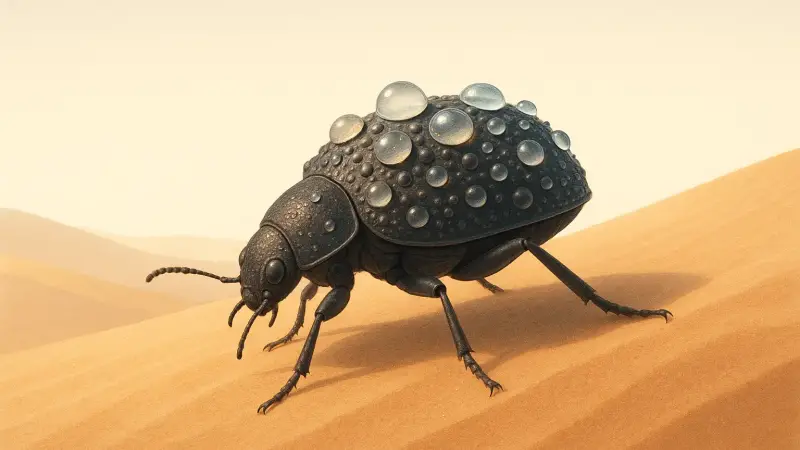
A beetle in a place with almost no water
How does an animal get a drink when there’s no rain to count on? In the Namib Desert in Namibia, some darkling beetles manage it by treating fog like a moving water source. They don’t “find” puddles. They make tiny ones on their own bodies. When moist air rolls in from the Atlantic, droplets form on the beetle’s back, then gather into larger beads, and those beads run forward toward the mouth. It sounds simple, but it depends on a very specific surface: a shell that isn’t smooth, and isn’t uniformly “water-friendly” either.
The bumpy shell isn’t just texture
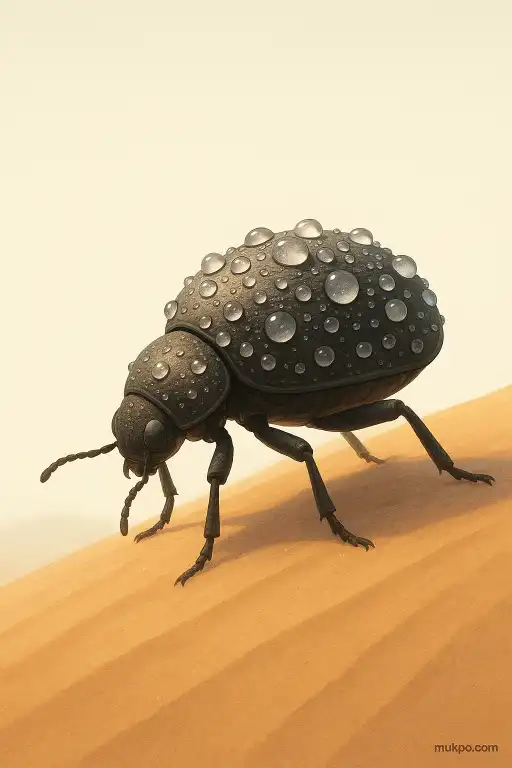
If you look closely at the back of these beetles, the bumps are not random decoration. They create a landscape where water behaves differently from spot to spot. The raised areas can encourage the first tiny droplets to start, while nearby flatter areas can discourage water from spreading out into a thin film. That matters because a film clings and evaporates fast. A bead is heavier, easier to grow, and more likely to move.
A detail people usually overlook is scale. These bumps are small enough that a droplet can “choose” one bump over the next. That lets the beetle’s back act like a droplet nursery. Lots of small droplets appear, then some win and grow as they merge. The roughness also helps the air flow break up near the surface, which can increase the chances that suspended fog droplets touch down instead of sliding past.
Fog becomes a bead, then a moving bead
Fog isn’t one thing. Sometimes it’s dense and low, sometimes it’s thin. The mechanism still relies on the same steps: contact, condensation, coalescence. First, water in the air hits the shell and sticks as tiny droplets. Then those droplets merge into larger ones. When a bead reaches a certain size, gravity starts to beat the surface’s grip, and the bead begins to roll.
The direction of travel is not magic. It comes from posture and shape. When the beetle tilts its body, the “downhill” path points toward the head. A smooth surface would let water slide off too easily, often sideways. A surface that holds too tightly would keep droplets stuck. The bumpy, mixed-wettability setup lands in the usable middle: droplets form readily, then release when they’re big enough to matter.
Timing and behavior matter as much as anatomy
Fog in coastal deserts often arrives at predictable times, like mornings or evenings, but it varies with weather. Beetles don’t passively wait all day. When conditions are right, they can position themselves to intercept more moisture. In the Namib, observers have reported beetles orienting into the wind and raising the body so the back faces the airflow, which increases droplet contact and makes the run-off path more reliable.
The overlooked situational detail here is wind speed. A strong breeze can strip droplets away before they grow, while still air can reduce the rate at which fog droplets collide with the shell. The best harvesting conditions are a narrow window: enough moving fog to feed the surface, but not so much force that droplets get blown off. That’s part of why the behavior shows up only when the air feels “just right.”
Why engineers keep copying this surface
People have tried to copy these shells for water collection in dry regions, because the physics works without pumps or power. The key idea isn’t “make it rough.” It’s to control where droplets begin and where they’re allowed to travel. That usually means combining areas that attract water with areas that repel it, and doing it at small scales so droplets merge into beads instead of spreading out.
It’s also why simple fog nets and “beetle-inspired” panels don’t always perform the same way in every place. Fog droplet size, wind, salt, dust, and surface wear all change the outcome. A panel that works in one coastal desert may clog or lose its water-shedding behavior elsewhere, because the tiny surface differences that guide a bead are also the first things to get dulled, scratched, or coated.
Related reads
- Why people apologize for tiny slip ups even when they aren’t at fault
- How tiny ice crystals sculpt snowflakes in midair
- The elevator that waits for applause before moving up
- Why walking often clears the fog and helps you solve problems
- How peregrine falcons harness mountain winds to reach dive speeds
- Why your handwriting shifts when you write in a hurry