
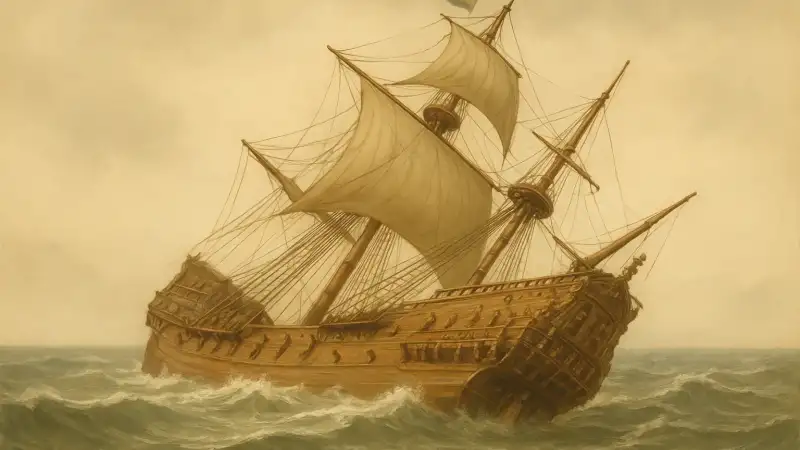
A ship can look perfectly fine at the dock and still be waiting to fall over. That’s the unnerving part of what happened in Stockholm in 1628. The Swedish warship Vasa set off on her first sail, caught a light gust, leaned to port, then leaned again—and didn’t come back. Water poured in through the open lower gunports. Within minutes she was on the bottom, not far from shore. The mechanism wasn’t a storm or enemy fire. It was simple stability. Too much weight high up, not enough righting ability when she heeled, and just enough wind to tip the balance.
What people saw in Stockholm harbor
Vasa didn’t sink out in the open Baltic. She went down in view of crowds, after leaving the quay and sailing only a short distance. Accounts describe her heeling once, recovering a bit, then heeling again more sharply. That second lean mattered because the lower gun deck ports were open for the send-off. As soon as the waterline reached them, the ship effectively made holes in her own side. Seawater rushed in low and fast, and the extra weight of that water made the heel worse.
That detail—open gunports—is easy to miss because it sounds like a small procedural choice. It wasn’t the root cause, but it turned a stability problem into a rapid capsize. A ship can ride out a momentary lean if it stays watertight. Vasa didn’t. The flooding started almost as soon as the deck edge dipped, so there was no time for the normal “she’ll come back up” moment.
A top-heavy design that couldn’t right itself
Warships are supposed to resist heeling. They do that through ballast and hull form. If a ship leans, buoyancy shifts and creates a righting force that pushes it upright. Vasa’s righting ability was too small for the amount of weight carried above. She had tall sides, heavy artillery, and an enormous amount of decorative carving and structure high on the hull. That raises the center of gravity. Once the center of gravity gets too high, the ship can still float, but it doesn’t want to stand back up after it leans.
The problem shows up in a plain way: the ship can feel “stiff” at the dock, then suddenly become unstable past a small angle of heel. Stability isn’t just a yes-or-no property. It changes with angle, with how much water is on deck, with how open the ship is, and with how quickly the wind loads the sails.
Pressure to build bigger, faster, and more heavily armed
Vasa was built as a prestige weapon for Sweden, under King Gustavus Adolphus. The expectations weren’t subtle. She needed to look intimidating and carry heavy firepower. That kind of pressure tends to create a design spiral. More guns mean more weight. More weight encourages a larger hull. A larger hull invites taller sides and more superstructure. And taller structure demands more bracing and ornament, which adds more weight up high again.
Records suggest the specifications shifted during construction, including the planned armament. Exactly which decisions were made when can be unclear from surviving documents, but the overall pattern is familiar in complex builds: changes arrive after framing has begun. At that point, the easiest way to add capability is often to stack it above what’s already there, because the underwater shape and ballast plan are harder to redesign midstream.
Testing hinted at the danger, but it didn’t stop the launch
Before the maiden voyage, there was a simple stability check that should make anyone uneasy: sailors ran from side to side on the deck to see how much the ship rolled. The test reportedly had to be stopped because the motion was too strong and felt unsafe. It’s an overlooked moment because it’s so informal. But it’s also revealing. People on board could feel that the ship didn’t behave like a stable gun platform.
Why continue after that? In a royal project, there isn’t always a clean “no.” Builders, officers, and officials can each assume someone else owns the decision. A ship that is already launched, already armed, and already expected to sail creates its own momentum. Waiting costs money and status. Sailing, even briefly, looks like progress—until the physics takes over.
The exact capsize sequence: heel, water, and a point of no return
The wind that day wasn’t extreme. That’s part of why the sinking is so stark. The sails caught a gust, Vasa heeled, and the righting force wasn’t enough to stop the lean. When she dipped far enough for water to enter the open gunports, the ship’s stability curve effectively collapsed. Flooding adds weight low, but it also removes buoyancy where the ship needs it and creates free-surface effects as water sloshes, making the ship even more tender.
Once that kind of flooding begins, the timeline gets brutally short. Cannons shift, people rush, and the ship’s movement becomes less controlled. The harbor being close didn’t help, because there was no room to bear away, reduce sail slowly, or find a safer angle. It was a public departure with open ports and a ship that couldn’t tolerate much lean, and those conditions lined up in the worst possible way.
Related reads
- When a familiar face suddenly feels unfamiliar and what the brain is doing
- Why your sense of direction blurs in repetitive city blocks
- What household biofilms in drains reveal about microbes and cleaning
- When ancient Rome’s Vestal Virgins faced scandal, trial, and ritual punishment
- Why applause rolls through a crowd in surprising waves
- How desert beetles harvest fog with bumpy shells