
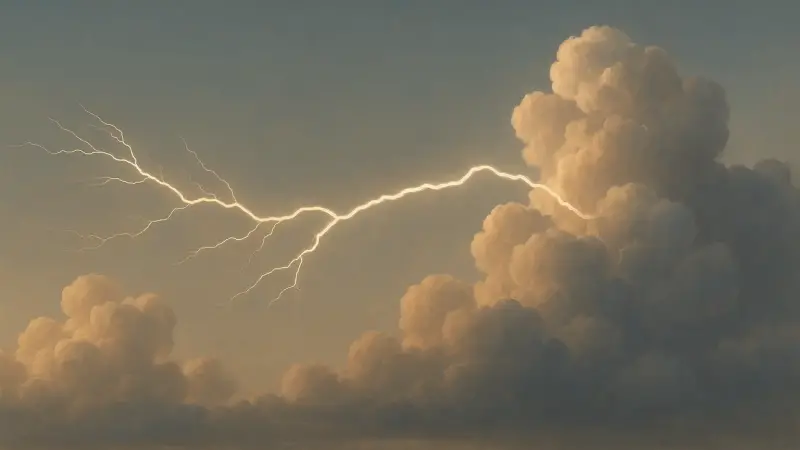
What people mean by “sideways lightning”
You look up at a storm and the flash doesn’t just go down toward the ground. It skates across the top of the cloud, sometimes for a long distance, like a bright seam. This isn’t tied to one famous place or single event. You can see it from Florida thunderstorms, summer storms over the Great Plains, or monsoon storms in northern India. The core mechanism is that a lightning channel will grow wherever the electric field is easiest to break through, and that “easy path” can run horizontally along the cloud’s upper layers instead of straight down.
A detail people often overlook is how high that bright line can be. A lot of it is happening near the anvil top of the storm, close to the tropopause, where the cloud spreads out and the air is colder and thinner than near the ground.
The charge layers inside a thunderstorm
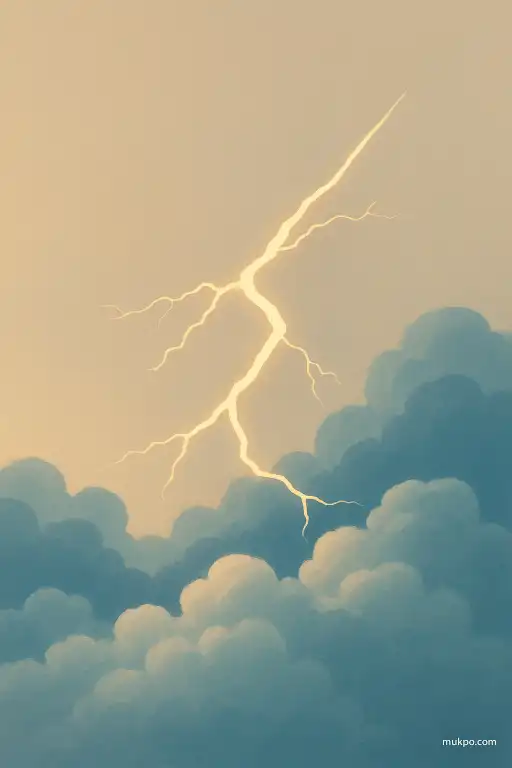
Inside a mature thunderstorm, charge usually separates into broad layers. A common setup is positive charge higher up and negative charge in the middle, with another positive region nearer the base. The exact pattern varies by storm, and it can shift over minutes, but the important point is that the charge is not sitting in one compact lump. It’s spread out across a large, sheared, moving cloud.
That layered structure matters because electric fields build up strongest between regions of opposite charge. If the biggest contrast is arranged across the cloud top—between the upper positive region and the surrounding air or neighboring charge pockets—then a discharge can begin there and keep finding new “steps” sideways rather than diving downward.
How a lightning channel chooses a direction
Lightning doesn’t launch as one clean bolt. It grows in segments. The channel advances through short jumps called leaders, testing the air ahead, branching, then committing where the electric field is strongest. Gravity doesn’t steer it. The field does, along with the local conductivity of the air and what charges are available nearby.
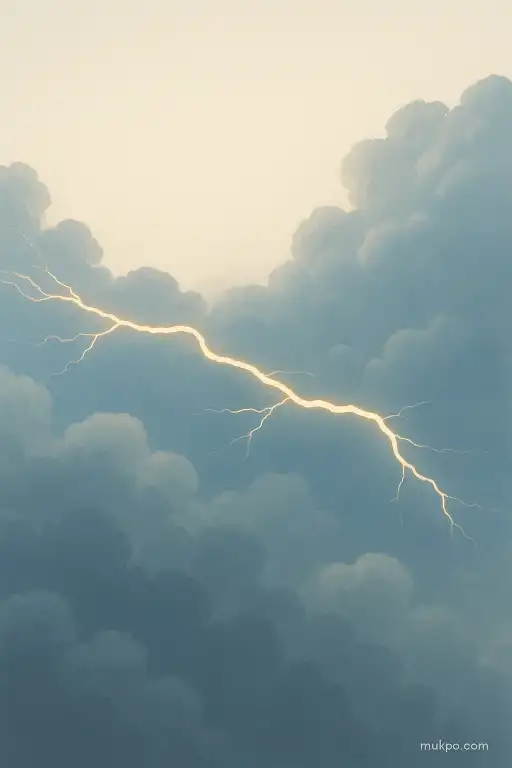
Near cloud tops, the air density is lower, so the breakdown threshold is lower too. That makes it easier for a leader to keep extending through the upper parts of the storm. If the charge region is wide—like the flat, spreading anvil—then the leader has room to run laterally for tens of kilometers, staying inside or just along the edge of the charged cloud rather than punching down toward the ground.
Why cloud tops and anvils are good “runways”
The top of a big thunderstorm is not a smooth dome. It’s a broad, windy platform shaped by strong upper-level winds. That wind shear spreads the ice-rich anvil far from the storm’s core, and it can also spread the upper charge region with it. So the storm ends up with a long, charged layer that’s physically arranged like a shelf.
The other overlooked detail is that the brightest part you see may be the return stroke lighting up an existing channel, not the very first scouting leader. By the time the flash lights up the cloud top, the path may already be laid out sideways through the anvil. The light then diffuses through cloud ice and water droplets, which makes the whole top glow and hides the smaller branches that explain how it got there.
What it connects to when it doesn’t go to the ground
A sideways flash is often an intracloud discharge, meaning it’s connecting charge regions within the storm or between nearby storms. Sometimes it reaches into the clear air above the anvil and keeps propagating because the electric field extends beyond the visible cloud. Whether it stays inside the cloud, skims the top, or jumps to a neighboring cell depends on the charge layout at that moment, which is hard to know from the ground.
That’s why you can watch the same storm behave differently from minute to minute. One flash will drop a cloud-to-ground strike. The next will sprint sideways across the anvil and fade. It’s the same basic process, just following a different set of charge reservoirs that happen to be lined up horizontally at the time.
Related reads
- The library shelf that adds new titles while no one is looking
- A river that briefly flows uphill after the full moon
- The microbe discovered living inside salt crystals and how it survives
- How the Swedish warship Vasa capsized on her maiden voyage in 1628
- When a familiar face suddenly feels unfamiliar and what the brain is doing
- Why your sense of direction blurs in repetitive city blocks