
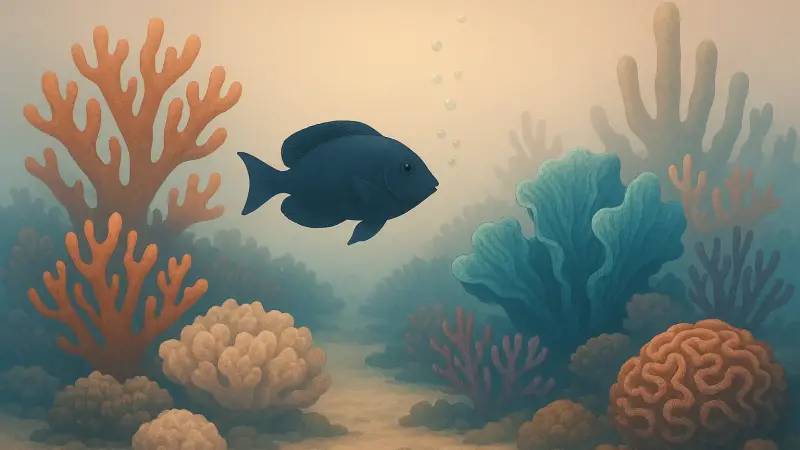
Hearing a reef after dark
People who dive at night sometimes notice it first as an odd background buzz. Not from the boat. Not from their own gear. The water itself seems to have a steady crackle and a shifting chorus. This isn’t tied to one single reef. It shows up around places like the Great Barrier Reef in Australia, the Florida Keys in the US, and reefs across the Caribbean. The core reason is simple: after dusk, the mix of reef animals that are active changes, and so does the sound they make. A reef “hum” is lots of tiny noises piling up at once, plus sound moving well underwater.
What makes the crackle

The most famous contributor is the snapping shrimp. Each snap is a sharp pulse that comes from a fast claw movement that creates a tiny cavitation bubble, which collapses and makes a loud click. A single shrimp is small, but reefs can have huge numbers of them packed into crevices. When many snap at slightly different times, it turns into that constant “frying” sound divers describe. This is one of the overlooked details: the loud part is not the claw hitting something. It’s the bubble collapse, and it’s surprisingly strong for the animal’s size.
Fish add another layer. Some grunt, croak, or drum by vibrating muscles against their swim bladder, and some scrape or crunch when feeding. The exact species driving the nighttime chorus varies by reef and season, and it isn’t always obvious from the surface. On some reefs, dusk is when certain fish get more active and start calling around shelter or territory. On others, the sound shifts later, depending on tides, moonlight, and who is moving where.
Why the timing shifts after dusk
Light changes behavior fast on a reef. Daytime activity favors animals that feed and navigate visually. After dark, different predators and grazers come out, and daytime animals tuck into holes. That swap changes the “sound budget” of the reef. Snapping shrimp keep going around the clock, but other noises can spike when fish leave shelter, when hunting starts, or when groups assemble.
Dusk is also a handover period. You can have day and night species briefly overlapping, which can raise the overall noise level. Some fish calls are linked to courtship or spawning and happen at predictable times of night, but the schedule isn’t universal. It can vary with temperature and local conditions, and in some places it’s still unclear which species are responsible for certain repeating patterns recorded on hydrophones.
How the reef’s shape turns noise into a “hum”
Underwater sound travels differently than in air. It carries farther, and the environment matters a lot. A reef is full of hard surfaces, overhangs, and channels that reflect and scatter sound. That doesn’t create one single note, but it can smooth lots of separate clicks and calls into something that feels continuous at a human scale. In shallow areas, waves and boat traffic can mask parts of it, while calmer nights can make the biological sounds feel louder.
There’s also the simple fact that many reef animals live inside the structure. A shrimp snapping deep in coral rubble may be hidden from sight, but the sound escapes easily. People often overlook how much of reef life is tucked away like that. At night, when visibility drops, hearing becomes a more reliable clue than seeing, so the same background activity can suddenly feel more present.
What the chorus does for reef life
For the animals making the sounds, some are accidental. Crunching and scraping are just feeding. Snaps can be tied to defense and competition for shelter. Other sounds are signals. Fish calls can coordinate mating, warn rivals, or keep groups together when it’s dark. The meaning depends on the species, and even then it can be hard to interpret without watching the behavior at the same time.
For animals listening, reef sound can work like a landmark. Studies in several regions have found that larval fish and other drifting young animals can orient toward reef noise, especially at night when they’re closer to settling. That doesn’t mean sound is the only cue, but it’s one of the few that can travel through murky water over distance. On a quiet night, a reef can be audible well before it’s visible, and that can shape who arrives, who stays, and who finds a place to hide.

Related reads
- Why a whiff can unlock a vivid childhood memory
- Why bread molds faster on a sunny windowsill
- Why an unexpected compliment can make you freeze instead of smile
- Why lightning can leap sideways across cloud tops
- The library shelf that adds new titles while no one is looking
- A river that briefly flows uphill after the full moon