
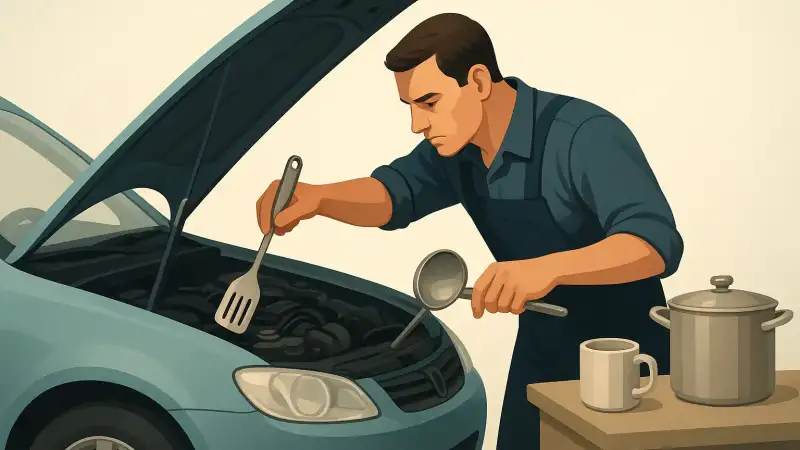
How “kitchen utensil” car repair even happens
You notice it when a tool roll is missing the one thing you expect. No ratchet. No trim remover. Just a drawer that looks like it belongs under a stove. This isn’t one single place or one famous mechanic, and the details vary a lot. But you hear versions of it in different settings: a driveway in rural Australia, a busy street in India, or a parking lot repair in the U.S. The core mechanism is simple. A car problem needs leverage, pressure, scraping, prying, clamping, or scooping. Kitchen utensils are already shaped for those exact forces.
It also happens because modern cars are a mix of delicate plastics and stubborn metal. A “real” tool can be too aggressive, or it can just be unavailable at the moment. A spoon, spatula, or pair of tongs shows up not as a joke, but because it’s close, it’s familiar, and it can apply controlled force without instantly chewing something up.
The jobs utensils can actually do
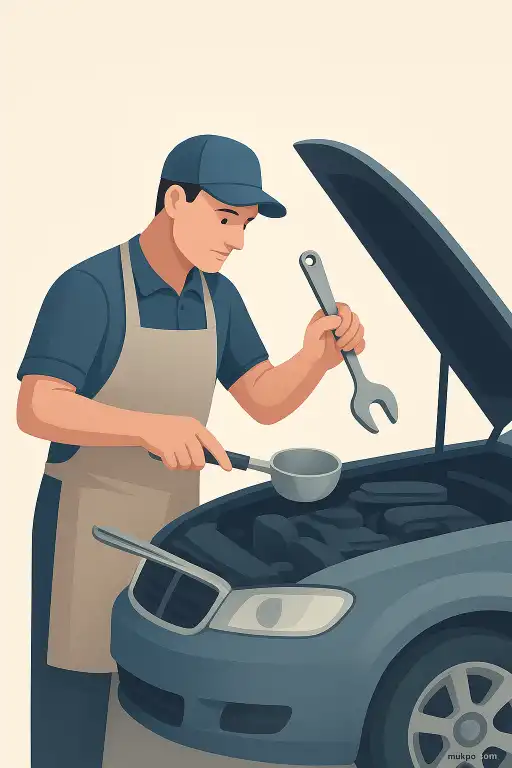
Most of the time, utensils stand in for hand tools that are about shaping force rather than measuring anything. A wooden spoon becomes a soft drift for tapping a stuck plastic clip. A butter knife becomes a light-duty prying blade for a trim edge. A whisk can fish something out of a tight space if there’s enough “spring” to grab it. Tongs can hold a hot hose clamp long enough to move it. None of that requires precision, just a usable shape and the right amount of stiffness.
There’s also the “clean and scrape” category. A plastic spatula can lift old gasket residue without gouging aluminum the way a hard steel scraper might. A teaspoon can scoop grit out of a recess before a sensor goes back in. People overlook how often the real problem is dirt in the wrong place. A little debris on an electrical connector seal can keep it from seating, and then the “repair” is just getting the seal to sit flat again.
A concrete example: the stuck clamp and the soft pry
Picture a common situation: a coolant hose clamp that’s half-buried under an intake tube. The clamp is reachable, but not comfortably. The engine is warm. The person working doesn’t have long pliers on hand. A pair of kitchen tongs can pinch the clamp ears well enough to slide it back. Not perfectly. But enough to move it down the hose, twist the hose loose, and get access. The overlooked detail here is heat transfer. Thin, cheap metal utensils heat up fast, so the grip point can become the hazard, not the engine bay itself.
Or take interior trim. Door panels and dash pieces are held with clips that want steady, broad prying force. A narrow screwdriver concentrates force and can punch a white stress mark into the plastic. A dull butter knife or a stiff plastic spatula spreads the load. It may still break a clip, but it can reduce the odds of cracking the panel surface, which is usually the visible, expensive part.
Why it sometimes works better than the “right” tool
Utensils are designed around hands and food, so they’re often friendlier to soft surfaces. Rounded edges. Wider faces. A little flex. That’s exactly what you want when you’re dealing with vinyl, painted trim, brittle plastic tabs, or aluminum threads that cross easily. A mechanic who reaches for a utensil is often trying to avoid a second problem: a cosmetic mark, a sliced boot, a pinched wire, or a cracked connector housing.
There’s also a “feel” factor. A spoon or wooden handle can transmit small changes in resistance that a long ratchet sometimes masks. When someone is nudging a seal into place or coaxing a hose over a bead, that feedback matters. It’s not precision like a torque wrench. It’s tactile control. People tend to underestimate how much car work is basically controlled persuasion.
Where it falls apart (and why the best stories are the worst cases)
The hard limit is anything that needs known torque, alignment, or repeatable grip. Utensils slip. They bend. They round fasteners. Once a bolt head is damaged, the problem multiplies. Another limit is contamination. A utensil that touched grease, coolant, or brake dust shouldn’t go back into a kitchen. That sounds obvious, but it’s the detail that gets ignored when the repair is happening in a hurry, in a shared space, with whatever is within reach.
The funniest versions tend to be the ones where it barely works. A fork used as an electrical jumper. A ladle used as a funnel. A rolling pin used as a press. Those make good stories because they’re strange. But the quieter, more common reality is smaller: a spatula protecting paint while something gets levered, or a spoon pushing a stubborn grommet into a hole without tearing it.
Related reads
- The coral reef chorus: why reefs hum after dusk
- Why a whiff can unlock a vivid childhood memory
- Why bread molds faster on a sunny windowsill
- Why an unexpected compliment can make you freeze instead of smile
- Why lightning can leap sideways across cloud tops
- The library shelf that adds new titles while no one is looking