

Some years feel like they took forever. Others vanish. There isn’t one single “place” where this happens. People describe it in Tokyo, London, and São Paulo, and the details vary, but the complaint sounds the same: weeks that used to feel separate now smear together. The core mechanism is pretty plain. The brain doesn’t store time like a stopwatch. It builds time out of memories, changes, and attention. When life gets more repetitive and less “first-time,” there are fewer distinctive markers to anchor a day. Looking back later, the calendar may show a full month, but memory offers only a few pegs.
Time is built from memory, not minutes
In the moment, a day can feel slow or busy for lots of reasons. But when people say time is speeding up with age, they usually mean in hindsight. The brain reconstructs the past using what it stored. If it stored many distinct moments, the period looks “long.” If it stored fewer distinct moments, the same period looks “short.” This is why a vacation can feel fast while it’s happening, then look huge when you think back on it.
That hindsight effect is where blurring shows up. You don’t remember “Tuesday” and “Wednesday” as separate files. You remember the few moments that were different, emotional, or important. Everything else gets compressed, because it didn’t create a strong enough memory trace to stand alone.
Routine creates fewer memory “anchors”
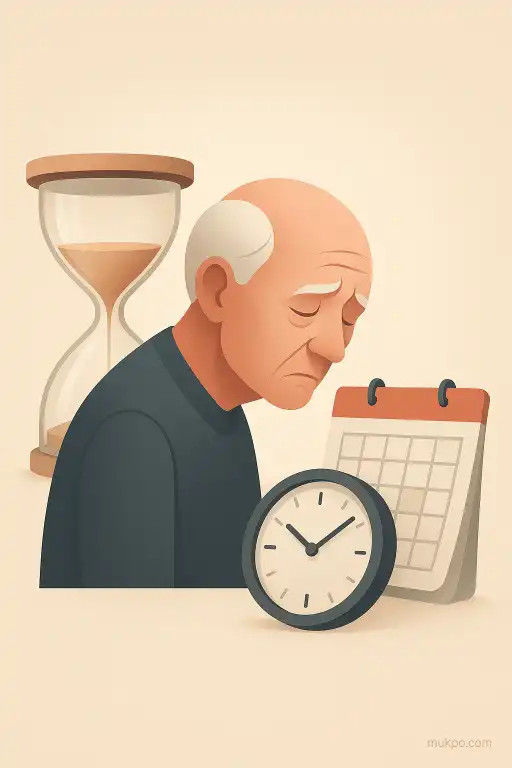
As people get older, daily life often becomes more structured. The commute is familiar. The work patterns repeat. Meals, routes, and conversations become predictable. Predictability is efficient, and the brain likes efficiency. But it also means fewer new cues to separate one day from the next.
A concrete example is the “two-week blur” many people report around ordinary work stretches. Imagine two Mondays that involve the same train platform, the same coffee order, the same meeting room, and the same handful of emails. Later, memory doesn’t have much to grab onto, so both Mondays collapse into a single generic “workday.” It’s not that nothing happened. It’s that nothing happened that marked the day as its own.
Novelty and first-time moments stretch the timeline
Childhood looks long partly because it is full of firsts. New classrooms. New rules. New social worlds. Even boring days can contain unfamiliar details, because everything is still being learned. Adults can still have novelty, but it tends to be less constant, and it’s often confined to narrower areas of life.
One overlooked detail is that novelty doesn’t have to be exciting to be memorable. It can be a tiny disruption: a road closure that forces a different walk, a new colleague sitting in a different spot, a power outage that changes the evening rhythm. When those disruptions don’t happen, days become harder to tell apart later, even if they felt busy while they were occurring.
Attention drops when the brain can predict what’s next
Attention is part of the memory problem. When something is familiar, the brain spends less effort encoding it in detail. A practiced task can be done on “autopilot,” which is useful but sparse in terms of memory. People often notice this when they arrive somewhere and barely remember the drive. The trip wasn’t missing. It just wasn’t encoded richly.
This is also why days with the same kinds of screens, the same apps, and the same indoor lighting can blur. The brain gets fewer sensory changes to tag as “this moment, not that one.” The overlooked piece is often lighting and environment. A day spent under consistent artificial light, in the same room, with similar sounds, offers fewer natural boundaries than a day that moves through different spaces and daylight shifts.
Life structure changes how time gets labeled
Adults rely more on abstract labels: quarter ends, school terms, rent cycles, project milestones. Those labels are practical, but they can erase the texture between them. When a month is mentally stored as “that project month,” the individual days inside it may not be kept as separate items unless something forces separation.
There’s also a social piece. Childhood and early adulthood often come with built-in markers other people reinforce: grades, new years of school, moving out, first jobs. Later, the markers can be fewer or more private, depending on the person and culture. When fewer events get named and retold in conversation, fewer days get rehearsed, and unrehearsed days are easier for memory to compress into a blur.
Related reads
- A mechanic who fixes cars using only kitchen utensils
- The coral reef chorus: why reefs hum after dusk
- Why a whiff can unlock a vivid childhood memory
- Why bread molds faster on a sunny windowsill
- Why an unexpected compliment can make you freeze instead of smile
- Why lightning can leap sideways across cloud tops