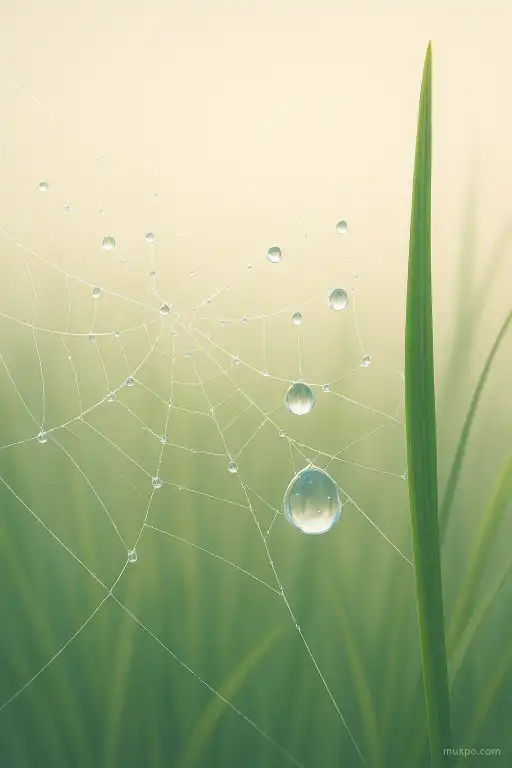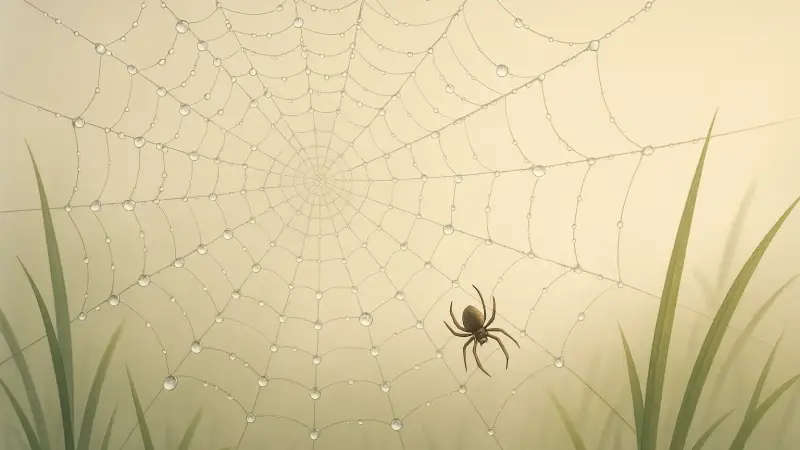
On some cool mornings, a spider web looks like it’s been strung with pearls while the grass around it looks almost dry. It isn’t one single place where this happens. You can spot it in a backyard in Oregon, a garden in England, or a rice field edge in Japan, depending on the night. The basic reason is simple: dew forms where water vapor can condense, and the web offers tiny, high-energy spots that let droplets start and cling. Nearby grass may still be wet, but it spreads water as a thin film you don’t notice, or it dries at a different pace because the leaf is warmer, better ventilated, or shaped to shed.
Condensation needs a place to start
Dew isn’t “falling” onto things. It forms when water vapor in air turns into liquid on a surface that has cooled below the dew point. That cooling is often from radiative heat loss to the night sky. The overlooked detail is that condensation usually needs a starting point, called a nucleation site. A perfectly clean, smooth surface can resist the first tiny droplet because it takes energy to create a curved liquid surface. Give the water even a microscopic edge, crack, dust speck, or chemical patch, and the first droplet becomes much easier to form.
Spider silk is full of “starts.” It’s thin, textured at small scales, and often carries bits of dust, pollen, and airborne particles caught overnight. Many webs also include sticky capture threads coated with glue droplets, and those are already soft, water-attracting gels. So when the air reaches the dew point, the web offers countless little anchors for droplets to begin and stay put.
Silk chemistry makes water cling
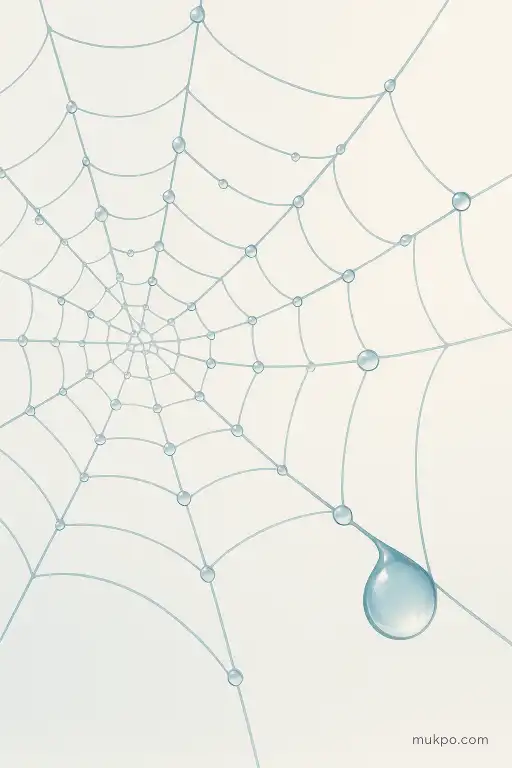
Not all silk behaves the same, but many common web threads have surface chemistry that encourages water to wet and stick. The capture spiral on an orb web, for example, carries a hygroscopic coating in its glue. Hygroscopic means it pulls in water from humid air. That makes those spots excellent at grabbing moisture early, sometimes even before true “dew” is obvious elsewhere. The droplet is then pinned in place by the coating’s stickiness and by tiny variations along the thread.
Even non-sticky silk can show beading because it’s so slender. A thin fiber has a high surface-to-volume ratio, and tiny droplets can wrap around it and stay stable. The result is lots of separated beads rather than one continuous wet layer. That bead pattern is what the eye notices from a distance.
Grass often gets wet in a way you don’t see
Grass blades are wide compared with spider silk, and they’re designed to manage water. Many have waxy cuticles with microstructures that make liquid spread into a thin film or roll off as larger drops. Either way, it can look less dramatic than a row of bright beads on a thread. Grass also sheds water downward. A blade can be wet at the base and dry-looking on the tip, depending on how droplets migrate.
Grass is also tied to the ground, which can be warmer than the air just above it late at night. That small temperature difference matters. If a blade stays even slightly warmer than the dew point, it won’t condense much right then. A web strand suspended in open air can cool quickly and uniformly, especially if it “sees” a lot of clear sky, so it may cross the dew point sooner.
Shape and airflow change who cools first
A web is mostly empty space, and its threads are exposed to moving air. That sounds like it would dry them, but it can also keep feeding them humid air that’s ready to condense if the thread is cold enough. Grass sits in a rough boundary layer near the ground where airflow can be slower and more complex. Humidity and temperature can vary sharply over a few centimeters, especially in a lawn or field where the soil is releasing heat and moisture through the night.
The geometry matters too. A thin strand loses heat by radiation and doesn’t have much thermal mass to resist cooling. A grass blade has more material and may be connected to a plant that’s still exchanging heat with the ground. So the web can end up colder than the blade beside it, even though they’re in the same patch of air.
Why the web looks like it has “more” dew
Part of this is just optics. Dew beads on a thread act like tiny lenses. They flash bright highlights at sunrise or under a streetlight. A thin film on grass doesn’t sparkle the same way, and a larger drop that rolls off a blade may end up hidden at the plant’s base. So the web announces its moisture while the grass can keep it quiet.
There’s also timing. A web can collect droplets quickly and hold them in place, while grass may wet and then drain, or warm a little after first light and evaporate a thin coating before anyone notices. That’s why the “pearl necklace” effect often feels selective, even when the whole yard has been cycling water between air and surfaces all night.