
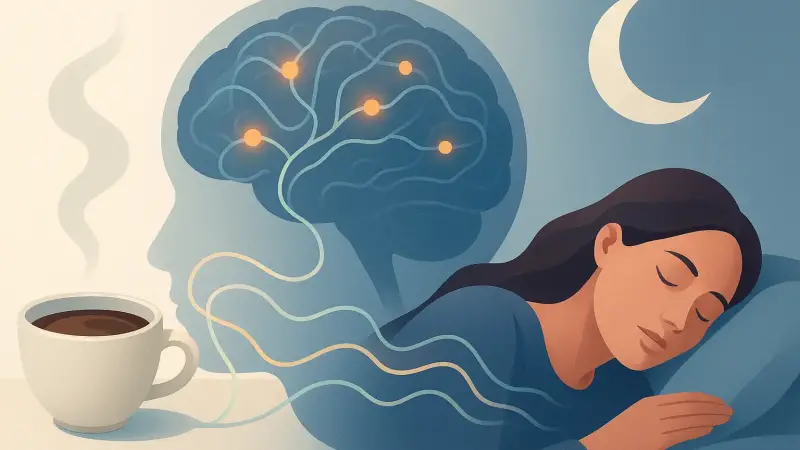
People notice it in a lot of places, not one: a late coffee in New York, an afternoon energy drink in London, a post-dinner espresso in Italy. Sleep still happens, but it shifts. Bedtime feels farther away. The core mechanism is simple enough to say out loud. Caffeine blocks adenosine, the brain’s “pressure to sleep” signal, and that changes the timing of when the body starts acting like it’s night. It’s not only about feeling awake. It can nudge the internal clock itself, so the whole rhythm of the evening gets rearranged.
Bedtime isn’t just a decision
Sleep timing is partly a negotiation between two systems. One is the built-up need for sleep across the day, driven by adenosine rising in the brain. The other is circadian timing, the 24-hour clock coordinated by the brain’s suprachiasmatic nucleus, which takes cues from light and other signals and schedules things like melatonin release and a drop in core body temperature.
Caffeine hits the first system directly. It sits on adenosine receptors (especially A1 and A2A) and blocks adenosine from binding. So the brain doesn’t “hear” the same level of sleep pressure. That means the normal evening slope toward drowsiness can flatten. People often describe it as being tired but unable to fall into sleep.
Blocking adenosine can also move the clock
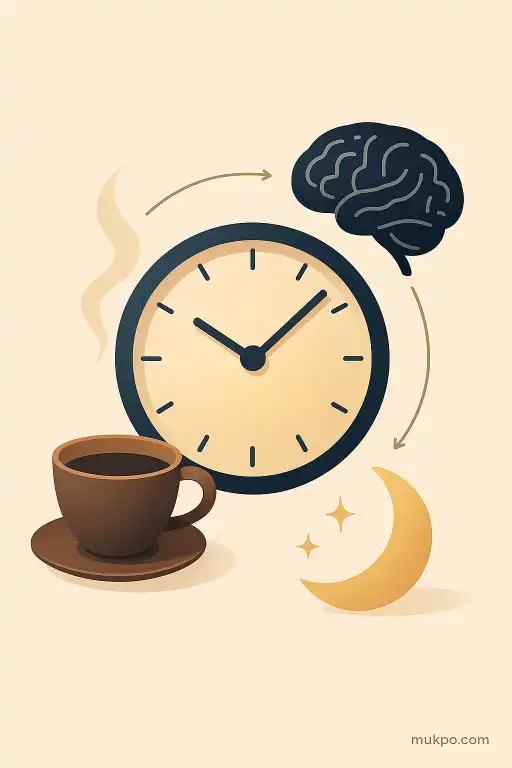
The overlooked detail is that adenosine isn’t only a fatigue signal. It also interacts with circadian biology. Research in humans has found that caffeine taken in the evening can delay the timing of melatonin release, which is one of the body’s clearer “night has started” markers. That delay doesn’t require someone to feel wired. The timing shift can happen even when the person is mostly sitting still in dim light.
This is why bedtime can feel “fine” on the clock but not inside the body. The circadian system has not moved into its usual night mode yet, so sleep onset gets pushed later. And because wake time is often fixed by work or school, the delay can compress the sleep window rather than simply shifting it forward.
Half-life turns one drink into an all-evening effect
Caffeine doesn’t leave the body quickly. Its half-life is often around 3 to 7 hours in adults, and it varies a lot. That range is not trivia. It means the caffeine from a 4 p.m. drink can still be meaningfully active at 10 p.m., and sometimes well past midnight. People tend to focus on the moment they drank it, not the long tail afterward.
Metabolism shifts the story further. Genetics (like differences in CYP1A2 activity), pregnancy, liver function, and some medications can slow clearance. Smoking can speed it up. Even the same person can have different clearance at different times of life. So two people can drink the same amount at the same hour and end up with very different “bedtime biology.”
Sleep architecture changes even when sleep still happens
When caffeine is still active at night, the change is not limited to falling asleep later. Sleep can become lighter. The brain has more micro-awakenings that a person might not remember in the morning. Deep sleep pressure can be altered, and the usual pattern of cycling through stages can look different on a sleep study than it felt subjectively.
This is one reason people can say, honestly, “I fell asleep fast,” and still feel off the next day. The issue is not always sleep onset. It can be fragmentation, less consolidated slow-wave sleep, or a REM pattern that shifts later into the night, when the alarm is more likely to cut it off.
A concrete evening that shows the rewiring
Picture someone who finishes dinner, then goes to a late movie. They buy a large cola around 8:30 p.m. Nothing dramatic happens. They sit in a dark theater, so they assume the “sleep environment” part is handled. But caffeine is now blocking adenosine as it rises through the evening, and it may also be delaying the body’s melatonin timing. The drive to sleep and the clock’s signal for night separate a bit.
The small, usually overlooked detail is the next morning. If they still wake at the same time, the body often responds to the shortened night with stronger daytime sleep pressure. That can make the next day’s caffeine feel more necessary, earlier. Over a few days, bedtime drift can start to look like a personal habit, when it’s partly a pharmacology-and-clock interaction playing out across the calendar.
Related reads
- The wood frog that stops its heart and revives with spring thaw
- Why morning dew beads on spider silk and not on nearby grass
- Why days blur as you get older
- A mechanic who fixes cars using only kitchen utensils
- The coral reef chorus: why reefs hum after dusk
- Why a whiff can unlock a vivid childhood memory