
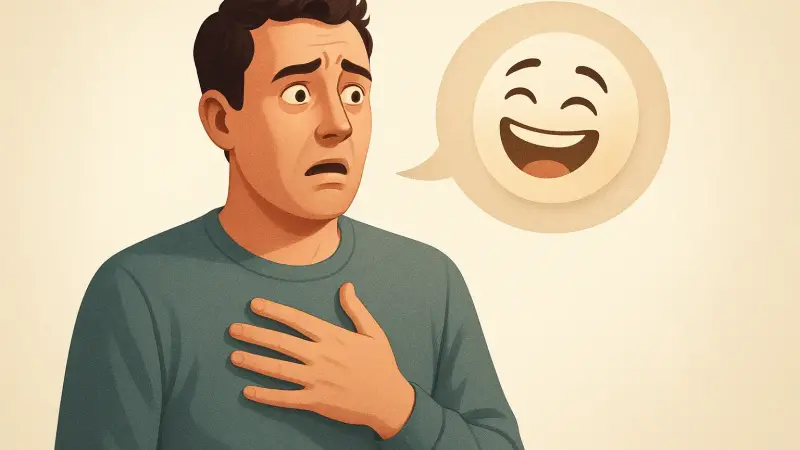
You’re in a meeting, a group chat, or a family dinner and someone throws a joke at you. Not a clever pun in general. A joke about you. Sometimes you laugh right away. Other times you go blank for a beat, like your face forgot what it’s supposed to do. This isn’t one single “thing” that happens in one place. You can see it in a U.S. office meeting, on a U.K. panel show clip, or at a wedding toast in India. The core mechanism is fast social threat detection. Your brain has to decide, very quickly, whether this is play or a small attack.
Jokes are fast social tests
A joke that “lands on you” forces a rapid read of status, intent, and audience. The words matter, but the social context matters more. Is the speaker someone who usually teases everyone? Is this a room where people score points? Is it a moment where you’re already being evaluated, like a presentation or an introduction?
Humor also carries plausible deniability. If you react badly, the speaker can claim it was “just kidding.” That ambiguity makes your brain do extra work. It isn’t only decoding a line. It’s predicting what your reaction will do to your standing with the group.
The freeze response can be the first response
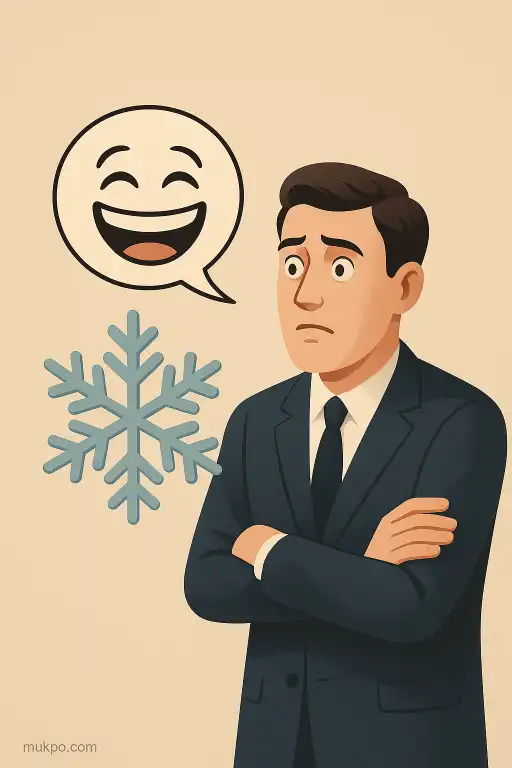
People talk about fight-or-flight, but freeze is part of the same family. When something is uncertain and socially risky, a brief pause can show up before any conscious choice. It can look like a blank stare, a delayed smile, a tight jaw, or a sudden quiet.
That pause can happen because the brain is checking for danger cues while also inhibiting movement and speech. It’s a timing problem. The body is preparing for multiple possibilities at once, and the safest immediate move can be to do nothing until the situation is clearer.
Your brain is trying to classify it: play or aggression
Teasing between friends often has markers that say “this is play.” There’s a familiar tone, a shared history, and a quick repair if it goes too far. When those markers are missing or mixed, the joke becomes harder to classify. A line that would feel fine from one person can feel sharp from another.
A specific detail people overlook is the audience’s posture and attention. If everyone’s eyes snap to you at once, the moment becomes more evaluative. Even without any hostile intent, that collective attention can make your body treat the joke like a small spotlight test: respond correctly, and do it fast.
Working memory gets crowded at the worst moment
Coming up with a smooth reaction uses working memory. You need to hold the words, the subtext, and a possible reply, all while monitoring faces. Stress and social threat narrow that capacity. The result can be a mental “stall,” even for people who are usually quick.
That’s why freezing is common when the joke targets something already loaded: a recent mistake, a sensitive trait, a role you’re insecure about, or a boundary you’ve been unsure how to set. The brain pulls up extra material to evaluate what the joke implies, and the extra evaluation slows the response.
Timing and power change what a joke feels like
The same words can hit differently depending on power. A joke from a boss in a U.S. workplace meeting can create a different kind of freeze than the same joke from a close peer, because the consequences of misreading it are higher. The body reacts to stakes, not just content.
Timing matters too. A joke that lands on you right after you’ve spoken up, made an error, or entered a room can trigger a momentary “scan” for social safety. You can sometimes see it in the micro-delay before a smile reaches the eyes, or in a laugh that arrives a second late because the system that checks for threat finished first.
Related reads
- An old radio that plays broadcasts from distant towns at random
- What happens in your body in the seconds before you speak up
- Why scrolling social feeds makes you feel worn out
- How lichens turn bare rock into the first soil
- The shop window that arranges itself to tell a story at dusk
- How caffeine rewires your bedtime rhythm