

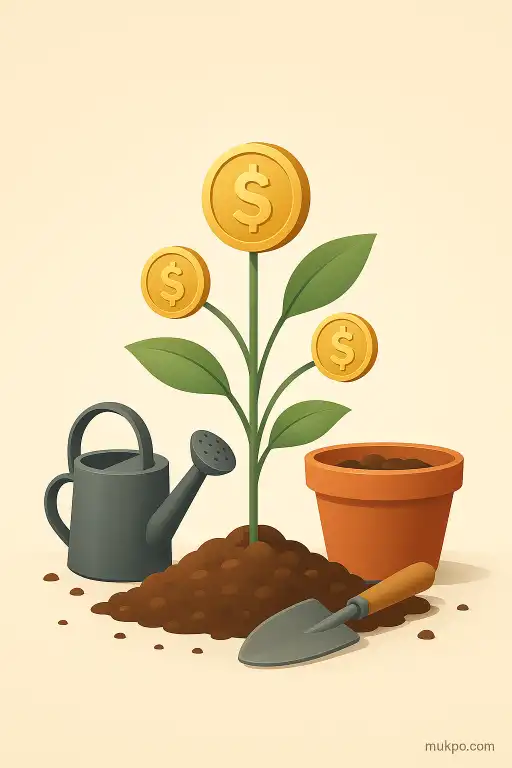
People like to say a garden “prints money” when it’s doing well. But there isn’t one real, documented garden that literally produces coins in spring. What does exist are scattered cases where coins seem to “sprout” at the same time every year because of ordinary ground mechanics. It’s been reported in lots of places with old soil and old foot traffic—English back gardens near former Victorian houses, U.S. yards around nineteenth‑century farm sites, and parts of Central and Eastern Europe where older coins still turn up after thaw. The pattern feels seasonal because the soil changes seasonally, not because the coins are new.
Why coins rise when the ground changes
Coins don’t move like seeds. They get nudged. When soil freezes, water expands and lifts small objects. When it thaws, fine particles settle back down around them, and the heavier object can end up closer to the surface than before. Do that over and over through winter, and a coin that was a few inches deep can slowly work upward.
Even where it doesn’t freeze hard, repeated wetting and drying has a similar effect. Dry soil shrinks and cracks. Water later fills the gaps and carries fine grains downward. The coin isn’t “climbing,” but the dirt around it is rearranging. Spring is when people notice, because the ground is soft, plants are still low, and bare patches are easy to see.
How coins got into the soil in the first place

Most yard coins aren’t ancient treasure. They’re ordinary losses layered over time: pockets emptied on a porch step, kids playing, a dropped coin near a clothesline, a coin tossed into a flowerbed for luck. Older properties accumulate more of these, especially around paths, gates, and places people paused.
There are also deliberate deposits that people forget. Some households hid coins in jars or tins during hard periods, then later moved away or died. When the container rusts or breaks, the contents scatter and look like a natural “crop.” That’s why some finds come up in tight clusters rather than as one-off pennies.
The spring timing is mostly about visibility
A lot of the “every spring” feeling comes from the surface changing, not the coins. Winter strips back ground cover. Spring rain washes soil off small high points and exposes edges of metal. Early gardening also disturbs the top few inches in exactly the places coins tend to be—beds, borders, and the loose soil along paths.
One overlooked detail is how often the first sign is not a shiny disk, but a dark stain. Copper and copper-plated coins can leave a greenish or blackened patch in damp soil. People sometimes spot the discoloration before they spot the coin itself, especially in clay-rich beds that hold water after snowmelt or rain.
Why it clusters in certain corners of a yard
Coins don’t distribute evenly. They concentrate where movement and pauses concentrate. Old walkways, clothesline areas, play spots, and the strip of ground under a gate latch are common. If a garden “sprouts” coins in the same bed every year, it’s often because that bed sits next to a historic route across the property.
Soil type also matters. Sandy soil drains fast and can let objects settle deeper with foot traffic. Heavy clay heaves and cracks more dramatically, which can bring items back toward the surface. A slight slope changes things too. Water moving downhill carries fine sediment away and can leave heavier pieces—like coins—more exposed on the upslope side of a small terrace or border.
What people think they’re seeing when the coins look “new”
Fresh-looking coins can be misleading. Modern coins have hard alloys and protective plating, and soil can act like a gentle abrasive. A coin that spent years underground can come up looking oddly clean after a season of freeze-thaw scouring and spring rain. The opposite happens too: coins can come up almost black, which makes them seem older than they are.
Then there’s the human factor. Once someone expects coins, their eyes start scanning for circles and glints. A few early finds can turn a normal yard into “the money garden” in family lore. And because the ground conditions repeat, the story gets reinforced the next spring when another coin edge shows in the same patch of turned soil.
Related reads
- Why rushing makes tiny problems feel catastrophic
- How leafcutter ants cultivate fungal gardens that never touch sunlight
- The neighbor who returns lost keys with a typed note of thanks
- How photorespiration makes hot days harder for crops
- How backyard compost heaps generate heat and reduce food waste
- Why names disappear mid-conversation