
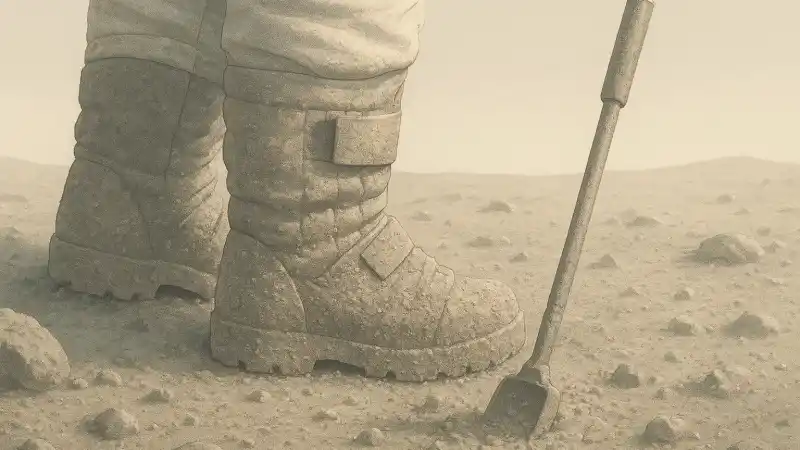
A small problem astronauts couldn’t shake off
On Apollo 17 in 1972, Gene Cernan and Harrison Schmitt kept noticing the same annoying detail: gray dust that stuck to their boots, worked into suit joints, and followed them back into the Lunar Module. It wasn’t one “dust event” in one place. It showed up across Apollo sites like Mare Tranquillitatis (Apollo 11) and the Taurus–Littrow Valley (Apollo 17). The basic reason is simple. Lunar dirt is sharp, extremely dry, and it picks up electric charge. In vacuum there’s no moisture or air layer to soften the contact, so once those grains touch a surface they tend to cling and stay put.
The grains aren’t rounded like beach sand
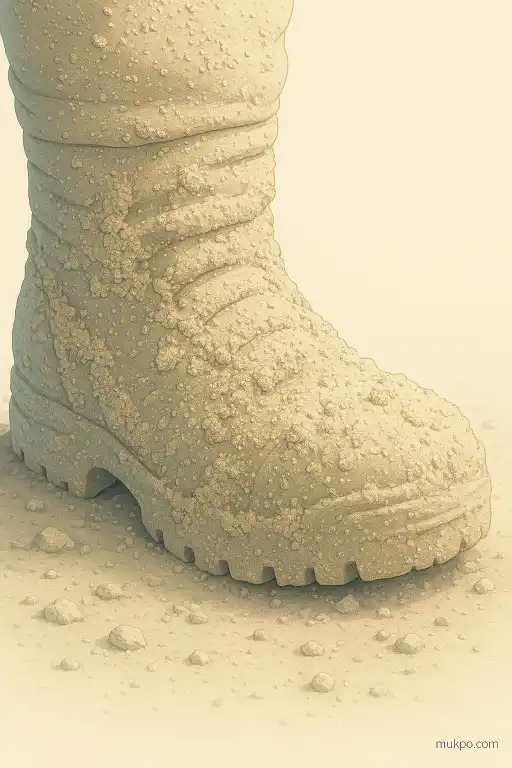
Lunar “dust” is mostly tiny fragments created by billions of years of micrometeorite impacts. There’s no wind or flowing water to tumble those fragments into smooth grains. Under a microscope, many particles look like jagged shards, and the smallest bits can include glassy splinters formed when impacts melt and re-freeze rock. That shape matters. Sharp edges wedge into fabric weaves, hook onto scratches in metal, and mechanically lock in place instead of rolling off.
A detail people usually overlook is that the Moon’s soil isn’t just loose powder. It also contains “agglutinates,” clumps made when impacts weld mineral grains together with glass. Those clumps can break into smaller, angular pieces with fresh, reactive surfaces. Freshly fractured surfaces make stronger contact at the microscopic level, so the dust doesn’t behave like dead, rounded grit. It behaves like tiny broken ceramics.
Vacuum changes how surfaces touch
On Earth, air and humidity interfere with close contact. A thin film of water and adsorbed gases sits on most surfaces, even if they feel dry. On the Moon, vacuum strips that away. When a dust grain presses against a boot or an instrument housing, it can get closer to the surface atoms than it would on Earth. That makes weak molecular attractions (like van der Waals forces) more effective than people expect from “just dust.”
Vacuum also changes how the dust moves. When astronauts step, grains don’t get slowed by air drag. They can bounce and travel in long, low arcs and keep moving until they hit something. That means more impacts per grain, more chances to lodge into seams, and more abrasion. Apollo crews described dust as getting into zippers, bearings, and connector interfaces because it didn’t just fall straight down and stop.
Sunlight and friction give it static charge
Lunar dust also clings because it’s often electrically charged. Sunlight knocks electrons off exposed surfaces through the photoelectric effect. In shadowed areas, surfaces can charge differently due to the surrounding plasma environment. The result is a patchwork of electric potentials across the ground and whatever is sitting on it. Fine grains can pick up charge and then feel electrostatic attraction to nearby materials, especially insulating ones like suit outer layers.
Friction adds another layer. Walking, brushing, and the constant contact between regolith and fabric can create triboelectric charging, like static you get with synthetic clothes, but without humid air to bleed it away. Once charged, the dust doesn’t need “stickiness” in the usual sense. It just gets pulled in and held by electric forces, and the smallest grains respond the most because they weigh so little.
Why it ends up on instruments, not just boots
Boots are the obvious carrier, but instruments create their own dust problems. Anything that warms up in sunlight can set up tiny temperature gradients near the surface, and small grains can be nudged by those gradients. Moving parts and handholds also concentrate contact points, so dust gets ground into specific places rather than spreading evenly. That’s why the dust showed up on camera lenses, tool handles, and seals, not just as a general coating.
Another overlooked detail is the way the dust’s clinginess stacks with its abrasiveness. The same sharpness that makes it stick also makes it act like fine sandpaper once it’s trapped. When astronauts handled equipment repeatedly, the dust wasn’t just sitting there. It was being pressed, smeared, and worked into surfaces. That combination is why crews reported both stubborn dust and increasing wear, even over only a few EVAs.
Related reads
- The island that outlawed high heels to protect marble floors
- How a backyard puddle led scientists to a new species of water mite
- How subterranean rivers hollow out caves through chemical weathering
- Why your mouth moves when you read silently
- A garden that sprouts coins instead of flowers every spring
- Why rushing makes tiny problems feel catastrophic