

Why ice can act like a tiny engine
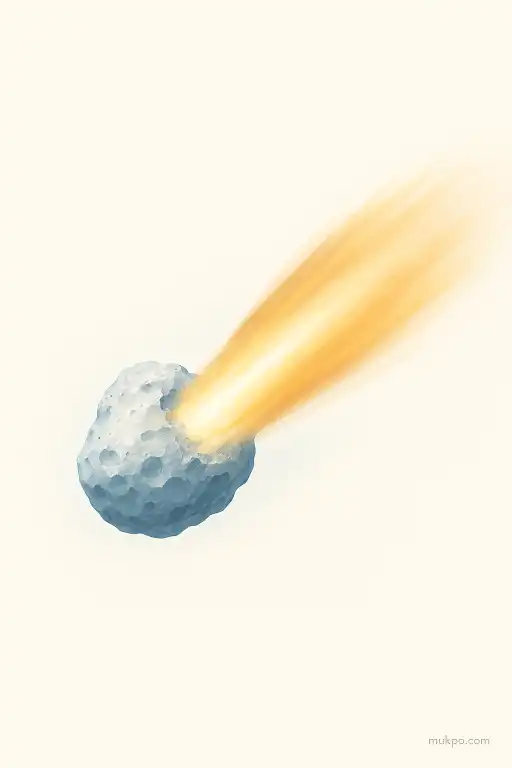
Sunlight feels gentle on skin, so it’s odd to hear that it can make a comet “spray” material into space. There isn’t one single famous jet to point to, but spacecraft have watched them up close at Comet 67P/Churyumov–Gerasimenko (Rosetta), 1P/Halley (Giotto), and 9P/Tempel 1 (Deep Impact). The basic mechanism is simple: solar energy gets absorbed, buried ice warms, and some of it turns directly into gas. That expanding gas finds a way out through weak spots, and it drags dust with it, turning an invisible flow into visible streamers.
What “comet ice” actually is

A comet nucleus isn’t a clean snowball. It’s a mix of water ice, frozen gases like carbon dioxide and carbon monoxide, and a lot of dark dust and organic-rich material. That dark stuff matters because it soaks up sunlight more effectively than bright ice. As the surface heats, the top layer can become a dry, crumbly crust while colder ice survives underneath. The crust can slow gas from escaping evenly, which sets the stage for pressure building in pockets rather than just leaking out everywhere.
One detail people tend to overlook is that water ice isn’t always the first driver. Far from the Sun, water stays too cold to sublimate much, but CO and CO2 can still turn to gas at lower temperatures. That means a comet can already be active while it still looks “too cold” if you’re only thinking about water.
How sunlight gets under the surface
Sunlight doesn’t need to drill deep to matter. It only has to heat the top few centimeters to start a chain reaction. Heat conducts downward slowly, and pores between grains can let vapor move around. If the surface is fluffy and porous, gas can percolate out more gently. If it’s sintered or cemented by re-frozen material, gas has a harder time escaping, so pressure can rise beneath a tougher skin.
The exact balance varies from comet to comet, and even from one patch of ground to the next. Rosetta’s images of 67P showed jets coming from sharp scarps, pits, and fractured terrain, not evenly across the whole sunlit side. That’s a clue that local structure—cracks, voids, and layered material—controls where sunlight’s heat gets turned into focused outflow.
From escaping vapor to a narrow jet
Gas leaving a porous surface doesn’t automatically form a skinny beam. Collimation happens when the flow is guided. A narrow fracture, a pit with steep walls, or a channel under the crust can act like a nozzle. The gas accelerates as it expands into lower pressure above the surface, and it preferentially exits where resistance is lowest. When that flow entrains dust grains—sometimes tiny, sometimes surprisingly chunky—it becomes bright enough to see as a jet against the darkness of space.
Dust is not just decoration. It changes the heating. Dust left behind can form an insulating layer that chokes off activity in one spot while concentrating it somewhere else where the crust is thinner or freshly broken. That’s why jet sources can switch on and off as the comet rotates, and why two nearby areas at the same sunlight angle can behave differently.
Why jets come and go instead of staying steady
A rotating nucleus creates a daily cycle of heating and cooling. The surface warms quickly in sunlight and cools fast in shadow, but deeper layers lag behind. This mismatch can stress brittle crust and widen cracks over time. It can also cause re-condensation at night: vapor that couldn’t escape may freeze again closer to the surface, subtly changing the plumbing for the next rotation. The result is activity that can be episodic rather than smooth.
Geometry matters too. As a comet approaches the Sun, the same sunlight delivers more energy, and previously inactive ices can start sublimating. But the exact moment a given jet appears is often unclear because it depends on local composition, pore sizes, and whether a sealed pocket finally vents. On 67P, Rosetta saw bursts that looked like sudden releases from specific spots, consistent with gas finding a new path through a changing surface.
Related reads
- The morning mind fog that caffeine can’t shake
- Why crowded silence can feel louder than noise
- Why lunar dust clings to boots and instruments
- The island that outlawed high heels to protect marble floors
- How a backyard puddle led scientists to a new species of water mite
- How subterranean rivers hollow out caves through chemical weathering