
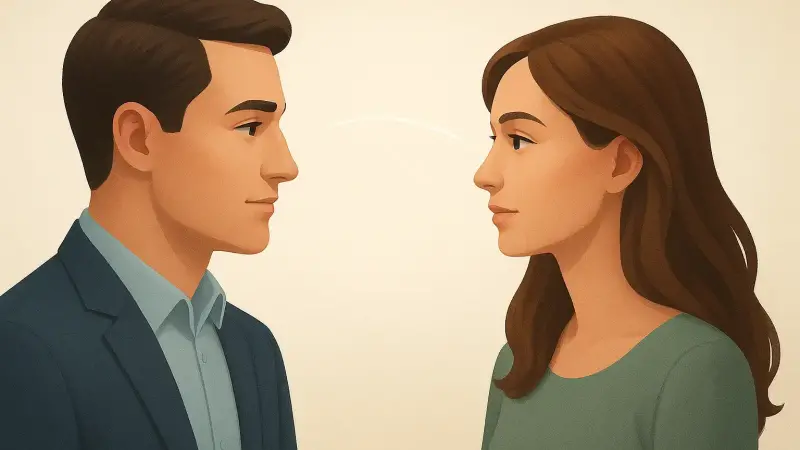
That tiny moment where the room shifts
This isn’t one single place or event. It happens in airports, in school hallways, and in meeting rooms from New York to Tokyo. A conversation is moving along on words, and then there’s a brief lock of eyes—sometimes less than a second. The pace changes. People choose different sentences. They soften, or they sharpen. The core mechanism is simple: eye contact is fast social information. It signals attention, confidence, threat, warmth, and status all at once, before anyone has time to explain themselves.
Eye contact is a signal, not just looking
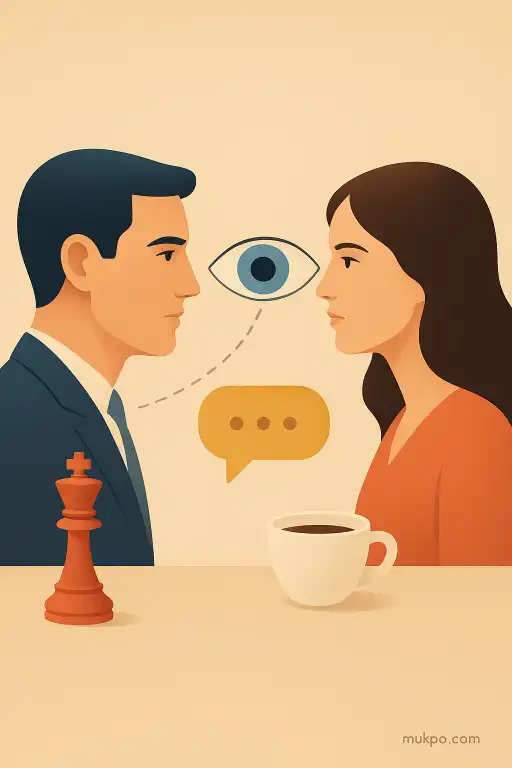
People often treat eye contact like it’s “polite” or “rude,” but in real conversations it behaves more like a traffic signal. It can invite someone to continue, or it can close a door. A single glance can say, “I’m tracking you,” which raises the stakes. Even without any change in tone, that stakes-raising effect can make someone more careful with details, more defensive, or more honest. It can also make someone feel exposed. That feeling shows up quickly because faces are one of the brain’s highest-priority categories.
One overlooked detail is timing: people don’t hold eye contact evenly. They often look away while they’re thinking, then reconnect right before a key phrase. That quick reconnection can make the phrase land as a commitment. It can also make it sound like a challenge, depending on what came before.
Micro-moments that change what gets said
Picture a small, concrete scene: two coworkers in a hallway after a meeting. One says, “We can revisit that later.” If the other person meets their eyes at exactly that moment, the sentence can stop sounding like a brush-off and start sounding like a promise that will be checked. The speaker may add specifics without planning to: “Later today” or “after lunch.” If there’s no eye contact, the same words can stay vague and float away.
The reverse happens too. A brief glance can shut down extra information. If someone asks a sensitive question and gets immediate direct eye contact, the person answering might shorten their response. Not because they’re lying, but because the attention feels intense. People often shift to safer wording when they feel closely watched.
Culture and context change the meaning
The same look can mean different things in different settings. In some workplaces in the United States, steady eye contact is treated as engagement. In parts of Japan, longer direct eye contact can read as intrusive or confrontational, especially across status differences. In many places, context matters as much as culture: a crowded subway, a doctor’s office, a job interview, or a tense family dinner all set different expectations for how long a glance should last.
That’s why a single glance can change a conversation even when nobody intends it to. Two people can interpret the same moment differently. One person experiences it as respect. The other experiences it as pressure. The words that follow get shaped by that mismatch.
Why it changes the body, not just the mood
Eye contact can trigger a quick physiological response. Heart rate can shift. Breathing can get shallower. The body treats direct gaze as socially important, sometimes as a mild threat, sometimes as connection. That can change how quickly someone speaks, how long they pause, and whether they fill silence. In a negotiation, that can make a person volunteer a justification. In a personal talk, it can make them skip a detail they were about to share.
Another often-missed detail is blinking. During moments of high attention, people can blink less. That tiny change can make a look feel “hard” or “intense” even if the person isn’t trying to project anything. The other person reacts to that intensity, and the conversation takes a different turn.
When a glance becomes a decision point
Conversations have forks where someone decides whether to press, retreat, joke, or get serious. A single glance often lands right on those forks. If someone looks up and catches eyes right before saying a name, an apology, or a number, it can feel binding. If someone looks away right before answering, it can feel like hesitation even when they’re simply searching memory. The listener adjusts immediately. They ask follow-ups, or they let it pass.
That’s why people sometimes leave a talk remembering one moment more than the rest. Not a sentence. Not a fact. Just that brief point where eyes met and the next words came out differently.
Related reads
- The bar where tips were paid in rare sea glass found at low tide
- Why a stranger’s smile makes you lower your guard
- How sperm whale clicks sketch the seafloor
- How hammerhead sharks use a wide head to scan for prey
- How comet ice turns sunlight into streaming jets
- The morning mind fog that caffeine can’t shake