
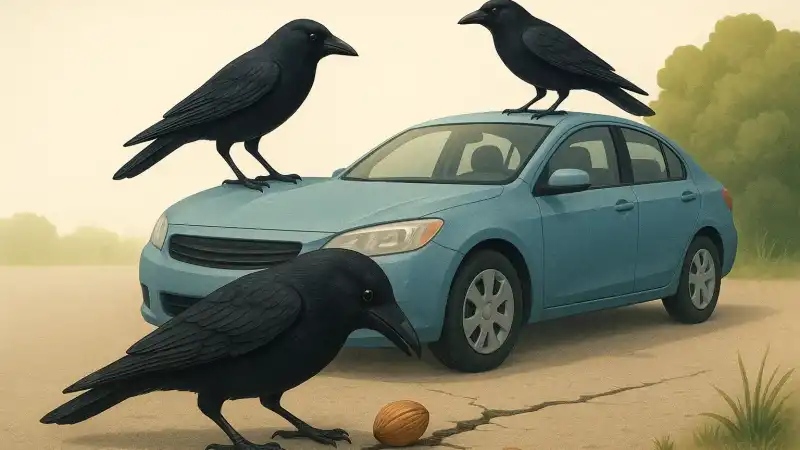
At some intersections, you can watch a crow do something that looks almost like planning. This isn’t one famous “crow town,” either. People report it in places like Japan, parts of coastal California, and cities in British Columbia. A crow drops a hard nut onto the road, then waits. A car rolls over it and cracks the shell. After the traffic pauses, the crow walks back out and picks up the pieces. The basic mechanism is simple: the bird uses the weight of a passing tire as a tool it doesn’t have to carry.
What the crow is trying to solve
Many nuts are protected by shells that are tough in a very specific way. You can peck at them for a long time and still not get a clean break. Dropping them from a height helps, but it’s unreliable. A walnut might bounce. It might land on soil. Or it might crack in the wrong place and still be hard to open.
Cars provide something gravity drops don’t: predictable force on a hard surface. A tire compresses the nut against asphalt and creates a sharp, crushing stress that the shell can’t absorb. The crow isn’t “using the car” like a partner. It’s using a repeated event in the environment that delivers the same kind of impact over and over.
The basic sequence people see
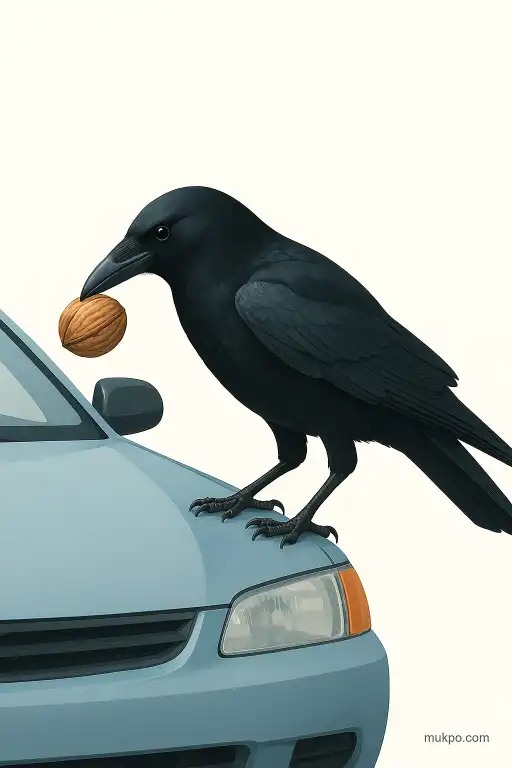
The common pattern is drop, wait, retrieve. A crow carries a nut to a roadway, releases it, and moves back to a safe spot. After one or more cars pass, the bird returns to check the result. If the shell didn’t crack, it may pick the nut up and drop it again. If the shell did crack, it starts pulling out the edible part or carries pieces away.
Where the nut is placed matters. Observers often notice crows choosing spots where cars slow down or stop, like near stop lines and crosswalks. It reduces the risk of the nut being thrown far away by fast tires. It also creates a clearer “gap” for the crow to walk in and collect food without darting between moving wheels.
Traffic lights make it easier
Intersections with signals change the whole problem. The crow doesn’t need to guess when a car will come. It can watch the flow. When cars are moving, it stays back. When the light changes and the lane stops, the crow can step out more calmly and inspect the nut. That timing can look almost deliberate from the sidewalk.
A specific detail people overlook is how much “waiting” is part of the behavior. The impressive part isn’t the drop. It’s the restraint. A crow may stand on the curb with a cracked nut in view and not rush for it until the lane is fully stopped or clear. From a distance, it can look like the bird is just hanging around. Up close, it’s often watching car speed and wheel path.
Why it works better than other tricks
Crows already use hard surfaces as anvils. They also cache food and return later. Using a road combines both tendencies with an outside force. The bird doesn’t have to hammer the shell itself. It also doesn’t have to risk repeated close contact with a nut that might roll away every time it’s struck.
It’s not foolproof. Nuts can be smashed into messy fragments, or scattered across lanes. Sometimes a tire doesn’t hit the nut at all. And sometimes the cracked pieces are exposed long enough for another crow to grab them first. The method is a trade: less physical effort, more dependence on timing and luck.
What it suggests about crow learning
This behavior likely spreads because it’s visible. A crow can watch another crow succeed and copy parts of the sequence without needing to “understand cars” in any human way. Young birds also spend a lot of time observing adults and experimenting with objects. Roads are full of both: hard surfaces, repeated patterns, and lots of chances to try again.
Exactly how much is individual invention versus local tradition varies and is hard to pin down from casual observation. But you can sometimes see the difference between a bird that has the timing down and one that doesn’t. One will drop a nut, retreat to the curb, and wait through several moving cars. Another will hop forward too soon, spook back, then circle as if it’s still working out what part of the scene matters.
Related reads
- How a 14th-century Florentine guild staged a mock funeral to settle a trade dispute
- How gut microbes extract energy from fiber
- Why you blush before you speak even when no one heard you
- Why insults stick in memory but compliments fade
- How a single glance of eye contact can change a conversation
- The bar where tips were paid in rare sea glass found at low tide