
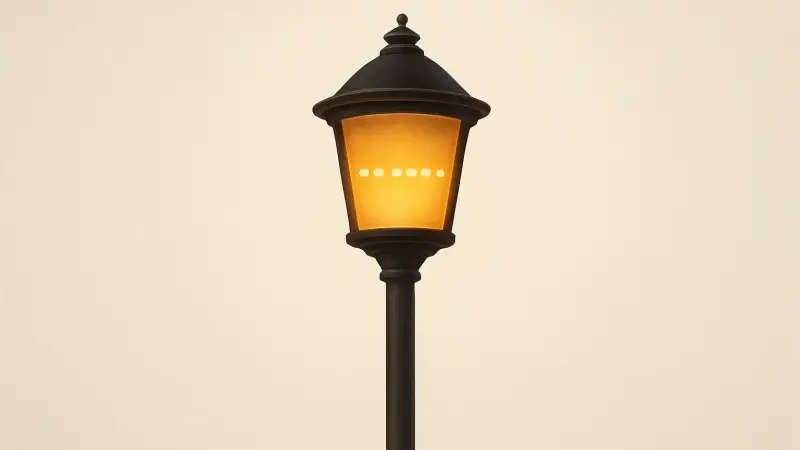
You’re waiting at a crosswalk and the streetlight across the road keeps winking. Not randomly. Long, short, short. Then a pause. Then another cluster. People start saying it’s Morse code, and that it’s been doing it “for decades.” This isn’t one single famous light in one single town. Stories like this pop up in different places, and they’re usually hard to pin to one verified address. A common modern version involves LED streetlights installed in the 2000s and 2010s, where the “blinks” are sharp and repeatable. The odd part is how steady the pattern can look when you’re standing still and watching.
Why it can look like intentional Morse
Morse is just timed pulses. Streetlights already run on timed pulses internally, even when they look steady. Many LED fixtures don’t smoothly dim the way an old incandescent bulb did. They switch on and off fast using a driver circuit. That technique is called pulse-width modulation, and it’s everywhere in modern lighting.
If the switching frequency is high, your eye can’t see it. But you can still “see” it under certain conditions. Quick glances. Eye movement. A phone camera with a rolling shutter. Or reflections off moving surfaces. The light can seem to form clean dots and dashes when it’s really a repeating electronic rhythm that your perception samples unevenly.
The decade-long part is often a repeatable fault

A streetlight that seems to blink in the same pattern for years usually isn’t sending a message. It’s behaving the same way because the underlying fault is stable. LED drivers can fail in ways that don’t kill the light outright. A degrading capacitor, a cracked solder joint, or thermal stress can create a regular stutter: on for a bit, off for a bit, repeat.
Utilities also add control gear that can introduce periodic behavior. Photocells, timers, and networked nodes used for dimming and monitoring can misread conditions or fall into a loop. If the light is on a system that ramps output at set times, a glitch can make that ramp look like deliberate pulses. It’s the same sequence because it’s the same piece of hardware doing the same wrong thing every night.
How cameras turn flicker into “code”
A detail people usually overlook is that they often “confirm” the Morse by filming it. That can backfire. Most phone cameras use a rolling shutter, meaning each line of the image is captured at a slightly different time. If the light output is flickering, the camera can convert that into visible banding and apparent on/off pulses that look more structured than what your eyes saw.
There’s also a mismatch between electrical mains frequency and the driver’s switching. In regions with 50 Hz or 60 Hz power, some lighting electronics end up with beat patterns. Those beats can produce a repeating envelope—brighter, dimmer, brighter—on a timescale that feels like human signaling. It’s not that the lamp is “speaking.” It’s that two clocks are drifting against each other in a predictable way.
Why observers agree on the same letters
If a blink pattern is even vaguely regular, people tend to parse it into letters. Morse has lots of short combinations that feel easy to spot. SOS is the classic because it’s symmetrical and memorable. People also expect the light to “say” something relevant, like HELP or HI, so they unconsciously choose cut points between letters that make a word.
The pauses matter as much as the flashes. Real Morse has timing rules: the gap between dots and dashes, the gap between letters, the gap between words. A streetlight with an electrical stutter rarely matches those gaps cleanly. But from across a street, with traffic and head turns and a few missed blinks, the brain fills in the spacing and turns a repeating fault into language.
What you’d expect if it were actually deliberate
A deliberate signal would need a deliberate controller. Streetlights aren’t normally built to modulate output at slow, human-readable rates. They’re designed for constant illumination, maybe with scheduled dimming. To “send” Morse, someone would have to rewire the control side, add a flasher, or hack a smart node, and keep it running without being replaced during routine maintenance.
That last point is the practical snag in the “decades” claim. Fixtures get swapped. Poles get rewired. Entire neighborhoods get upgraded. So when a story says a light has blinked the same message for decades, it’s often unclear whether it’s the same hardware, the same exact spot, or just the same kind of flicker that people keep noticing and retelling whenever a lamp in that area starts to fail in a familiar way.
Related reads
- Why singing sand dunes howl when wind sweeps them
- The tiny fossil pollen that rewrote a desert’s past
- Why a brief compliment can lift your mood for days
- How crows use cars to crack nuts
- How a 14th-century Florentine guild staged a mock funeral to settle a trade dispute
- How gut microbes extract energy from fiber