

At a work event, someone walks up and says hi like you’ve met before. The face clicks fast. The name doesn’t. This isn’t one single place or moment; it happens in a London office, a Chicago elevator, or a Tokyo conference hall. The core reason is simple: a face comes with built-in structure your brain is already trained to read, but a name is a thin, arbitrary label that has to be pulled from memory by the right cue. One awkward detail people overlook is that a name can be “known” and still fail to show up on demand, because the link between the person and the word is fragile.
Faces arrive with meaning built in
Faces are dense with information. Even when someone is silent and standing still, there are stable patterns: the spacing of eyes, the shape of the jaw, skin texture, how the mouth sits at rest. That visual pattern is something the brain can match against stored patterns quickly, often without needing extra context. It’s recognition, not retrieval.
Names don’t work like that. “Maya,” “Chris,” or “Pat” don’t contain clues about the person’s face, age, or role. They point outward to a specific individual only because a link was formed at some moment. Without a strong cue, the sound of the name has nothing to grab onto, so it doesn’t get pulled up as reliably as a face does.
A name is a label, and labels are easy to misplace
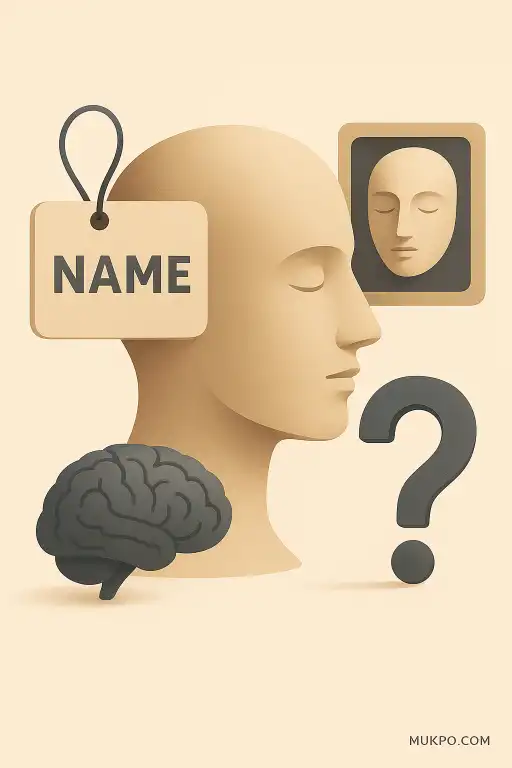
Most of the time, a face is learned alongside context. Where you met, what the person was wearing, the mood of the interaction, the setting. That web of details gives multiple paths back to recognition. A name is often learned in a much thinner way. It might be heard once over background noise, or read quickly on a badge, then immediately replaced by the next introduction.
There’s also a special kind of failure that feels personal but isn’t: the name sits “on the tip of the tongue.” The person can produce facts—where the coworker sits, what project they’re on, who they usually have lunch with—yet the exact word won’t come. That pattern fits how labels behave in memory. The knowledge is there, but the precise sound sequence is blocked.
Recognition is easier than recall
Seeing a face is like being handed the answer choices. The face itself is the cue, and the mind only has to decide whether it matches something stored. Names demand a different operation. They often require recall: producing the word with no partial list to choose from, just an expectation that the right syllables will appear.
This difference shows up in everyday moments. Someone might hear “Is that Daniel?” and suddenly the name becomes obvious. A single hint converts recall into recognition, because the brain can now check a candidate label against what it already knows. Without that candidate, the search space is huge, especially for common names that are shared by many people in memory.
Names compete with each other more than faces do
Faces are usually unique enough to stand apart. Names are reused constantly, and that creates interference. If there are three Alexes in the same workplace, the label “Alex” doesn’t reliably point to one person. Even if the face is clear, the brain has to pick the right link among several similar links, and the wrong one can pop up first.
People also store names in a more “sound-based” form than they realize. That means names that share first letters, rhythm, or common endings can collide. It’s why someone might blurt “Megan—no, Morgan” while fully recognizing the person. The face is stable. The verbal system is juggling near-neighbors.
Social context changes what gets encoded
Introductions often happen while attention is split. Hands shake. Small talk starts. The room is loud. A person’s face is right there, moving, expressive, and emotionally relevant. The name may be a quick sound at the start, then gone. If the name isn’t rehearsed or used immediately, it can be encoded as a faint detail compared with the vivid visual stream.
That’s why the failure feels lopsided. The observer can track the person across the room and know they’ve met, sometimes even remember the exact conversation, yet still stall on the label. It’s not a lack of respect. It’s a mismatch between a system built for rich patterns and a system that has to fetch a short, arbitrary word at the exact moment it’s needed.
Related reads
- The Paris baker whose 1817 substitution sparked a week of bread riots
- A streetlight that has blinked in perfect Morse for decades
- Why singing sand dunes howl when wind sweeps them
- The tiny fossil pollen that rewrote a desert’s past
- Why a brief compliment can lift your mood for days
- How crows use cars to crack nuts