
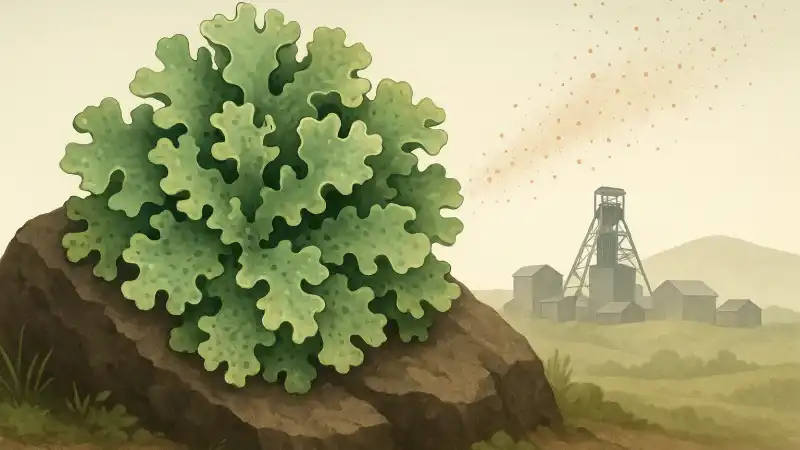
A patch on a wall that acts like a filter
If you walk past an old brick wall near a mine, you might see pale crusts or leafy gray-green patches clinging to the mortar. In places like Sudbury, Ontario, those patches are often lichens. They don’t have roots, and they don’t “drink” from soil. They mostly take what the air gives them. That’s the trick. When dust from blasting, hauling, or smelting carries metals like nickel, copper, lead, or zinc, lichen surfaces can trap those particles and pull some metal ions into the tissue as they rehydrate after rain or fog. It looks passive, but it’s a kind of steady, everyday collecting.
How metal gets into lichen without the lichen “eating” anything
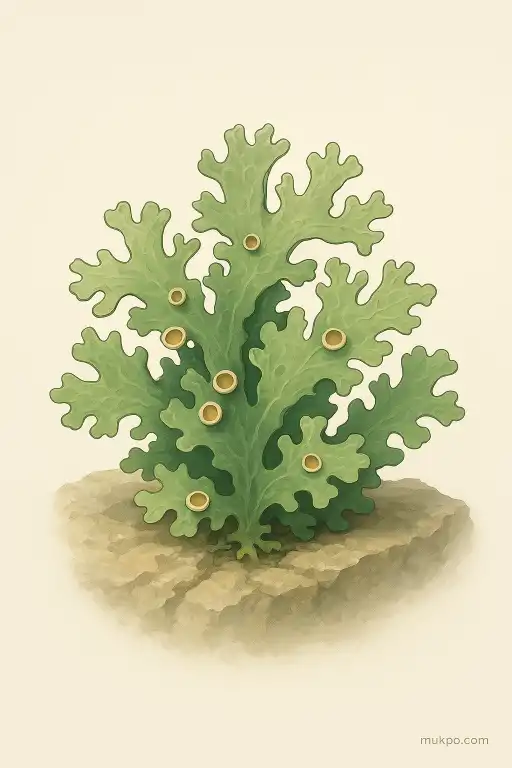
Lichens are a partnership: a fungus builds the structure, and an alga or cyanobacterium makes sugars. Neither partner has a cuticle like a plant leaf. Water and dissolved ions move straight across the outer layers. When airborne dust lands, some of it sticks to the rough surface and gets held there by polysaccharides and tiny crevices. When the lichen wets up, a thin film of water forms and starts dissolving the most reactive bits of that dust. Metal ions can swap onto binding sites in the cell walls, especially where negatively charged groups are available.
People often overlook a simple detail: lichens spend a lot of time dry. That sounds like it would slow everything down, but it can concentrate contamination. Each wetting event is short. The lichen grabs what is available, then dries again with particles still stuck to the surface. Over months and years, the same thallus can build a record of what has been floating in the air around it.
What mining-town air looks like at lichen scale
Mining and ore processing don’t release metals as neat “metal vapor” most of the time. A lot travels as fine dust: bits of ore, tailings, road dust from truck traffic, and particles from stacks where sulfur and metal-bearing aerosols can form. Which metal shows up depends on local geology and what is being processed, so it varies. Near a copper operation, copper and arsenic may be prominent. Near a lead-zinc mine or smelter, lead, zinc, and cadmium can be more noticeable. Lichens don’t choose which one to take. They accumulate whatever lands and dissolves.
That’s why the “same” lichen species can look chemically different block to block. A patch on a tree facing a haul road may load up with coarse grit. A patch tucked behind a building can collect finer particles that stay airborne longer. Even the height matters. Dust that settles quickly may dominate near ground level, while smaller particles can reach rooftops and higher trunks.
Why some lichens survive where others disappear
Heavy metal exposure can damage photosynthesis and disrupt enzymes, so sensitive species drop out first. What remains tends to be species that tolerate drying, acidity, and metal stress. Tolerance can come from several routes: binding metals in the outer layers so they don’t reach sensitive cells, producing compounds that chelate metals, or parking metals in forms that are less reactive. The fungus side does a lot of the physical shielding, while the photosynthetic partner often determines how quickly the lichen shows stress because it handles light and carbon fixation.
There’s also a simple ecological filter: lichens grow slowly. After a big pollution pulse, the surface may be bare for a while. The species that recolonize are the ones whose spores or fragments arrive first and can handle the conditions. In historically polluted regions, that can make lichen communities look “simpler” even after emissions drop, because recovery is measured in decades, not seasons.
How scientists use them as living monitors
Because lichens integrate deposition over time, they’ve been used for biomonitoring in mining and industrial regions across several countries rather than one single famous town. Studies in places such as Sudbury (Canada), the Copper Basin in Tennessee (United States), and parts of northern Europe near smelters have used lichen chemistry to map where metal fallout is heavier. Sometimes researchers sample native lichens already growing on bark or rock. Other times they transplant clean material into an area and retrieve it later, so the “exposure clock” is clearer.
A practical complication is that measurements can mix two things: metal stuck to the outside as dust, and metal absorbed into the tissue. Labs may wash samples or analyze both washed and unwashed portions to separate those effects, but methods differ. That’s why numbers from different studies are not always directly comparable, even when the same metal and the same lichen genus are involved.
Related reads
- How mantis shrimp detect polarized light
- Why names are harder to recall than faces
- The Paris baker whose 1817 substitution sparked a week of bread riots
- A streetlight that has blinked in perfect Morse for decades
- Why singing sand dunes howl when wind sweeps them
- The tiny fossil pollen that rewrote a desert’s past