
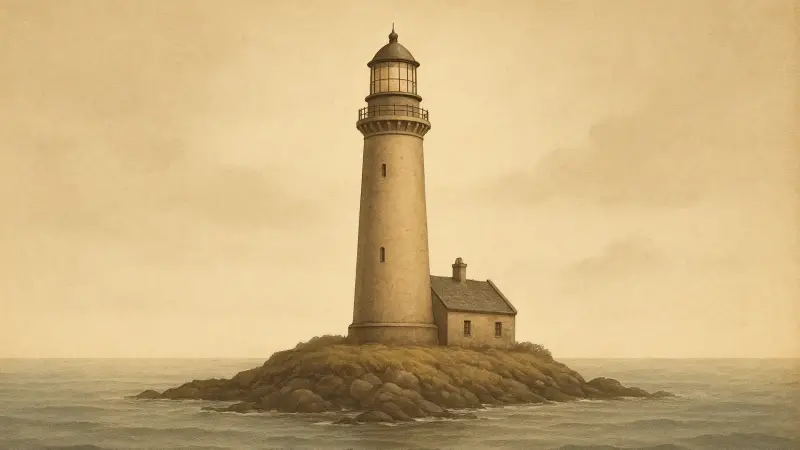
People picture lighthouses as simple places: a lamp, a logbook, a steady routine. The Flannan Isles case from 1900 breaks that expectation in a very specific way. Three men were assigned to Eilean Mòr, a small Scottish island out in the Outer Hebrides, and then they were gone. Not “lost at sea on a known errand,” not “missing after a wreck that left clues.” When the relief vessel finally reached the station, the light was out, the buildings were closed up, and the usual handover did not happen. What’s left is a chain of ordinary lighthouse details that don’t quite fit together.
Where it happened, and what the station was like
Eilean Mòr is one of the Flannan Isles, west of Lewis, exposed to Atlantic weather with very little shelter. The lighthouse there was run by the Northern Lighthouse Board, with a small team on the island and a rotation that depended on a relief boat. That setup matters because “missing” on a rock in the ocean is not the same as missing in a town. There were only so many places to go, and leaving the light unattended was not a casual choice.
A concrete scene helps. The relief vessel Hesperus arrived in late December 1900 after delays from rough seas. The crew saw no one waiting, which was itself odd, because handovers were routine and usually punctual. The lighthouse lamp was not burning. That’s not a small oversight. It’s the whole point of the station.
The first odd signs on the day the relief boat arrived
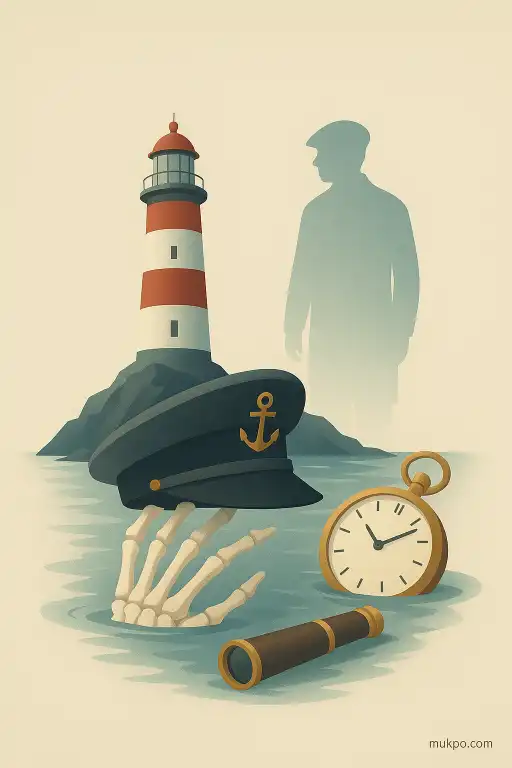
Accounts of the arrival vary in small details, but the broad pattern is consistent: the landing felt wrong before anyone even stepped inside. No flag signals. No movement. No response to shouts. When someone finally entered the lighthouse, the interior did not look like a place abandoned in a panic. It looked like a place left abruptly, but not ransacked or collapsed into chaos.
One overlooked detail in retellings is that lighthouse life ran on paperwork and schedules. The “normal” end of a shift included written entries, handover notes, and predictable storage of gear. So when people talk about an untouched table or a closed door, it isn’t just spooky set dressing. It’s evidence about what the keepers expected to happen next—because they had to live with the consequences of a mistake, and mistakes were recorded.
What the missing men were likely doing
The strongest practical explanation starts with maintenance. Lighthouses on remote rocks needed constant attention: securing equipment, checking stores, inspecting damage after heavy weather, and dealing with the landing area. On Eilean Mòr, the landing and the paths around it were the most dangerous working spots. They were exposed, slippery, and sometimes violently struck by waves. It’s the kind of place where one person can fall or be hit, and the other two react without taking time to prepare for a long absence.
It also helps to remember how small crews operate. Three men sounds like redundancy, but the work often pulls people toward the same problem at the same time. If something shifts on a winch line, if a crate breaks loose, if a railing fails, everyone’s attention snaps to the same edge of the island. That’s when “three missing” stops sounding impossible. It becomes a sequence of fast, human decisions made in bad weather.
The weather, the sea, and why the island doesn’t give evidence back
The Flannan Isles sit where Atlantic storms have room to build. Waves can throw spray high above the rocks, and storms can rearrange anything not bolted down. If the men were swept away, the sea is very good at erasing the trail. There may be no body to recover, no equipment left to snag, no clear mark that stays visible after days of battering water and wind.
This is also why the timing of the relief matters so much. The Hesperus did not arrive on a neat, calm schedule. Weather delays are normal out there. That means a gap can open between when something happens and when anyone else can physically reach the station. Even a short delay changes what evidence survives. A broken rope can be carried off. A displaced object can be smashed, moved, or buried under salt and debris.
How the story grew larger than the paperwork
Because the bare facts are thin, the case became a magnet for added drama. Over the years people have repeated claims about strange meals left out, supernatural signs, or ominous final messages. Some of those details are unclear, disputed, or hard to trace back to the earliest records. That doesn’t mean nothing happened. It just means the most vivid versions are not always the most reliable ones.
What stays stubbornly solid is the shape of the problem: a remote station, a delayed relief, a light that should not be out, and three working men who likely stepped outside for something that felt immediate. The island’s geography and the station’s routines narrow the options, but they don’t produce the one neat moment everyone wants to point to.
Related reads
- The 17th-century Ottoman court that negotiated with a nonexistent envoy
- An apartment block where every mirror vanished overnight
- The bat tongue that scoops nectar with brushlike hairs
- How brief mirror practice changes the way you move
- The statue whose bronze weeps salty streaks after foggy nights
- How mussel byssal threads anchor entire intertidal communities