
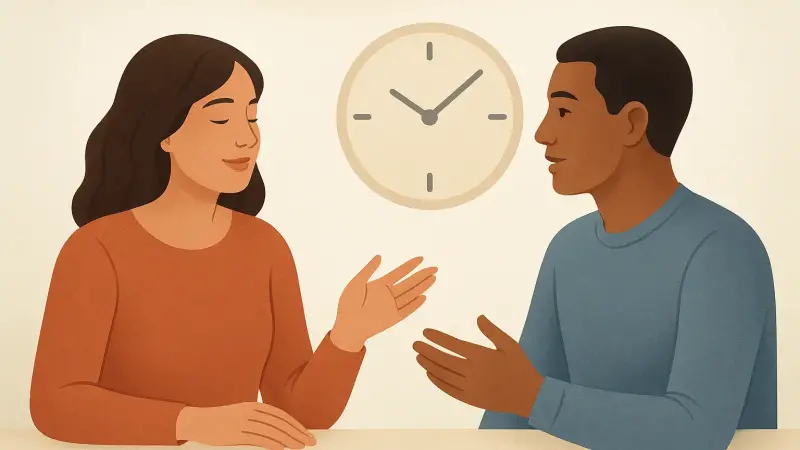
When the clock disappears
It’s not one single place or event. It can happen in a noisy café in New York, on a late-night train in Tokyo, or at a kitchen table anywhere. Two people start talking, and then someone glances at their phone and it’s been two hours. The basic mechanism is simple: attention gets pulled so fully into the exchange that the brain stops checking time the way it usually does. Time doesn’t literally speed up. The usual signals that keep it “present” in the background get quieter, because something else is taking the full bandwidth.
Attention is a limited budget
Everyday time awareness depends on small, repeated “monitoring” moments. A quick internal scan. A look around. A subtle sense of pace. When a conversation becomes absorbing, those monitoring moments drop. It’s not just that the topic is interesting. It’s that the person is tracking meaning at high resolution: word choice, tone, timing, facial expression, and what it implies.
This is why the same person can lose time in one chat and not in another. A conversation that requires constant interpretation tends to consume more attention than one that stays predictable. The brain can’t fully do both at once—follow the thread closely and keep running a clean “how long has it been?” counter.
Rhythm matters more than the topic
A common overlooked detail is turn-taking. When two people match each other’s pace, interruptions are rare, and responses land quickly, the exchange becomes smoother to process. That smoothness reduces friction, and friction is one of the things that makes time feel noticeable. Awkward pauses, forced laughter, or frequent “wait, what?” moments act like speed bumps that bring time back into view.
Small physical cues can lock this rhythm in. People unconsciously mirror posture, head nods, and even breathing patterns during high rapport. It’s not mystical. It’s coordination. Coordination makes the conversation feel like one continuous stream instead of a series of separate actions, and continuous streams are easy to stay inside without checking the edges.
Emotion warps the time markers
Emotional arousal changes how the brain tags moments. If the conversation carries suspense, humor, flirtation, or vulnerability, the body is slightly activated. Heart rate and alertness shift. That can narrow focus and reduce awareness of outside cues like background music, other tables talking, or the hum of traffic. Those cues usually provide “time texture.” When they fade, there are fewer anchors to estimate duration.
There’s also a difference between how time feels during the conversation and how it’s judged afterward. In the middle of a deeply engaging chat, time can feel thin or absent. Later, the same span can feel either short or strangely full depending on how many distinct moments were encoded into memory. A conversation that circles one idea for an hour may feel like it vanished. One with several emotional turns can feel longer in hindsight even if it didn’t feel long while it was happening.
The environment stops interrupting you
Situations that usually create interruptions often don’t, and that’s part of the trick. In a bright restaurant with fast service, you’d expect constant breaks: menus, ordering, drinks arriving, the check. But when the exchange is intense, those events get processed as minor blips. Someone answers the server without breaking the thread. A phone buzzes and gets ignored. Even a posture shift happens without the “reset” that would normally remind someone to look at the time.
One concrete example is two friends talking in a café while a line forms and clears behind them. They register movement, but it doesn’t become a full scene in the mind. The overlooked detail is how little they look away. Gaze shifts are one of the main ways people sample the room and update their sense of passing time. When attention stays locked on a face, the room doesn’t get enough sampling to build a timeline, so the clock feels like it never started.
Related reads
- A café that brews espresso in cups stitched from old concert wristbands
- The beach where certain shells sing when the tide goes out
- The Cold War diplomat who ran an art forgery ring out of a consulate pouch
- Why an entire block unintentionally matched paint after a single storm
- The streetlight turned time capsule: decades of lost items stuck in its base
- How morning light recalibrates your mood and sleep