
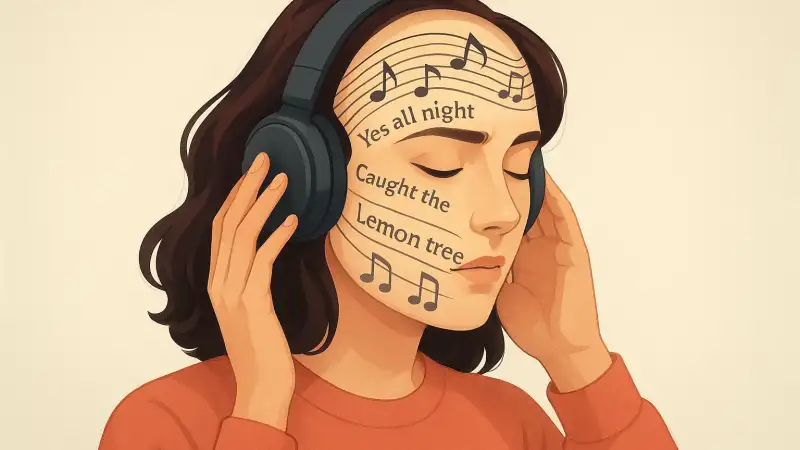
The moment a line turns into a different song
Most people have had the odd experience of singing along confidently and then feeling a little jolt when they finally see the printed words. This isn’t tied to one place or event. It shows up everywhere people share music, from U.S. radio to U.K. chart hits to Japanese karaoke rooms. Think of “Sweet dreams are made of cheese” (instead of “these”) in Eurythmics’ “Sweet Dreams,” or “Excuse me while I kiss this guy” in Jimi Hendrix’s “Purple Haze.” Once a wrong line “locks in,” it can feel like the original version is the weird one. The core mechanism is simple: the brain fills gaps fast, using whatever sounds plausible in the moment.
Why lyrics are easy to mishear
Sung language is harder to parse than spoken language. Vowels get stretched, consonants get softened, and timing gets bent to fit the melody. Reverb and backing instruments smear edges that normally separate words. Even the singer’s accent matters, because the listener’s brain expects certain sound patterns and may “snap” unfamiliar ones into familiar words. There’s also a small detail people overlook: sibilants and stops like “s,” “t,” “k,” and “p” carry a lot of word boundary information, but they are often the first sounds to disappear under cymbals and hi-hats.
Mixing choices can tilt the odds. If the vocal is treated like another instrument, with heavy effects or pushed slightly back, the listener leans more on rhythm and broad vowel shapes than on crisp consonants. The result is a kind of phonetic silhouette. Two very different sentences can share the same silhouette when sung quickly. That’s why mondegreens aren’t just “not listening closely.” Sometimes the signal really is ambiguous.
How the brain edits what it hears
Perception isn’t a clean recording. The brain predicts the next sound and checks it against what arrives. When the incoming audio is unclear, the prediction can win. Familiar phrases have an advantage because they are easy to retrieve and they fit common song themes. If a listener expects a love song, the mind is already primed with a shortlist of likely words. That’s why misheard lyrics often land on ordinary, conversational lines even when the real lyric is specific or odd.
Context also rewrites the line midstream. If the chorus has one clear word, the brain builds the rest around it to keep meaning coherent. A single anchored word can force the surrounding sounds into a sentence that makes sense. That “sense-making” happens fast and usually stays invisible. The listener doesn’t experience it as guessing. It feels like hearing.
Why the wrong version sticks so hard
Once a person has sung a misheard line a few times, it becomes a practiced motor pattern. The mouth remembers it. That matters because singing along isn’t just listening; it’s rehearsal. The next time the song plays, the brain retrieves the rehearsed line automatically. If the true lyric conflicts with that stored pattern, the true one can sound “off” even after it’s been revealed.
Social reinforcement strengthens it further. A misheard lyric that gets repeated in a friend group, a comment thread, or a meme starts to feel like the “real” cultural object. People can even remember first hearing the song with the wrong words, because memory tends to store the interpreted version, not the raw audio. So the mishearing isn’t just a mistake; it becomes part of the song’s personal history.
What changes in the song’s meaning
A swapped phrase can shift the whole emotional angle. If a line turns specific into generic, the story flattens. If it turns neutral into funny, it can make the track feel lighter than it was written to be. People often overlook how much one concrete noun does in lyrics. Replace one object or person with another and the listener’s mental scene changes instantly. A “guy” instead of “the sky,” for example, doesn’t just change one word. It changes what the singer is doing and who they’re addressing.
There’s also an effect on attention. When a listener believes they know the words, the song becomes predictable and smooth. When the lyric is uncertain, attention spikes and small details in the arrangement become more noticeable. That’s why the moment of learning the real lyric can make the entire track feel newly produced, even though nothing in the recording changed.
Related reads
- The Victorian engineer who patented safety coffins and set London’s burial panic in motion
- The phantom buzz: why phones feel like they’re vibrating when they’re not
- Why we rehearse arguments long after they’re over
- How archerfish aim water jets to dislodge insects from branches
- Why fog clings to valley floors while nearby ridges stay clear
- Why some conversations make you forget time completely