
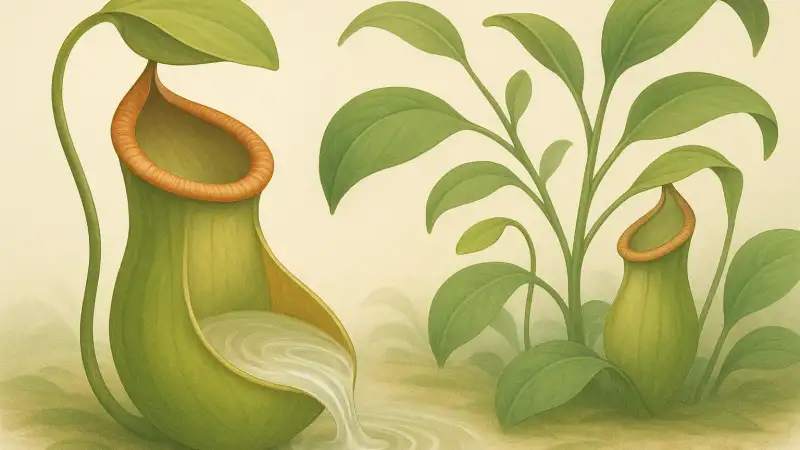
Watching an insect lose its footing
A smooth rim looks harmless until it gets wet. That’s the basic setup in a lot of pitcher plants, and it’s not one single place or species. It happens in Southeast Asia with Nepenthes (like Nepenthes rafflesiana in Borneo and Sumatra), and in North America with Sarracenia (like the purple pitcher plant, Sarracenia purpurea). An insect comes for nectar. It steps onto a glossy edge. Then the surface stops behaving like a surface. The animal can’t get traction, it slides inward, and the liquid at the bottom turns a fall into a trap.
The slippery part is engineered

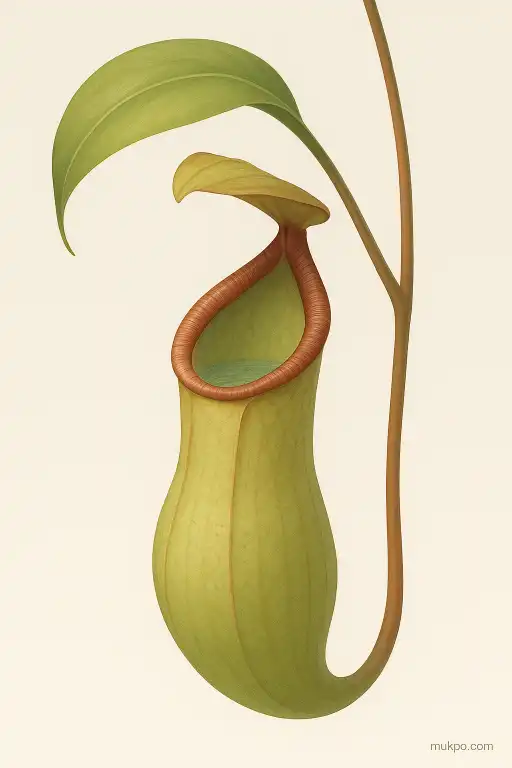
The “lip” of many pitchers is a specialized zone. In Nepenthes it’s called the peristome. It’s not just smooth. It has tiny ridges and grooves that control how water sits on it. When humidity is high or rain hits, those microstructures help a thin film of water spread into a continuous layer. Once that film is continuous, an insect’s adhesive pads and claws don’t find dry contact points. Friction drops sharply and a stable foothold disappears.
A detail people often overlook is directionality. The ridges on some peristomes are arranged so the water film channels more easily toward the inside of the trap than back out. The result isn’t only “slippery.” It’s slippery in a way that biases motion. A struggling insect tends to skid along the path the surface already makes easiest, which is inward.
Wetness changes the physics of insect feet
Insect feet are not simple hooks. Many have soft pads that rely on close contact and controlled adhesion. On a dry surface, those pads can grip surprisingly well. Add a water layer and the pad is no longer touching the plant surface directly. It’s interacting through a lubricating film. Claws also have trouble if the microtexture they would normally catch is filled in by water. That’s why a pitcher can seem safe in dry conditions and suddenly become dangerous after a brief shower.
This is also why the trap can work without any snapping motion. The insect supplies the energy by walking, leaning, or scrambling. The plant’s job is to make that effort unproductive. Once the insect’s center of mass tips over the edge, the geometry of a steep, inward-curving wall makes recovery unlikely, even before the liquid comes into play.
Fluid flow turns a slide into a one-way trip
Inside the pitcher, fluid matters in more than one way. The bottom liquid is often not plain rainwater. Its viscosity and chemistry vary by species and conditions, and it can include digestive enzymes and other compounds. A more viscous fluid resists movement. A struggling insect can’t “swim” effectively, and each kick wastes energy against drag rather than producing lift. Even when the fluid is relatively thin, wet wings and a soaked body make climbing harder on a smooth inner wall.
Flow also matters on the way down. Water films and droplets can run along the inner surface and keep it slick. Some pitchers have downward-pointing hairs or a waxy zone that sheds particles and reduces grip. As liquid trickles, it can re-wet areas an insect might otherwise use to pause. The plant doesn’t need a strong current. It needs enough moving moisture to stop the surface from ever becoming reliably “dry” again.
A concrete scene: after rain on a peristome
Picture a humid morning in Borneo with a Nepenthes pitcher that has just been splashed by rain. The peristome is now coated in a thin, continuous water layer. An ant follows a scent trail to the rim and starts feeding on nectar. Its feet look like they’re stepping normally, but the pads are now separated from the plant by that film. A slight shift is enough. It slides, catches briefly, then slides again. The motion is jerky, like repeated loss of traction rather than one clean fall.
Once it drops inside, the situation changes from “can’t stand” to “can’t climb.” The walls are steep, the footholds are unreliable, and the bottom fluid grabs at every movement. The drowning part is not just about depth. It’s about the combined effects of wet surfaces, biased sliding, and a fluid that keeps turning effort into heat and turbulence instead of escape.
Related reads
- How misheard lyrics rewrite whole songs in your head
- The Victorian engineer who patented safety coffins and set London’s burial panic in motion
- The phantom buzz: why phones feel like they’re vibrating when they’re not
- Why we rehearse arguments long after they’re over
- How archerfish aim water jets to dislodge insects from branches
- Why fog clings to valley floors while nearby ridges stay clear