
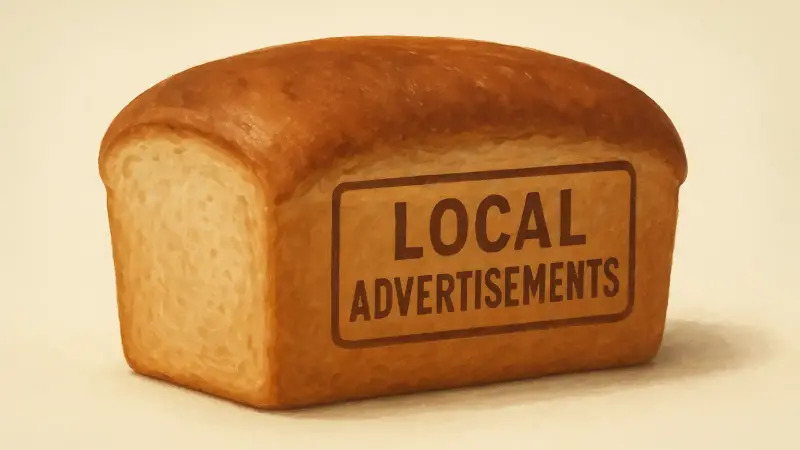
People expect bread to carry a bakery’s name, maybe on a paper bag or a twist tie. But there have been places where the message went straight onto the loaf itself. This wasn’t one single famous incident. It was more of a quirky advertising idea that popped up in different regions at different times, often as a short-lived promotion. The clearest examples tend to come from early-to-mid 20th-century U.S. commercial baking, where bakeries were already experimenting with branded wrappers, printed wax paper, and giveaways. Stamping a loaf was the same impulse, just more literal: ink or dye applied to the crust, so the bread became the billboard.
How a loaf could carry an ad
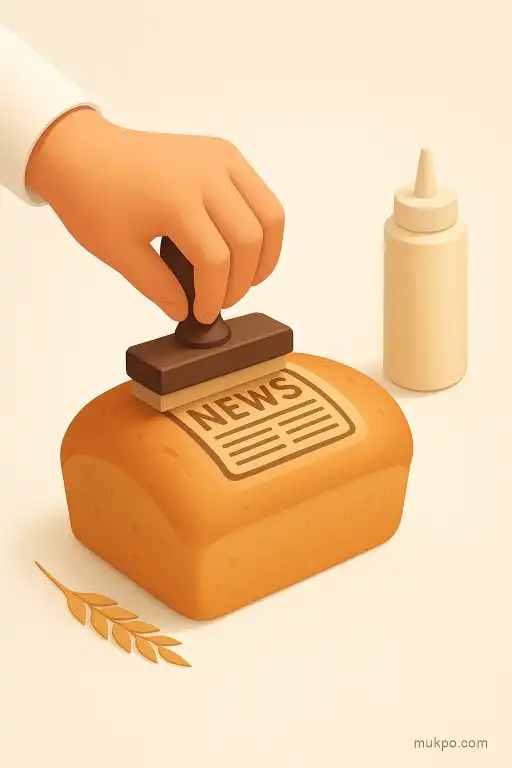
The basic mechanism is simple. A bakery uses a stamp or stencil to put a short message on the crust after baking, usually on the top or side where it stays readable. The print had to survive heat and handling, so it couldn’t be ordinary office ink. Accounts vary, but the idea generally relied on food-safe dyes, or a light “branding” approach that marked the surface without adding anything wet. Either way, the crust was doing the work. A soft, flour-dusted surface blurs detail. A firm, browned crust keeps edges sharper.
The overlooked detail is timing. If the mark went on too early, it could spread as the loaf expanded. If it went on too late, the crust could be too brittle and crack, or the stamp wouldn’t take at all. That’s why descriptions of these promotions often mention that only certain loaf styles were used. A smooth-topped pan loaf is much easier to print than a rustic boule with a heavily blistered crust.
What kinds of businesses wanted to be on bread
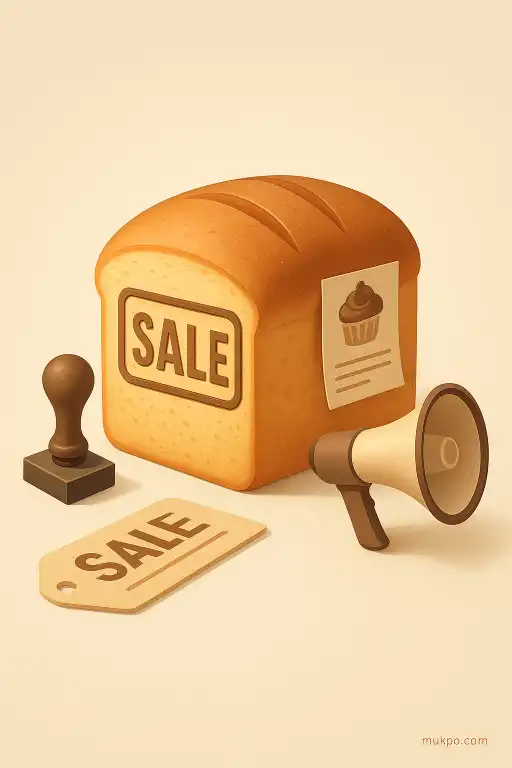
The messages were usually short. Think of a local store name, a phone number, a sale, or an event date. Bread isn’t a poster. You don’t get many characters before the letters run into each other, or the curve of the loaf makes them hard to read. That constraint shaped what got advertised. A neighborhood grocer, a movie theater, a diner, or a civic event is the right scale. A long slogan isn’t.
There’s also a built-in distribution system. Bread already travels daily into homes, restaurants, and corner shops. A bakery didn’t have to convince people to pick up a flyer. The ad arrived with dinner. That was the pitch, and it’s why the idea appealed to businesses that cared about repeat local attention more than broad reach.
What it looked like in real life
Picture a pan loaf on a kitchen counter. The stamp sits on the crown, slightly off-center, because the highest point gives the flattest readable surface. Darker crust gives more contrast, but it also means the message feels more “burned in,” which not everyone likes. Lighter loaves take color better, yet show smudges more easily. Some bakeries would keep the design very plain—block letters, no fine lines—because fine detail disappears fast on bread texture.
A concrete situational example is a bakery delivering to a small group of neighborhood shops on a set route. The stamped loaves are placed face-up in the display, so the message is visible to the next buyer. That’s different from a loaf bought, bagged, and carried home immediately. The same stamp can act like a shelf label in a shop, but it becomes a private oddity once it’s in someone’s breadbox.
Why it didn’t become normal
The practical problems add up. Every extra step in a bakery slows things down, and bread is about speed and volume. A stamp has to be cleaned. A stencil has to be aligned. If the ink bleeds, the loaf looks spoiled. If the mark is too faint, the advertiser complains. And if the message is wrong—an outdated phone number, a canceled event—there’s no easy fix. You can’t unstamp a crust.
Packaging also got better. Once printed bags and branded labels became cheap and flexible, they did the same job with less risk. A paper wrapper can carry longer copy, better graphics, and it doesn’t mess with the food surface. It’s also easier to swap designs from one advertiser to the next without changing the production line.
The strange little afterlife of edible ads
The concept never fully disappeared. It just moved to other foods that hold marks more predictably, like cookies, crackers, and tortillas, where a flat surface makes printing easier. Restaurants have also used branded buns for special events, because a single day of production is manageable and the novelty is the point. Bread can still carry a message. It’s just more of a stunt than a routine.
What sticks with people is how direct it feels. A flyer can be tossed. A radio ad fades. A stamped loaf sits there until someone slices it, and the message is literally consumed along with lunch. That bluntness is probably why the idea is remembered at all, even when the details of who did it, where, and for how long are often unclear.
Related reads
- Why small talk can feel draining even when you’re enjoying it
- The tiny breathing rhythm that can quiet a sudden panic spell
- Why people speed up their speech when they’re trying to impress
- Villages where residents race souped-up lawnmowers for a day of chaotic fun
- Tiny houses carved inside walnut shells that collectors pay a surprising sum for
- How a stolen bucket set two medieval Italian city-states on a year-long bloody feud