
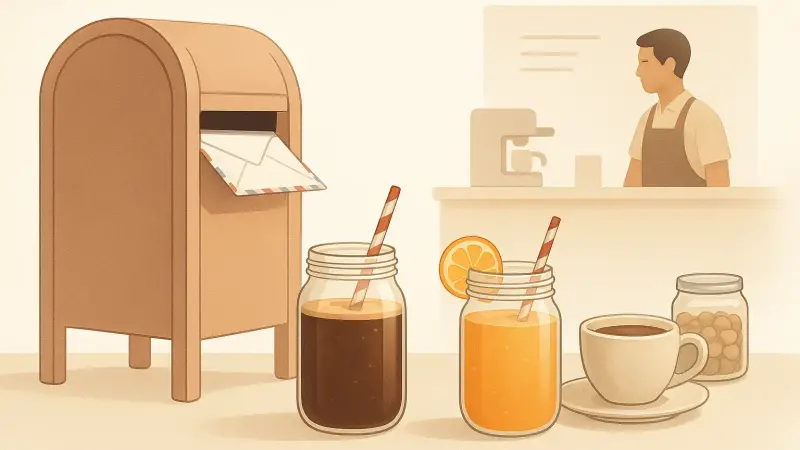
You see “served in a jar” and you assume it’s just a cute container choice. Then you notice the label is in another language, with a customs sticker still half-attached. This isn’t one single famous place, and details vary by shop. But the basic idea shows up in travel stories and niche cafés in places like Tokyo, London, and New York: the drink isn’t made on-site. It arrives already sealed, in glass jars shipped from abroad. The café’s job is to keep the jars cold, open them to order (or hand them over sealed), and build a menu around what can survive a long trip.
How the jar becomes the point
A mailed drink changes what a “café” even is. Instead of beans and grinders and a house recipe, the headline product is the sealed container and its origin story. The menu often reads more like a small import shelf: a few coffee drinks from one country, fruit sodas from another, maybe a milk tea line that comes in identical jars with different colored caps. The café still does some work—refrigeration, portion control, garnishes, maybe pouring over ice—but the core mechanism is distribution, not brewing.
That also explains why jars, not cans. Glass feels “handmade” even when it isn’t. It photographs well. And a sealed jar implies the drink is exactly what it was where it was made, untouched by the shop except for the moment it’s opened.
What has to be true for it to work

Shipping liquid is expensive and fussy. Weight adds up fast. Breakage is a real risk. So the drinks that show up this way tend to be high-margin, limited-run, or tied to a brand that people will pay extra to try. The practical winners are concentrated coffee milk drinks, sweetened teas, and syrups blended with dairy or oat bases that handle cold storage. Anything carbonated can be trickier. Pressure changes and rough handling don’t mix well with glass.
One detail people usually overlook is headspace. That small pocket of air under the lid is not just “empty.” It matters for pressure, for how the drink expands and contracts with temperature, and for whether the seal stays reliable through shipping. A jar filled to the brim is more likely to leak, crack, or fail a seal test than one filled with a consistent gap.
Customs, food rules, and the paperwork vibe
Whether this is straightforward or a nightmare depends on what’s inside the jar and where it’s crossing. Dairy, fresh fruit, and anything that counts as a “perishable prepared food” can trigger extra scrutiny. Some drinks may be perfectly legal to import commercially but not legal to bring in casually, and some may require specific labeling in the destination country. That’s why these cafés often feel half café, half logistics project. They may only carry products that already have compliant ingredient lists, nutritional panels, and shelf-life documentation from the producer.
The other quiet constraint is temperature history. Even if a jar is safe when refrigerated, the journey might include hours on a hot tarmac or days in a warehouse. So shops that rely on mailed jars tend to pick drinks designed to be stable under less-than-ideal handling, or they ship via cold chain when they can justify the cost.
What customers are actually buying
The appeal isn’t only taste. It’s the feeling of scarcity and specificity. A sealed jar from another country reads like proof. You can point to the label, the cap, the barcode style, even the manufacturing date format. People treat it like a tiny collectible. In some cafés, the empties are part of the experience too. Customers keep the jar, reuse it, or bring it back for a discount if the shop runs that kind of program (not all do).
It also changes service. The “barista” moment becomes opening, pouring, and presentation. You may see staff decant the jar into a glass to show color and layers, or serve it with the lid and ring still on the side so the customer can see it was sealed. That little ritual stands in for the craft you’d normally watch at an espresso machine.
The tradeoffs cafés don’t put on the menu
Inventory is unforgiving. If jars arrive late, the menu collapses. If a shipment breaks, it’s not just lost product, it’s lost “destination.” And because the drinks are pre-made, consistency is outsourced in a way that can be uncomfortable for a shop’s reputation. If a batch tastes off, the café can’t fix it with a grind adjustment or a different steep time. They can only stop selling it.
There’s also a quiet waste question. Glass is recyclable, but shipping heavy single-serve jars across borders is packaging-intensive. Some cafés try to counter that by using larger jars poured into cups, or by treating the jar as a returnable container. But a lot depends on local recycling systems and whether customers actually keep or return the jar instead of tossing it on the way out.

Related reads
- How a small favor can quickly change someone’s impression of you
- The town where every street sign is painted by a stranger overnight
- How microplastics hitch rides inside sea salt crystals
- How 17th-century Ottoman tulip mania turned gardens into a speculative market
- The hotel room shaped like an egg people book for its strange acoustics
- The bench that secretly grows a community garden inside its slats