
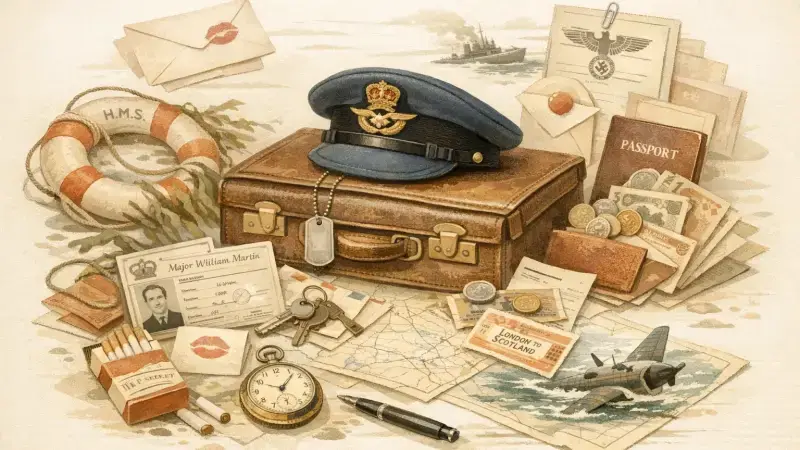
How a dead body became a weapon
People rarely ask how you “prove” a lie in wartime when nobody can check the facts. In 1943, British intelligence built an entire false story around a corpse and pushed it toward Nazi Germany, hoping it would be treated as ordinary evidence. The operation is known as Operation Mincemeat. It used a real dead man, a carefully constructed identity, and a set of documents that looked like they belonged to an actual British officer. The mechanism was simple. Make the enemy feel like they discovered something by accident, then let their own bureaucracy do the rest.
Choosing the body and shaping the “officer”
The body was of a man who died in Britain, then was repurposed as “Major William Martin, Royal Marines.” The name was forged. The life had to be forged too. That meant more than a uniform and ID. The pockets needed clutter that felt unplanned, the sort of mess people carry without thinking. Investigators later noted how personal items mattered as much as official papers: receipts, small notes, and the kind of everyday fragments that make a person seem real.
One detail people tend to overlook is how much the ruse depended on the body telling the right medical story. The planners had to consider what a coroner might notice and what kind of death could plausibly match the scenario the papers implied. A corpse is not a neutral prop. It carries timing, condition, and clues that can either support the narrative or wreck it in minutes.

Planting evidence that looks like a mistake
The documents were designed to be “found,” not delivered. That distinction mattered. A letter that arrives through official channels triggers suspicion. A briefcase chained to a drowned officer looks like an accident. The package included apparently sensitive correspondence suggesting Allied intentions in the Mediterranean, with the aim of steering German attention toward Greece and away from Sicily ahead of the Allied invasion.
The setup also had to survive handling by strangers. Paper, ink, seals, and folds all create tiny signals. If a letter looks too fresh, or too carefully staged, it reads as a performance. The planners leaned on mundane realism: documents that seemed used, slightly worn, and carried for a while. That “lived-in” look is hard to fake, which is why so much effort went into it.
Why enemy intelligence took the bait
German intelligence wasn’t duped because it was stupid. It was duped because the story fit what it already considered plausible and because it appeared to come from routine chance rather than a deliberate channel. Once a narrative reaches the level of desks, stamps, and filing systems, it gains inertia. People assume someone else verified it. That’s especially true when the information seems valuable but not unbelievable.
There’s also a human factor that doesn’t get enough attention. Analysts are trained to doubt obvious traps, but “accidental” discoveries can feel safer. A dead courier looks like a tragedy, not a message. That emotional texture can lower defenses. It doesn’t prove authenticity, but it changes how hard people push against the idea.
What had to go right for the ruse to hold
For the deception to work, several moving parts had to align: the body had to be discovered by the right authorities, the documents had to be preserved long enough to be read, and the enemy had to believe the British would carry that kind of material in that way. Even small deviations could have broken it. If the briefcase looked tampered with too early, or if the identity details didn’t match expectations of a Royal Marines major, suspicion would have spread fast.
Operation Mincemeat sits in an uncomfortable space. It’s remembered as clever tradecraft, but it also depended on a real person’s death and on strangers treating a body as credible paperwork. That tension is part of why it still lands today. It isn’t just a story about forged letters. It’s a story about how institutions decide what counts as proof when the only witness left is silent.

Related reads
- A time capsule hidden in a wall that revealed a vanished life
- The city that once outlawed chewing gum
- Why some octopuses stack stones to build dens
- How the immortal jellyfish reverses aging
- The 9th-century pope who put a rival corpse on trial in the Cadaver Synod
- Why the first second after you look feels frozen
If you liked this, you might also enjoy: