
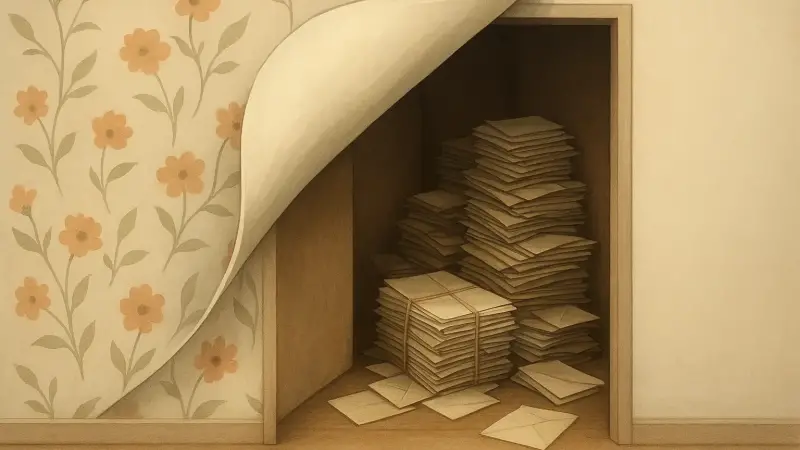
How a room ends up “behind” wallpaper
People don’t usually think of wallpaper as something that can hide architecture. It feels thin. Decorative. But there isn’t one single famous “wallpaper room” story. It’s a kind of discovery that pops up in different places, usually during renovations in older housing stock—Victorian-era homes in the UK, pre-war apartments in New York, or century-old farmhouses in the American Midwest. A contractor strips paper, finds a seam that shouldn’t be there, and the wall sounds hollow in one spot.
The mechanism is rarely magical. It’s small decisions layered over time. A doorway gets sealed to stop drafts. A servant stair is blocked off after a remodel. A closet becomes dead space when plumbing is rerouted. Then someone paper-hangs straight over the patched outline, because wallpaper is good at hiding uneven repairs, old cracks, and mismatched plaster.
Why letters end up stored where no one looks
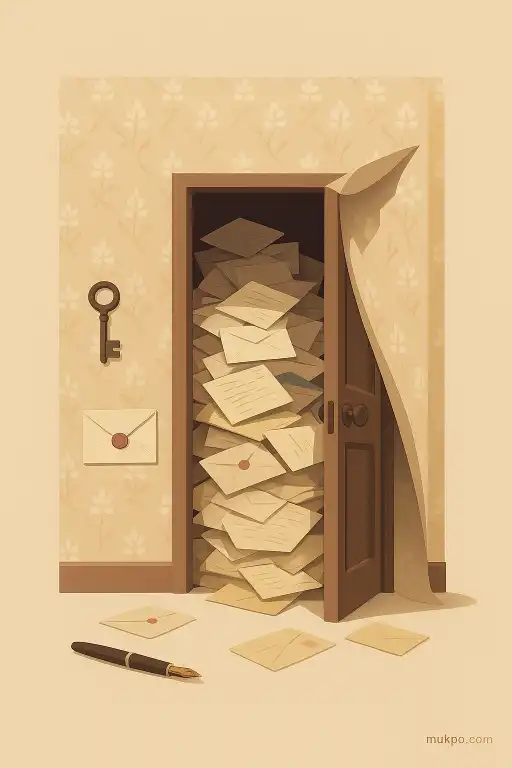
When a hidden space turns up “stuffed with letters,” it usually wasn’t planned as an archive. Letters are light, compact, and easy to shove into a gap without making a mess. They also feel private in a way that ledgers and newspapers don’t. A person can tell themselves they’re not destroying anything. They’re just putting it out of sight until later.
One overlooked detail is how often paper survives because of neglect. Letters kept in a dry, enclosed void—behind lath and plaster, inside a walled-off closet, above a dropped ceiling—can be spared from sunlight, handling, and routine cleaning. The same space might still be bad for paper if it’s damp or if insects get in, so the condition varies wildly. A “room” that is actually a sealed-off corner can preserve ink for decades, while a real unused room with a leaky roof can ruin everything in a few seasons.
The practical reasons the room was closed off
Most hidden rooms start as something mundane: a back staircase, a small maid’s room, a coal storage space, a narrow passage used to access wiring, or a portion of an attic that became inconvenient. When building codes change or families stop employing live-in staff, those spaces lose their purpose. If the door is in an awkward location—inside a bedroom, behind kitchen cabinetry, or opening into a hallway that gets reconfigured—it becomes tempting to erase it rather than explain it.
There’s also the simple math of heating and maintenance. Old houses can be expensive to keep warm. Sealing off a drafty annex or an unused nook can feel like an upgrade. Sometimes the closure is done neatly, with framing and plaster. Sometimes it’s quick: a sheet of board over the opening, wallpapered to match the rest of the room. The faster and cheaper it is, the more likely the outline is still there for someone to find later by tapping, noticing a repeating pattern that suddenly misaligns, or seeing baseboards that don’t quite make sense.
What the letters usually reveal
The dramatic version is love letters and confessions. The more common version is ordinary life: receipts folded into envelopes, school notes, letters about money, family updates, notices from landlords, correspondence with a bank. The emotional weight comes from accumulation. A decade of small worries and small joys looks different when it’s stacked in one place, unread, with the dates marching forward.
When a find includes “lost letters,” it’s often unclear whether they were truly lost or intentionally hidden. People did misplace mail, especially when households were busy and addresses changed. But hiding letters can also be a way to avoid conflict, delay decisions, or keep relationships compartmentalized. Even when the content is tame, the act of stuffing paper into a sealed space suggests someone wanted time. A detail people miss is the envelope condition: unopened, neatly tied bundles point to storage, while torn flaps and crumpled pages suggest someone read them in a hurry and then wanted them gone.
How these discoveries happen during renovation
They’re usually found during work that changes surfaces: removing wallpaper, replacing plaster, updating wiring, or repairing water damage. A worker finds multiple layers of paper and realizes one layer spans over a place where trim should be. Or a stud finder shows framing where it shouldn’t. Sometimes the giveaway is sound. A wall that should be solid gives a deeper thud in a rectangle where a door once was.
Once an opening is made, the “hidden room” is often smaller than people imagine. It might be a wedge-shaped void behind a chimney chase. It might be a shallow storage cavity. But when it’s full of letters, even a small space can look packed. Dust makes paper stick together. Rodents sometimes drag in extra scraps for nesting. And the first light in decades makes the scene feel staged, even when it’s just the result of someone, long ago, shoving bundles through a gap and smoothing wallpaper back into place.
Related reads
- Why your palms sweat during a tense decision
- Why you remember someone’s face but not their name
- Why your throat tightens before you speak in public
- A statue that slowly accumulates extra coats of paint overnight from visitors’ tributes
- How your stomach keeps time without a clock
- A parking meter that once spooled out free bakery coupons during a heatwave