
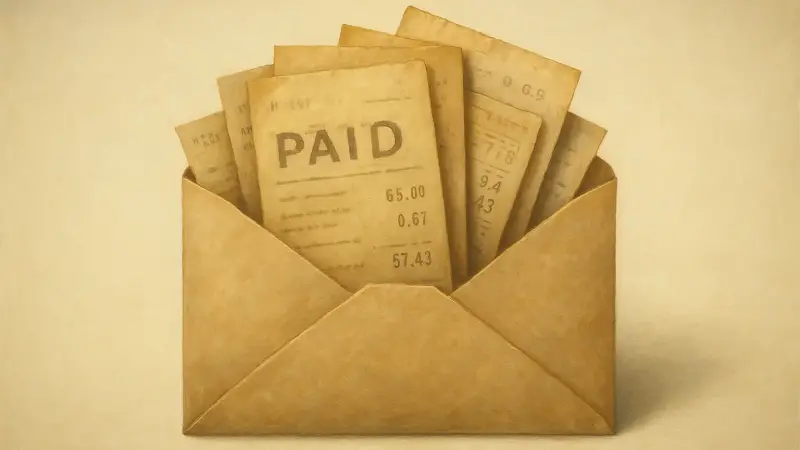
People treat receipts like trash the moment the bag is unpacked. But sometimes they’re more like slow-moving money. This isn’t one single incident with one famous landlord. It’s a pattern that shows up in different places for different reasons. In the U.S., unclaimed property programs in states like California and New York exist because people lose track of small financial claims all the time. Old receipts can become proof that something was paid, or proof that someone is owed a refund, a rebate, a settlement check, or a deposit that never made it back. The odd part is the timing. The payment isn’t new. The paper just finally gets used.
How a receipt turns into rent money
A receipt doesn’t magically become cash. It becomes leverage in a very specific situation: there’s a dispute, or there’s a pot of money waiting for someone who can prove they qualify. The receipt is the proof. It can back up a claim that a security deposit was paid, that a month of rent was paid and misapplied, or that a utility bill connected to a rental was already settled. If the landlord’s records are messy, a dated receipt with an address and a payment method can carry surprising weight.
It also shows up outside landlord-tenant fights. Class action payouts and company refunds often require documentation, especially when the purchase was long ago and the company can’t or won’t find your transaction. A decades-old receipt can unlock a check that feels “new” even though it’s really delayed bookkeeping. When that check arrives, it’s easy to see how it might get used for something immediate like rent.
What people actually find in a “stash”
When someone says they found a hidden cache of old receipts, it’s rarely a neat folder marked “important.” It’s more often a shoebox, an envelope in the back of a drawer, or paperwork tucked into a cookbook or a moving box. The surprise is that it isn’t one receipt. It’s dozens or hundreds, spanning years, with enough context to reconstruct a mini financial history: addresses, landlords’ names, old phone numbers, appliance serial numbers, policy numbers, even handwritten notations like “paid cash.”
The detail people overlook is that receipts aren’t all equal. The ones that matter tend to have a full address, a unit number, the payee name, and a date that matches a lease term. A generic register slip that only shows an amount is much weaker. A receipt that shows the payment method can matter too, because it ties into other records that might still exist, like bank microfilm, archived statements, or a property manager’s old ledgers.
Why “decades old” can still be usable
People assume there’s a single expiration date on financial claims, but it varies a lot by category and place. A security deposit dispute can have strict deadlines. An uncashed check can fall under unclaimed property rules. A settlement might have its own claim window. Receipts don’t override those rules, but they can still be relevant long after the original transaction because they help prove identity, residence, or purchase history when a program or dispute is reopened.
Recordkeeping is another reason old paper suddenly matters. Landlords sell buildings. Property managers change. Banks merge. Digital systems get replaced. It’s not unusual for the person with the most complete record to be the tenant who kept the “junk” paper. When the official side has gaps, even a faded receipt can become the cleanest timeline available.
A concrete way it plays out
Picture a tenant who rented a place years ago and moved several times. A box from that move sits untouched. Later, a letter arrives saying there’s money held by a state’s unclaimed property office, or a former landlord resurfaces claiming a balance is due. The tenant digs, finds the stash, and suddenly has dated proof of payments, a deposit, and maybe a forwarding address scribbled on a receipt copy. The paper doesn’t create money. It changes the outcome of a claim or a dispute.
The “rent got paid” part can be indirect. A recovered deposit can cover next month’s rent somewhere else. A refund check can keep a lease from going into late fees. Or a receipt-backed dispute can stop a collection effort that would have eaten the same amount in installments. The mechanism is boring and administrative. The effect feels dramatic.
Why receipts end up hidden in the first place
Most stashes happen because people don’t store receipts as records. They store them as reminders. “Return this.” “Submit this.” “Keep this until the lease ends.” Then life moves on, and the papers get shoved into whatever is at hand. The hiding isn’t intentional. It’s just how paper behaves when it’s handled in small, stressful moments like moving, signing a lease, or arguing over a deposit.
And receipts age in a fragile way. Many are printed on thermal paper that fades with heat, light, and time. That’s another overlooked detail. A stash can look useless at first glance because half the slips are blank. The ones that still show a name, an address, and a date tend to be the ones that matter, even if they’re creased, stapled, or stuck to an old envelope.
Related reads
- Why waiting in line feels longer than the same wait at home
- How two Yorkshire cousins convinced Edwardian Britain that fairies danced in their garden
- How a bark beetle epidemic transformed 20th century North American forests
- What aurora colors reveal about collisions in Earth’s upper atmosphere
- The fish with transparent teeth that glow under red light
- The pause when two people start talking at once and who yields