
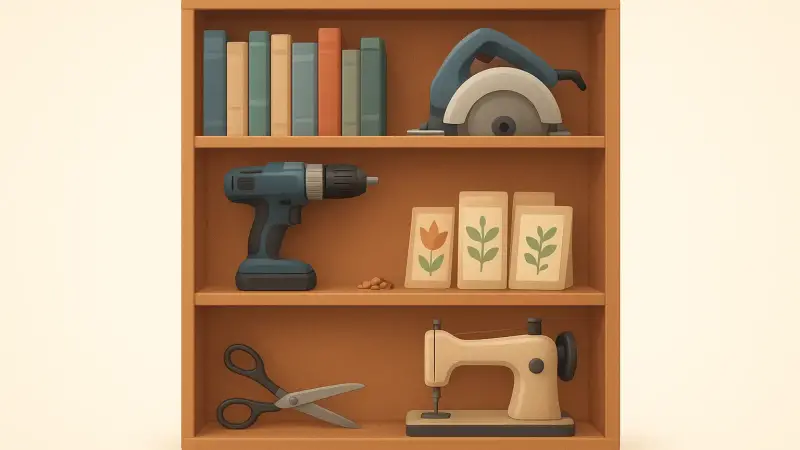
What “borrowing” looks like when the item is a drill
People tend to assume a library is only for books. Then you walk into the Berkeley Public Library in California and see a Tool Lending Library desk, with circular saws and sanders sitting where you’d expect new releases. This isn’t one single program in one single town. It shows up in different forms, like the Toronto Tool Library in Canada, and the Sacramento Public Library’s Library of Things. The mechanism is familiar: an inventory, a checkout period, a return date, and rules about care. The surprise is the category. Instead of lending information, the building lends capability.
The practical reason is boring and that’s the point. A power tool might get used for 20 minutes and then live in a closet for five years. A sewing machine might come out twice a year. Lending turns that idle time into shared time, the same way a popular novel does.
Why libraries are good at lending awkward, expensive stuff
Libraries already run the hard parts of borrowing: identity checks, due dates, replacement fees, and systems for holds. Those systems matter more with tools than with books because the stakes are different. A missing wrench is annoying. A missing sewing machine foot can make the whole kit unusable. Many “things” collections solve this by treating one item as a set, with a checklist at checkout and return. That little paper list is a detail people overlook, but it’s often what makes the program workable.
Tool libraries also tend to be strict about what they don’t do. Staff may show how to find a manual or confirm that a part is present, but they usually won’t certify that someone can safely run a table saw. Liability rules and insurance vary by place, and they shape the catalog. Some collections avoid high-risk equipment altogether. Others lend it, but only with extra steps like waivers or shorter loan periods.
Seeds, sewing machines, and the strange problem of “returns”
Seeds make the whole lending idea feel slippery, because the “item” is meant to be used up. Seed libraries handle this in a few different ways, and it’s not always clear from the outside which model a given location uses. Some are basically free seed swaps housed inside a library building. Others ask people to “return” seeds at the end of a season by saving some from their plants, drying them, labeling them, and bringing them back.
That return model runs into a specific, unglamorous complication: seed quality control. Seeds need to be dry enough, clean enough, and correctly identified, or the whole collection becomes unreliable. There can also be legal questions, depending on jurisdiction, about how seeds are packaged and distributed. Because of that, some programs focus on education and sharing rather than trying to maintain a formally “lended and returned” inventory the way a tool desk does.
What changes when the borrowed item can break
Breakage is not an exception with tools. It’s a normal operating condition. Libraries and tool-lending programs plan for it with maintenance routines, designated repair budgets, and choices about brands and models that have readily available replacement parts. A sewing machine program might stock the same model repeatedly, not because it’s the best machine, but because it keeps the spare-bobbin problem from spiraling. Standardization is a quiet form of customer service.
There’s also the question of cleanliness and consumables. Tools come back dusty. Sewing machines come back with lint under the plate. Some items can’t realistically be reissued without inspection. Many programs draw a line between the durable tool and the consumable materials that go with it. The library lends the drill, but not the drill bit that’s now dull. Or it lends the pasta maker, but not the flour. These boundaries are usually where the friction shows up.
How the catalog ends up reflecting local life
Once a place starts lending non-book items, the collection often becomes a portrait of what people nearby actually do. A neighborhood with lots of renters might see more demand for small repair kits and basic hand tools. A community with active gardeners pushes seed requests. A library serving a colder climate might find that certain home-maintenance tools circulate hard in fall and spring, then sit untouched in midwinter. The rhythm looks less like entertainment and more like chores.
And the most borrowed items aren’t always the flashy ones. It can be the mundane stuff that people don’t want to store: a heavy-duty stapler, a stud finder, a garment steamer, a set of clamps. The library ends up lending the kinds of objects that don’t feel worth owning until the exact day you need them, and then feel impossible to do without.
Related reads
- A post office that delivers mail by kayak to floating neighborhoods
- The Victorian spectacle of Barnum’s mermaid hoax that fooled museumgoers and ministers
- A vending machine that gives mystery books instead of snacks
- A hidden room behind wallpaper stuffed with decades of lost letters
- Why your palms sweat during a tense decision
- Why you remember someone’s face but not their name